One of my own poems this week.
Over ten years ago, I decided to make a year long project of researching and writing up my family history. I didn't know then how much I would find, and that I would still be researching ten years later. (The writing up part is yet to come).
It was inevitable that something of that research would filter into my poems from time to time. Today's poem is purely fictitious, but it does draw on what I now know of my Scottish families, and of others like them, for background.
Many Scottish families followed a very specific naming pattern. The most common variant is that the eldest son is named for his father's father, second son for his mother's father, third son for his father, and subsequent sons for other relatives such as uncles, or occasionally for an important figure such as the parish minister. With daughter's, the eldest was named for the mother's mother, second for the father's mother, and so on.
With high infant mortality, if a child died young, the name was very often used again, to ensure it was carried on. Unlike today, a name was less a sign of individuality than of belonging - and one might well find many cousins, all bearing exactly the same name.
Hard Water, Soft Rock
Five years since the minister called the banns
on three successive Sundays. There being
no objections, they were duly married.
Today in the same church, she names her daughter Agnes.
Twice before she has done this.
The first time it was famine, the second it was fever
that carried the child off. Scarce time
to have the bairn baptised, before
they're paying for the mortcloth.
She names her daughter Agnes,
because it was her mother's name.
Spring struggles with winter. Ice still sheets
the edges of the Bannock Burn. snow lies
unmelted in the kirkyard, in the shadows
cast by two small mounds. She prays
there will not be another.
She names her daughter Agnes,
because it was her mother's name,
and her mother's mother's mother before her
and because all families continue forever,
looking backwards.
*******
"Hard Water, Soft Rock" was published in The Chook Book, my poetry group's first collection which came out in 2004 and is now out of print (though I may be able to find one or two if anyone desperately wants one).
Our second collection, Flap: the Chook Book 2 is now available at Fishpond, and at the Madras Cafe Bookshop.
Tuesday, February 08, 2011

Sunday, February 06, 2011
Poetry and Disaster
One of my more uncharitable thoughts not too long after our 7.1 earthquake last September was "Maybe I should stay away from open mic poetry readings for a while, there are going to be so many bad earthquake poems around".
Which is why I found this week's feature article at Poetry Daily especially interesting. In it Katie Ford writes about the duty of the poet, with reference to New Orleans post Hurricane Katrina. This is the line that drew me in:
A reader recoils at the thought of large, painful subjects being written about poorly. I felt very validated on reading that line
I was intrigued to read further and discover this:
Perhaps, then, poets should not set before themselves the task of writing "about" anything in particular. Our task is blind, we find our way by feel—a sensation that can grow confident and nimble in the absence of full sightedness.
The whole article had me thinking - or rather, extended the thinking I had already begun - about the way I write. Usually, I start with an idea and try and make the words fit. I'm becoming more interested in starting with an interesting line, and exploring where it takes me. I haven't come to any conclusions yet. I do think that starting with an idea can work, but not always. That could be why I have so many failed poems! A proportion work, and many more don't quite make the grade.
Click the link if you want to read the whole article, the daily poems are archived on the site for a year, but I'm not sure how long the feature articles stay available, so it would be best to try sooner rather than later.
Which is why I found this week's feature article at Poetry Daily especially interesting. In it Katie Ford writes about the duty of the poet, with reference to New Orleans post Hurricane Katrina. This is the line that drew me in:
A reader recoils at the thought of large, painful subjects being written about poorly. I felt very validated on reading that line
I was intrigued to read further and discover this:
Perhaps, then, poets should not set before themselves the task of writing "about" anything in particular. Our task is blind, we find our way by feel—a sensation that can grow confident and nimble in the absence of full sightedness.
The whole article had me thinking - or rather, extended the thinking I had already begun - about the way I write. Usually, I start with an idea and try and make the words fit. I'm becoming more interested in starting with an interesting line, and exploring where it takes me. I haven't come to any conclusions yet. I do think that starting with an idea can work, but not always. That could be why I have so many failed poems! A proportion work, and many more don't quite make the grade.
Click the link if you want to read the whole article, the daily poems are archived on the site for a year, but I'm not sure how long the feature articles stay available, so it would be best to try sooner rather than later.
Thematic Photographic: Singles
I haven't done one of these for a while, since in January I was observing in words rather than pictures.
This photo was taken in late January - I was in the city and noticed this bauble that had seemingly fallen out of the window of an upper storey apartment, and landed unnoticed in the shrubbery. It seemed very appropriate for Carmi's theme this week - singles.

This photo was taken in late January - I was in the city and noticed this bauble that had seemingly fallen out of the window of an upper storey apartment, and landed unnoticed in the shrubbery. It seemed very appropriate for Carmi's theme this week - singles.

Thursday, February 03, 2011
Things that are Bugging Me
1) Tiny urls.
I was browsing a magazine in a waiting room, and came across an article with a web link in it. But instead of putting in a long but memorable url - say www.myfabulousbookstore/latestbooks/poetry (that's just an example I made up, don't try to find it) they thought it would be helpful to put in a short link instead. Something full of letters and numbers say tinyurl.2xc4jm72 (another totally made up example).
Sometimes, a tinyurl can be helpful in finding a particular page in a very large website. In examples like the one above, the longer url is actually way easier to remember.
2) NZ Post
This is bugging me rather more seriously than no 1 above. It's part of the continuing saga of attempting to get Flap: The Chook Book 2 listed at Fishpond. (Which is a fantastic New Zealand online bookstore with great customer service).
First I had to get it listed at Neilsen's book database. The listing was relatively easy to submit - a simple online process - but was supposed to take about two weeks and in fact took two months. Once accomplished, I needed to send my books to Fishpond as consignment stock, since we are not distributing it through any of the big distributors. They advise that tracked post is the best. So, I paid extra for packing, sent off my parcel, and checked Fishpond every so often to see if it was listed as in stock. After a while it occurred to me that maybe I should check the tracking number (this can be done online).
What it said was : "your item has been picked up and is en route to a New Zealand Post depot".
Two weeks to get from the Post Shop to the depot seemed a little ridiculous.
So - back to the Post Shop, who gave me a claim form to fill out. Then I saw that there was a toll free customer service number, so I rang them. They informed me that as it was sent to a customer who gets a lot of mail sent out in a large mail bag each day, I should check with them first. The reason is - since they get a lot of mail, it is not always scanned in when it is delivered.
So why charge extra for tracking, if it is not going to be tracked?
Furthermore, since the nature of the parcel makes it business mail, there is a deadline for claims for nondelivery of 14 days - in other words, if I leave it 14 days to make an enquiry, I can't claim compensation. But I can't lodge a claim now and then check, I still have to enquire first - and may not get a reply till after the weekend - which puts me over the 14 day deadline.
So - I now have my fingers crossed that the parcel has actually been received, and is in the queue for a website update. Otherwise I will have to start the whole process of sending the books again. Without any compensation for the missing books. Not good customer service, in my opinion. (Apparently if it was a private parcel, I would have three months to lodge a claim. It's not as if we are making any real profit out of this).
Now - having got that off my chest, I will return to writing something more rewarding, such as poetry ...
I was browsing a magazine in a waiting room, and came across an article with a web link in it. But instead of putting in a long but memorable url - say www.myfabulousbookstore/latestbooks/poetry (that's just an example I made up, don't try to find it) they thought it would be helpful to put in a short link instead. Something full of letters and numbers say tinyurl.2xc4jm72 (another totally made up example).
Sometimes, a tinyurl can be helpful in finding a particular page in a very large website. In examples like the one above, the longer url is actually way easier to remember.
2) NZ Post
This is bugging me rather more seriously than no 1 above. It's part of the continuing saga of attempting to get Flap: The Chook Book 2 listed at Fishpond. (Which is a fantastic New Zealand online bookstore with great customer service).
First I had to get it listed at Neilsen's book database. The listing was relatively easy to submit - a simple online process - but was supposed to take about two weeks and in fact took two months. Once accomplished, I needed to send my books to Fishpond as consignment stock, since we are not distributing it through any of the big distributors. They advise that tracked post is the best. So, I paid extra for packing, sent off my parcel, and checked Fishpond every so often to see if it was listed as in stock. After a while it occurred to me that maybe I should check the tracking number (this can be done online).
What it said was : "your item has been picked up and is en route to a New Zealand Post depot".
Two weeks to get from the Post Shop to the depot seemed a little ridiculous.
So - back to the Post Shop, who gave me a claim form to fill out. Then I saw that there was a toll free customer service number, so I rang them. They informed me that as it was sent to a customer who gets a lot of mail sent out in a large mail bag each day, I should check with them first. The reason is - since they get a lot of mail, it is not always scanned in when it is delivered.
So why charge extra for tracking, if it is not going to be tracked?
Furthermore, since the nature of the parcel makes it business mail, there is a deadline for claims for nondelivery of 14 days - in other words, if I leave it 14 days to make an enquiry, I can't claim compensation. But I can't lodge a claim now and then check, I still have to enquire first - and may not get a reply till after the weekend - which puts me over the 14 day deadline.
So - I now have my fingers crossed that the parcel has actually been received, and is in the queue for a website update. Otherwise I will have to start the whole process of sending the books again. Without any compensation for the missing books. Not good customer service, in my opinion. (Apparently if it was a private parcel, I would have three months to lodge a claim. It's not as if we are making any real profit out of this).
Now - having got that off my chest, I will return to writing something more rewarding, such as poetry ...
Tuesday, February 01, 2011
Tuesday Poem: View, by Christina Stachurski
My writing group, the Poetry Chooks, has been meeting since 1999. We had a slightly larger group to start with, but there are a core group of four who are still meeting now. These friends have been an amazing source of inspiration and support in my poetry writing efforts over all those years. This week I've chosen a poem by Christina Stachurski, one of the "chooks".
Spending all January trying to make one observation of detail each day, for A River of Stones, put me in mind of this poem by Christina. It comes not from our recent collection, Flap, but from our earlier book, The Chook Book. It is my favourite of Christina's from this collection. Although seemingly simple, it has always lingered with me.
View
From the gate
of the Selwyn St
cemetery
the lines
of lives once
chisel sharp
have lost their edge
Blue daisies drift
among the loving
pink of roses,
dark yews brood
We take a photograph -
you, me, Esther, Greg -
capturing this light
now
More poetry at the Tuesday Poem hub site
Spending all January trying to make one observation of detail each day, for A River of Stones, put me in mind of this poem by Christina. It comes not from our recent collection, Flap, but from our earlier book, The Chook Book. It is my favourite of Christina's from this collection. Although seemingly simple, it has always lingered with me.
View
From the gate
of the Selwyn St
cemetery
the lines
of lives once
chisel sharp
have lost their edge
Blue daisies drift
among the loving
pink of roses,
dark yews brood
We take a photograph -
you, me, Esther, Greg -
capturing this light
now
More poetry at the Tuesday Poem hub site
Monday, January 31, 2011
A River of Stones: January 31

I followed a trail of small stones through January, and I have run out of stones. Today, I only had time to gather breadcrumbs. And at the end of the trail of breadcrumbs, I found these two fine creatures, swimming on the river near my home.
(By the time I stopped the car and got out my camera, they had come up on the bank. Probably hoping to be fed).
So, no carefully polished words today. Perhaps the geese gobbled the breadcrumbs up?
For A River of Stones
Sunday, January 30, 2011
A River of Stones: January 30
A snail has left
his running stitch of silver thread
in long looping trails
on my path.
For A River of Stones
his running stitch of silver thread
in long looping trails
on my path.
For A River of Stones
Saturday, January 29, 2011
Friday, January 28, 2011
A River of Stones: January 28
Motorway construction site -
dust blows off the steep banks
long grass at the foot,
the white umbels of Queen Anne's Lace
dancing in the wind.
For A River of Stones
dust blows off the steep banks
long grass at the foot,
the white umbels of Queen Anne's Lace
dancing in the wind.
For A River of Stones
Thursday, January 27, 2011
A River of Stones: January 27
Almost dark.
Shining white daisies
tumble down the riverbank
towards their reflections -
waiting for the moon.
For A River of Stones
Shining white daisies
tumble down the riverbank
towards their reflections -
waiting for the moon.
For A River of Stones
Wednesday, January 26, 2011
A River of Stones: January 26
Outside my window
a reversing truck beeps
a duck quacks
who needs an alarm clock?
For A River of Stones
...The first sounds I heard as I woke this morning.
a reversing truck beeps
a duck quacks
who needs an alarm clock?
For A River of Stones
...The first sounds I heard as I woke this morning.
Tuesday, January 25, 2011
A River of Stones: January 25
The pied shag is perched
on a tangle of driftwood
in the river
his wings outstretched
like my high school teachers
flapping down the corridors
in their long black gowns.
for A River of Stones
The bird known as a shag in New Zealand is known in many other countries as a cormorant. Because they have no oil in their feathers, they spend a lot of time with their wings stretched out to dry in the sun. (What they do on wet days, I'm not quite sure). We see them often by the river near our house.
I don't think teachers wear their academic gowns much these days, but when I was at high school, they were worn not only at assemblies but also in the class room. My mother, who was a teacher, said that it was a very good protection against chalk dust. Of course, these days, with whiteboards and whiteboard markers, that is probably not a consideration.
on a tangle of driftwood
in the river
his wings outstretched
like my high school teachers
flapping down the corridors
in their long black gowns.
for A River of Stones
The bird known as a shag in New Zealand is known in many other countries as a cormorant. Because they have no oil in their feathers, they spend a lot of time with their wings stretched out to dry in the sun. (What they do on wet days, I'm not quite sure). We see them often by the river near our house.
I don't think teachers wear their academic gowns much these days, but when I was at high school, they were worn not only at assemblies but also in the class room. My mother, who was a teacher, said that it was a very good protection against chalk dust. Of course, these days, with whiteboards and whiteboard markers, that is probably not a consideration.
Monday, January 24, 2011
Tuesday Poem: Patterns by Amy Lowell
A few years back I was talking about the various things I have been interested and involved in over the years, and I was asked about their diversity. They included maths, science, quilt making, and poetry - and more recently, genealogy. I wasn't able to give an intelligent answer immediately, but then it came to me that what they have in common is patterns. I belive that it is a love of patterns that is one of my strongest reasons for an interest in all these varied areas.
Amy Lowell's poem "Patterns" intrigued me for that reason - it draws in at least two of my interests, textiles and poetry - but it also looks at the darker side of patterns. This poem is found in my old standby, the Collins Albatross Book of Verse, which was first published in 1933. My edition is dated 1960.
Patterns
I walk down the garden paths,
And all the daffodils
Are blowing, and the bright blue squills.
I walk down the patterned garden-paths
In my stiff, brocaded gown.
With my powdered hair and jewelled fan,
I too am a rare
Pattern. As I wander down
The garden paths.
My dress is richly figured,
And the train
Makes a pink and silver stain
On the gravel, and the thrift
Of the borders.
Just a plate of current fashion,
Tripping by in high-heeled, ribboned shoes.
Not a softness anywhere about me,
Only whalebone and brocade.
And I sink on a seat in the shade
Of a lime tree. For my passion
Wars against the stiff brocade.
The daffodils and squills
Flutter in the breeze
As they please.
And I weep;
For the lime-tree is in blossom
And one small flower has dropped upon my bosom.
And the plashing of waterdrops
In the marble fountain
Comes down the garden-paths.
The dripping never stops.
Underneath my stiffened gown
Is the softness of a woman bathing in a marble basin,
A basin in the midst of hedges grown
So thick, she cannot see her lover hiding,
But she guesses he is near,
And the sliding of the water
Seems the stroking of a dear
Hand upon her.
What is Summer in a fine brocaded gown!
I should like to see it lying in a heap upon the ground.
All the pink and silver crumpled up on the ground.
I would be the pink and silver as I ran along the paths,
And he would stumble after,
Bewildered by my laughter.
I should see the sun flashing from his sword-hilt and the buckles on his shoes.
I would choose
To lead him in a maze along the patterned paths,
A bright and laughing maze for my heavy-booted lover,
Till he caught me in the shade,
And the buttons of his waistcoat bruised my body as he clasped me,
Aching, melting, unafraid.
With the shadows of the leaves and the sundrops,
And the plopping of the waterdrops,
All about us in the open afternoon --
I am very like to swoon
With the weight of this brocade,
For the sun sifts through the shade.
Underneath the fallen blossom
In my bosom,
Is a letter I have hid.
It was brought to me this morning by a rider from the Duke.
"Madam, we regret to inform you that Lord Hartwell
Died in action Thursday se'nnight."
As I read it in the white, morning sunlight,
The letters squirmed like snakes.
"Any answer, Madam," said my footman.
"No," I told him.
"See that the messenger takes some refreshment.
No, no answer."
And I walked into the garden,
Up and down the patterned paths,
In my stiff, correct brocade.
The blue and yellow flowers stood up proudly in the sun,
Each one.
I stood upright too,
Held rigid to the pattern
By the stiffness of my gown.
Up and down I walked,
Up and down.
In a month he would have been my husband.
In a month, here, underneath this lime,
We would have broke the pattern;
He for me, and I for him,
He as Colonel, I as Lady,
On this shady seat.
He had a whim
That sunlight carried blessing.
And I answered, "It shall be as you have said."
Now he is dead.
In Summer and in Winter I shall walk
Up and down
The patterned garden-paths
In my stiff, brocaded gown.
The squills and daffodils
Will give place to pillared roses, and to asters, and to snow.
I shall go
Up and down,
In my gown.
Gorgeously arrayed,
Boned and stayed.
And the softness of my body will be guarded from embrace
By each button, hook, and lace.
For the man who should loose me is dead,
Fighting with the Duke in Flanders,
In a pattern called a war.
Christ! What are patterns for?
Amy Lowell 1874-1925
for Tuesday Poem
Amy Lowell's poem "Patterns" intrigued me for that reason - it draws in at least two of my interests, textiles and poetry - but it also looks at the darker side of patterns. This poem is found in my old standby, the Collins Albatross Book of Verse, which was first published in 1933. My edition is dated 1960.
Patterns
I walk down the garden paths,
And all the daffodils
Are blowing, and the bright blue squills.
I walk down the patterned garden-paths
In my stiff, brocaded gown.
With my powdered hair and jewelled fan,
I too am a rare
Pattern. As I wander down
The garden paths.
My dress is richly figured,
And the train
Makes a pink and silver stain
On the gravel, and the thrift
Of the borders.
Just a plate of current fashion,
Tripping by in high-heeled, ribboned shoes.
Not a softness anywhere about me,
Only whalebone and brocade.
And I sink on a seat in the shade
Of a lime tree. For my passion
Wars against the stiff brocade.
The daffodils and squills
Flutter in the breeze
As they please.
And I weep;
For the lime-tree is in blossom
And one small flower has dropped upon my bosom.
And the plashing of waterdrops
In the marble fountain
Comes down the garden-paths.
The dripping never stops.
Underneath my stiffened gown
Is the softness of a woman bathing in a marble basin,
A basin in the midst of hedges grown
So thick, she cannot see her lover hiding,
But she guesses he is near,
And the sliding of the water
Seems the stroking of a dear
Hand upon her.
What is Summer in a fine brocaded gown!
I should like to see it lying in a heap upon the ground.
All the pink and silver crumpled up on the ground.
I would be the pink and silver as I ran along the paths,
And he would stumble after,
Bewildered by my laughter.
I should see the sun flashing from his sword-hilt and the buckles on his shoes.
I would choose
To lead him in a maze along the patterned paths,
A bright and laughing maze for my heavy-booted lover,
Till he caught me in the shade,
And the buttons of his waistcoat bruised my body as he clasped me,
Aching, melting, unafraid.
With the shadows of the leaves and the sundrops,
And the plopping of the waterdrops,
All about us in the open afternoon --
I am very like to swoon
With the weight of this brocade,
For the sun sifts through the shade.
Underneath the fallen blossom
In my bosom,
Is a letter I have hid.
It was brought to me this morning by a rider from the Duke.
"Madam, we regret to inform you that Lord Hartwell
Died in action Thursday se'nnight."
As I read it in the white, morning sunlight,
The letters squirmed like snakes.
"Any answer, Madam," said my footman.
"No," I told him.
"See that the messenger takes some refreshment.
No, no answer."
And I walked into the garden,
Up and down the patterned paths,
In my stiff, correct brocade.
The blue and yellow flowers stood up proudly in the sun,
Each one.
I stood upright too,
Held rigid to the pattern
By the stiffness of my gown.
Up and down I walked,
Up and down.
In a month he would have been my husband.
In a month, here, underneath this lime,
We would have broke the pattern;
He for me, and I for him,
He as Colonel, I as Lady,
On this shady seat.
He had a whim
That sunlight carried blessing.
And I answered, "It shall be as you have said."
Now he is dead.
In Summer and in Winter I shall walk
Up and down
The patterned garden-paths
In my stiff, brocaded gown.
The squills and daffodils
Will give place to pillared roses, and to asters, and to snow.
I shall go
Up and down,
In my gown.
Gorgeously arrayed,
Boned and stayed.
And the softness of my body will be guarded from embrace
By each button, hook, and lace.
For the man who should loose me is dead,
Fighting with the Duke in Flanders,
In a pattern called a war.
Christ! What are patterns for?
Amy Lowell 1874-1925
for Tuesday Poem
Sunday, January 23, 2011
A River of Stones: January 23
Acrobats -
above the stage
a butterfly flits and twirls
For A River of Stones
The buskers are in town.
Every January, for just over a week, Christchurch hosts the World Buskers Festival. Unfortunately, since I work during the day, I can't catch the acts during the week - they take place mostly between 11 am and 5 pm. (There are night time performances too, but they are more formalised - stage shows indoors - I like the atmosphere of the street acts). And as I don't work in the city, that rules out lunchtime viewing, too. But I did take half an hour or so between weekend chores to catch a bit of the fun. I haven't checked up on my photos yet, will do so tomorrow.
above the stage
a butterfly flits and twirls
For A River of Stones
The buskers are in town.
Every January, for just over a week, Christchurch hosts the World Buskers Festival. Unfortunately, since I work during the day, I can't catch the acts during the week - they take place mostly between 11 am and 5 pm. (There are night time performances too, but they are more formalised - stage shows indoors - I like the atmosphere of the street acts). And as I don't work in the city, that rules out lunchtime viewing, too. But I did take half an hour or so between weekend chores to catch a bit of the fun. I haven't checked up on my photos yet, will do so tomorrow.
Saturday, January 22, 2011
A Giveaway
Juliet at Craftygreenpoet posted an offer on her blog - leave a comment and she would send a handmade gift to the first five who commented.
The only catch is that you have to pass the offer on. And I, rashly perhaps, signed up.
So, for the first five commenters here, I am offering a handmade gift, sometime in 2011. You do of course have to agree to the same condition - make the same offer on your own blog. (I need a bit of time to make them!) I have a pdf book of small quilting projects on my computer, and I'm itching to try some of them out. Who's up for it?
The only catch is that you have to pass the offer on. And I, rashly perhaps, signed up.
So, for the first five commenters here, I am offering a handmade gift, sometime in 2011. You do of course have to agree to the same condition - make the same offer on your own blog. (I need a bit of time to make them!) I have a pdf book of small quilting projects on my computer, and I'm itching to try some of them out. Who's up for it?
Friday, January 21, 2011
A River of Stones: January 21
Outside my office window
a composition in circles and lines
Grey and black cars angle parked
A row of rear wheels
Rain falling vertically
onto the asphalt.
For A River of Stones
a composition in circles and lines
Grey and black cars angle parked
A row of rear wheels
Rain falling vertically
onto the asphalt.
For A River of Stones
Thursday, January 20, 2011
A River of Stones: January 20
The Christmas tree is bare
Red and gold baubles packed in boxes
A mug of candy canes on the table
For A River of Stones
****
I was feeling particularly like slacking off today after being rudely woken at 6 am by a strong aftershock, which went on for some time. It was our fifth strongest since September 4th. And then we had about eight or nine more during the morning, one of them quite jolting.
I grew up in Wellington where mild shakes from time to time were normal. Apart from the six o'clock one, none of the others would have bothered me, coming singly. But when they go on and on, they do get rather tiresome to say the least.
When it came to it though, noticing one small detail each day seems to have become a habit. Perhaps even one that I will continue after the month is finished. It would be a shame to miss a day, having made3 it this far through the month.
Red and gold baubles packed in boxes
A mug of candy canes on the table
For A River of Stones
****
I was feeling particularly like slacking off today after being rudely woken at 6 am by a strong aftershock, which went on for some time. It was our fifth strongest since September 4th. And then we had about eight or nine more during the morning, one of them quite jolting.
I grew up in Wellington where mild shakes from time to time were normal. Apart from the six o'clock one, none of the others would have bothered me, coming singly. But when they go on and on, they do get rather tiresome to say the least.
When it came to it though, noticing one small detail each day seems to have become a habit. Perhaps even one that I will continue after the month is finished. It would be a shame to miss a day, having made3 it this far through the month.
Wednesday, January 19, 2011
A River of Stones: January 19
The joggers circle the park in twos
like the animals lining up
to enter the Ark
For A River of Stones
like the animals lining up
to enter the Ark
For A River of Stones
Tuesday, January 18, 2011
Tuesday Poem: Young Woman Marries the Farmer's Son, by Marisa Capetta
young woman marries the farmer's son
your first voice is the moon
suspended in billows
of red dam water
courtship brushes silent
black beetles from the hem
of my white cotton skirt
kiss me in summer hay paddocks
in a fox scented dawn,
on gravel roads along
barbed wire fences
white silk organza is stained
by glass bees our vows
are door frames in eroded mud
walls unroofed by a siege
of bougainvillea our vows are carved
in the flesh of small windfall apricots
and fit whole in our mouths
© Marisa Capetta 2010
Marisa Capetta is a Christchurch jewellery designer and poet. She was born in Rome and has lived in the USA and New Zealand.
Marisa read this poem towards the end of last year at one of the gapfiller events. Gapfiller is an organisation aiming to make creative use of the many blank spaces in our city where earthquake damaged buildings have been demolished. I was happy to read recently that they have received some City Council funding, so that they will be able to have more events.
I was captivated by Marisa's mysterious and lush use of language in this poem.
For Tuesday Poem.
your first voice is the moon
suspended in billows
of red dam water
courtship brushes silent
black beetles from the hem
of my white cotton skirt
kiss me in summer hay paddocks
in a fox scented dawn,
on gravel roads along
barbed wire fences
white silk organza is stained
by glass bees our vows
are door frames in eroded mud
walls unroofed by a siege
of bougainvillea our vows are carved
in the flesh of small windfall apricots
and fit whole in our mouths
© Marisa Capetta 2010
Marisa Capetta is a Christchurch jewellery designer and poet. She was born in Rome and has lived in the USA and New Zealand.
Marisa read this poem towards the end of last year at one of the gapfiller events. Gapfiller is an organisation aiming to make creative use of the many blank spaces in our city where earthquake damaged buildings have been demolished. I was happy to read recently that they have received some City Council funding, so that they will be able to have more events.
I was captivated by Marisa's mysterious and lush use of language in this poem.
For Tuesday Poem.
A River of Stones: January 18
The only things bouncing
on the trampoline
are raindrops.
They skitter sideways,
silver on the black surface.
For A River of Stones
on the trampoline
are raindrops.
They skitter sideways,
silver on the black surface.
For A River of Stones
Monday, January 17, 2011
A River of Stones: January 17
My green waste is fragrant
with the smell of rosemary prunings
and bruised plums.
For A River of Stones
(And I can still smell the rosemary on my hands, even after washing - lovely!)
with the smell of rosemary prunings
and bruised plums.
For A River of Stones
(And I can still smell the rosemary on my hands, even after washing - lovely!)
Sunday, January 16, 2011
A River of Stones: January 16
Ripe plums scattered on the grass
A cat picks her way across,
stops to fix me with her steady gaze.
For A River of Stones
A cat picks her way across,
stops to fix me with her steady gaze.
For A River of Stones
Saturday, January 15, 2011
A River of Stones: January 15
He wraps the sparrow in a cloth
to keep it still
snips the netting carefully
from its foot
proves big hands
can be both strong
and gentle.
For A River of Stones
to keep it still
snips the netting carefully
from its foot
proves big hands
can be both strong
and gentle.
For A River of Stones
Friday, January 14, 2011
A River of Stones: January 14

In Cashel St a girl is selling cherries
from a table on the pavement.
Three men in fluorescent vests
stand and point at a broken parapet.
A family passes by a row of closed shops:
"This is what it will be like in Brisbane"
the mother says.
For A River of Stones
I was surprised this morning to discover that a number of shops in town are still closed, not from the September 4 earthquake but from the Boxing Day aftershock. These shops look quite modern from street level, but stand back and gaze up - they are actually old brick and masonry buildings, and the cracks are showing.
It was a beautiful sunny day. In Brisbane, besides closed shops, there will be water and mud. If I was given the choice between the earthquake we had here, and the massive flooding they are having in Queensland (rain since November 30th, I gather), I think I would take the earthquake.
Thursday, January 13, 2011
A River of Stones: January 13
A sparrow hovers for a second
in a blur of wings
stationary above the water carafe.
For A River of Stones
I had a very intense day learning new computer systems at work, but over my lunch break, spent at a nearby cafe and garden centre with outdoor tables, I had an opportunity to watch the local bird life on the lookout for crumbs.
in a blur of wings
stationary above the water carafe.
For A River of Stones
I had a very intense day learning new computer systems at work, but over my lunch break, spent at a nearby cafe and garden centre with outdoor tables, I had an opportunity to watch the local bird life on the lookout for crumbs.
Wednesday, January 12, 2011
A River of Stones: January 12

The two stacks of shipping pallets
grow a little taller each day.
They lean into each other
like lovers.
For A River of Stones
Tuesday, January 11, 2011
A River of Stones: January 11
Two plump pigeons sit
on the parapet of a red brick building
surveying the traffic
like two opera going ladies
sitting in the best box seats.
For A River of Stones - a project to post one "small stone", a moment of careful observation, each day during January.
I am having a very busy week at work, so this will also have to serve as my post for Tuesday Poem. Is it a poem? Maybe, maybe not.
Over at the main Tuesday Poem site, Mary McCallum has written about Harvey McQueen who died on Christmas Day, and posted his poem Reading Janet Frame. It's worth a visit, for Harvey's gentle thoughtful poem, and for the other Tuesday poets, listed in the side bar there.
on the parapet of a red brick building
surveying the traffic
like two opera going ladies
sitting in the best box seats.
For A River of Stones - a project to post one "small stone", a moment of careful observation, each day during January.
I am having a very busy week at work, so this will also have to serve as my post for Tuesday Poem. Is it a poem? Maybe, maybe not.
Over at the main Tuesday Poem site, Mary McCallum has written about Harvey McQueen who died on Christmas Day, and posted his poem Reading Janet Frame. It's worth a visit, for Harvey's gentle thoughtful poem, and for the other Tuesday poets, listed in the side bar there.
Monday, January 10, 2011
A River of Stones: January 10
Buttons spread out
like pebbles on a beach -
searching for matching sets
For A River of Stones
(I was going to take a photo to go with this one, but I didn't get around to it. I bought a big bag of buttons very cheaply, taking a chance on finding enough the same for the shirt I'm making, instead of buying the more expensive carded buttons).
like pebbles on a beach -
searching for matching sets
For A River of Stones
(I was going to take a photo to go with this one, but I didn't get around to it. I bought a big bag of buttons very cheaply, taking a chance on finding enough the same for the shirt I'm making, instead of buying the more expensive carded buttons).
Sunday, January 09, 2011
A River of Stones: January 9

A metal tree bearing strange fruit: a pile of bright hats on the tip of each branch.
For A River of Stones
Saturday, January 08, 2011
A River of Stones: January 8
The exoskeleton of a small bronze beetle gleams among the breadcrumbs on my kitchen bench.
For A River of Stones
(It was a grass grub beetle. It probably laid its eggs, so that the larvae could chew up the roots of my lawn, before it flew inside through the open back door and died there. If I don't think about that though, it was very beautiful.)
For A River of Stones
(It was a grass grub beetle. It probably laid its eggs, so that the larvae could chew up the roots of my lawn, before it flew inside through the open back door and died there. If I don't think about that though, it was very beautiful.)
Friday, January 07, 2011
A River of Stones: January 7
Performing in my garden this morning - a Swan Lake of white tutued mushrooms in corps de ballet clusters.
(I'm not sure how to spell tutued. I guess that's what happens when you try to make a verb out of a word that really isn't)
For A River of Stones
(I'm not sure how to spell tutued. I guess that's what happens when you try to make a verb out of a word that really isn't)
For A River of Stones
Thursday, January 06, 2011
A River of Stones: January 6
He passes by on the footpath, hair a crest of spikes, like the stalks in the flowerbed behind him.
******
For A River of Stones
******
For A River of Stones
Wednesday, January 05, 2011
A River of Stones: January 5
Signs hang on the safety fence
in front of quake damaged buildings
- "Chemist Open"
- "Footpath Closed"
******
I was struck by the slightly contradictory nature of these two particular signs today.
For A River of Stones
in front of quake damaged buildings
- "Chemist Open"
- "Footpath Closed"
******
I was struck by the slightly contradictory nature of these two particular signs today.
For A River of Stones
Tuesday, January 04, 2011
A River of Stones: January 4

Their footprints crossed paths in the sand, but they never met.
For A River of Stones
I went to the beach this morning. Of all the possible observations to contribute for my "small stone" today, this one seemed most appropriate, in view of the news of the death of one of my Tuesday Poem colleagues, Harvey McQueen. I haven't been participating in Tuesday Poem very long, but through it, I came across Harvey's blog, full of thoughtful, considered posts. I will miss them.
Harvey's wife Anne has written the last post on his blog, Stoatspring. And there is a short tribute on the Tuesday Poem hub, to be followed by a longer one tomorrow.
Monday, January 03, 2011

Sunday, January 02, 2011

Saturday, January 01, 2011
A River of Stones: January 1
The last of the Christmas cherries lie shrivelled in the bottom of the bowl.
******
For an explanation of "a river of stones", go here
******
For an explanation of "a river of stones", go here
Friday, December 31, 2010
Happy New Year!
It's almost midnight here, and I will be happy to see the end of 2010.
There were good things and not so good things, but even the good things - such as the launch of our poetry book, Flap - mark the finish of projects from which I am ready to move on.
I was out and about in the city the other day, and took these photos:
The first, of men on a crane inspecting damage to a building in the square from the Boxing Day swarm of aftershocks
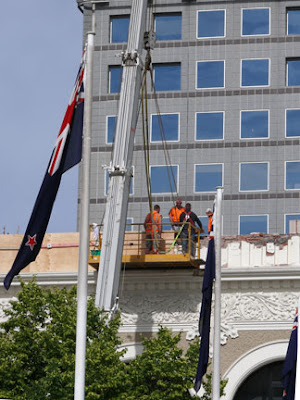
and the second is a banner on a fence put up by the folks at A Good Yarn - a fitting photo to mark the beginning of a new year.

There were good things and not so good things, but even the good things - such as the launch of our poetry book, Flap - mark the finish of projects from which I am ready to move on.
I was out and about in the city the other day, and took these photos:
The first, of men on a crane inspecting damage to a building in the square from the Boxing Day swarm of aftershocks

and the second is a banner on a fence put up by the folks at A Good Yarn - a fitting photo to mark the beginning of a new year.

Thursday, December 30, 2010
A Pocketful of Stones
I remember when my children were small, they often came home with found treasures in their pockets. They picked up stones and gravel by the roadside. We went orienteering, and while they waited for the older ones to return from their courses, the younger ones would fossick under the trees for pine cones, or in the paddock for bleached animal bones. When a school class was studying bones, I was able to present the teacher with a large box full - once the treasures of the day, now forgotten. I was glad to get them out of the house.
I think of the childrens' stone collections when I read Fiona's blog, a handful of small stones. Fiona says a small stone is a polished moment of paying proper attention.
During January, a large number of people will be writing a small stone each day - a project called A River of Stones or International Small Stones Writing Month (not NaSmaStoMo, as it was originally conceived, because the internet is international).
So, I have decided to take part. Polished, though? I'm not sure about that. Some of the stones my children gathered were shiny. Most were not. They seemed to delight in the ordinary - things that were part of the dailiness of life. I've decided not to obsess too much about the "polished" part, and just pay attention, as it were, to the "paying attention" part.
This seems rather like an exercise of Linda Gregg's, that I have followed, rather erratically off and on over the past few months. In her essay, The Art of Finding, she says "I have my students keep a journal in which they must write, very briefly, six things they have seen each day — not beautiful or remarkable things, just things." She talks about being available to seeing. It's an essay well worth reading. I've neglected Linda's exercise for quite a few weeks now, so January will help me get back into it.
My daily "small stones" will have the label "aros" for "a river of stones". It's not too late to join in, head on over and check it out.
I think of the childrens' stone collections when I read Fiona's blog, a handful of small stones. Fiona says a small stone is a polished moment of paying proper attention.
During January, a large number of people will be writing a small stone each day - a project called A River of Stones or International Small Stones Writing Month (not NaSmaStoMo, as it was originally conceived, because the internet is international).
So, I have decided to take part. Polished, though? I'm not sure about that. Some of the stones my children gathered were shiny. Most were not. They seemed to delight in the ordinary - things that were part of the dailiness of life. I've decided not to obsess too much about the "polished" part, and just pay attention, as it were, to the "paying attention" part.
This seems rather like an exercise of Linda Gregg's, that I have followed, rather erratically off and on over the past few months. In her essay, The Art of Finding, she says "I have my students keep a journal in which they must write, very briefly, six things they have seen each day — not beautiful or remarkable things, just things." She talks about being available to seeing. It's an essay well worth reading. I've neglected Linda's exercise for quite a few weeks now, so January will help me get back into it.
My daily "small stones" will have the label "aros" for "a river of stones". It's not too late to join in, head on over and check it out.
Tuesday, December 28, 2010
Tuesday Poem: All Beauteous Things
I remember when my eldest daughter started school, she would arrive home in the afternoon and scarcely was her foot in the door when she would announce "I'm bored". I found that I had only to wait a few minutes and she would find something to occupy herself. She had never had any trouble amusing herself before starting school, and I assumed that the problem was that after being told what to do all day, it took her time to re-orient to more self-directed pursuits.
I find it's the same with myself on weekends. By the end of the weekend I often have a long list of things that I could have spent my time doing, if I'd thought of it earlier. A four day break though, is perfect. I've been pottering about answering old e-mails, cleaning out my studio, gardening and so forth (taking frequent breaks from the heavy gardening because of the heat). And then today it rained, hard. I got out one of my set aside quilting projects, brought it downstairs and auditioned fabrics. My daughter had arrived and while she polished silver ready for New Year, and watched DVDs, I consulted with her on design choices, and cut and stitched borders. And then we did our bit for the shaky Canterbury economy by going out to the sales, along with my husband. We bought fabric for two shirts for him - his ideas on suitable summer shirts don't always fit well with the range in the shops - then I bought an iPod so I can listen to music or language lessons on my walk to work, and we bought a few other bits and pieces, and finished with the consumption of ice cream. A fitting conclusion to a summer shopping expedition.
I seem to be sliding into a position of ease with all this unaccustomed leisure - tomorrow I'm back to work. But then there's another four day weekend over New Year.
Tuesday Poem is on holiday until January 18th, but that's no reason why I can't post one here. So, thinking of the phrase "joy in the making", I decided to post this one. It comes from a book I won as a school prize more years ago than I care to count - The Collins Albatross Book of Verse. Possibly a bit cheesy for modern tastes, but I've always liked it.
All Beauteous Things
I love all beauteous things
I seek and adore them;
God hath no better praise,
And man in his hasty days
Is honoured for them.
I too will something make
And joy in the making;
Although tomorrow it seem
Like empty words of a dream
Remembered on waking.
-Robert Bridges (1844-1930)
I find it's the same with myself on weekends. By the end of the weekend I often have a long list of things that I could have spent my time doing, if I'd thought of it earlier. A four day break though, is perfect. I've been pottering about answering old e-mails, cleaning out my studio, gardening and so forth (taking frequent breaks from the heavy gardening because of the heat). And then today it rained, hard. I got out one of my set aside quilting projects, brought it downstairs and auditioned fabrics. My daughter had arrived and while she polished silver ready for New Year, and watched DVDs, I consulted with her on design choices, and cut and stitched borders. And then we did our bit for the shaky Canterbury economy by going out to the sales, along with my husband. We bought fabric for two shirts for him - his ideas on suitable summer shirts don't always fit well with the range in the shops - then I bought an iPod so I can listen to music or language lessons on my walk to work, and we bought a few other bits and pieces, and finished with the consumption of ice cream. A fitting conclusion to a summer shopping expedition.
I seem to be sliding into a position of ease with all this unaccustomed leisure - tomorrow I'm back to work. But then there's another four day weekend over New Year.
Tuesday Poem is on holiday until January 18th, but that's no reason why I can't post one here. So, thinking of the phrase "joy in the making", I decided to post this one. It comes from a book I won as a school prize more years ago than I care to count - The Collins Albatross Book of Verse. Possibly a bit cheesy for modern tastes, but I've always liked it.
All Beauteous Things
I love all beauteous things
I seek and adore them;
God hath no better praise,
And man in his hasty days
Is honoured for them.
I too will something make
And joy in the making;
Although tomorrow it seem
Like empty words of a dream
Remembered on waking.
-Robert Bridges (1844-1930)
Monday, December 27, 2010
Favourite Photos: In Need of Serenity

We thought things were settling down after our September earthquake, but yesterday proved us wrong. Starting at about 2 a.m when I was jolted awake, we had around 24 sharp aftershocks in as many hours. What was different about these ones is that they were all centred under the city itself, instead of some distance out to the west. In fact the biggest, at about 10.30 a.m., was centred about two blocks from our house. I think the scientists will be re-evaluating the extent of the fault line.
It was bad news for retailers, many of whom had to evacuate their shops in the middle of the busiest shopping day of the year, the one that would help get them back on their feet. A couple of blocks of the city were cordoned off while buildings were inspected. About twenty city buildings had damage additional to that from September. Most of the cordons have since been lifted but one street is still closed off.
I thought I was used to the aftershocks, but these were quite jolting, rather than a gentle rocking. At one stage I thought that outside in the garden would be a good place to be - generally, I don't notice the aftershocks so much outside - but the next one came and I understood what people meant when they said they heard a noise like an approaching freight train. Inside, the noise is more of things rattling. Outside, it was definitely like a freight train, and then the ground swayed under me. Strange, with thousands of aftershocks since September, that I've never really heard that sound before.
Things have settled down again, I think. The photo above is another of my favourite photos from this year, taken at the same place as the one in the previous post. On these wild West Coast beaches, making sculptures with the stones seems to be a popular pastime. This is another photo that I use as a desktop background (I have it set to change every 30 minutes).
And here is the trace of the seismograph drum from yesterday:

Other bloggers are sharing their year's favourite photos at Carmi's blog here
Saturday, December 25, 2010
Peace of the Season

I was feeling pretty stressed out in the run up to Christmas. Last year at least Christmas was a Sunday, leaving me a whole free Saturday for last minute preparations. This year I was working up to the last minute, and also committed to some other voluntary tasks. I had all sorts of things that I wanted to finish before Christmas, so they wouldn't be hanging around after.
Here in New Zealand, Christmas is not just Christmas, it is also the unofficial start of summer (probably the official start is 1st December, I'm not sure). After Christmas, nearly everyone goes on holiday. So preparation is not just preparation for Christmas, it's preparation for summer holidays, and it is easy to feel that anything left undone will spoil the holiday feeling.
Well, it's not all done and I realised that I just had to let that go, take a few days to relax, and leave the undone tasks to be done in their own good time in early January. I won't be going away, I have leave from one job, but I'll be using it to work overtime at my other job as I have a big project I'm not going to get done any other way. But I do have two long weekends of four days - one this weekend and one at New Year. Christmas Day, New Year's Day, and the day after each are all public holidays here, and since that falls on a weekend, we get the Monday and Tuesday off in each case.
For next year, I am working on shedding a few responsibilities so that I don't get so overwhelmed. For this year, I am working on finding a little peace within the "overwhelm"
The photo above is one I took on Hokitika beach on the West Coast of New Zealand earlier this year. At first, I was disappointed with it because it was late in the day and the low light made it came out blurry. But there is something about it that draws me. It is one of the photos I use for my desktop background, and it never fails to soothe me when I see it.
Whatever religion you follow, or whether you follow none, I wish you peace and blessings.
Others are sharing favourite photos at Carmi's blog, here
Wednesday, December 22, 2010
Flap: The Podcast

Before the launch of "Flap" two of our group were interviewed at Plains FM "Women on Air". Unfortunately I couldn't go as I had to work. But I'm sure Victoria and Barbara made a good job of it. I've just found the podcast on line here. I'll be listening to it over the Christmas break. (Currently it is at the bottom of the first page, but if they add more, you may need to look further down).
Yesterday I chose a poem by Kathleen Jones for my Tuesday Poem post. Kathleen was stuck in London by snow (I suspect she still is) and didn't have her post up at the time I posted, but she has managed internet access in the middle of her travel problems, and has posted a sequence of my poems, Kitchen Sonnets.
And there are twenty eight more excellent Tuesday Poems linked from the hub website here.
Tuesday, December 21, 2010
Tuesday Poem: Elizabeth and Mary, by Kathleen Jones
This week the Tuesday poets are participating in a not-so-secret Santa exchange. We have all been paired off to exchange gifts in the form of poems. My partner is Kathleen Jones who generously sent me a fine selection of poems to choose from. They were all excellent poems, but I chose "Elizabeth's Story" in deference to the season.
Kathleen says:
"As a child I was brought up with all the bible stories and even then I kept wondering what the real, human story was behind them. As a mother myself, I began to wonder how these two women had really felt to have what were then thought of as delinquent children who grew up to be such rebels that they became criminalised and were both executed by the governments of the day - Jesus on the orders of Rome and John by Herod. Elizabeth and Mary both lived through the massacres and purges of the times, protecting their children by either fleeing as refugees (Mary to Egypt) or in Elizabeth's case hiding her baby. There are several instances in the old testament where menstruating women (regarded as unclean until ritually purified) managed to conceal things and evade detection, so I used this scenario for Elizabeth concealing John, but this is speculation on my part! John's execution was particularly sad, as he was Elizabeth's only child, born when she was over forty."
Elizabeth's Story
You were my first-born, late-born son.
A gift
concealed beneath my skirt
when Herod's men stood at the door -
like Rachel
crouching on the stool
that kept her stolen birthright,
claiming Custom of Women.
And certainly
I smelt of woman's mysteries,
the birth-blood and the milk
And John
swaddled between my thighs
quiet
as if waiting for another birth.
A miracle.
These were the family infections -
miraculous births,
familiarity with angels,
a subversive streak.
My kinswoman and I were powerful women
who practised our own rebellions,
kept our own counsels.
We had imagined our sons differently,
taking their fathers' places.
But hers, already turning
water into wine,
disputing the prophets
with the priests,
and mine
(she grieved with me)
choosing the wilderness
beyond the Jordan,
living on locusts
and wild honey.
**********
Kathleen lives in England near the Lake District but is currently stranded in London, hoping to find some way of getting to Italy to spend Christmas with her partner, the sculptor Neil Ferber. Unfortunately her flight from Heathrow has been cancelled due to snow. Kathy, I hope you make it!
Cancellations seem to be a feature for Kathleen this year, as she was in Christchurch for the Writers Festival in September which was cancelled due to the earthquake. She was to speak about her biography of the writer Katherine Mansfield.
For more poetry on Tuesday, visit the Tuesday Poem hub site here. All the Tuesday poets are linked there in the sidebar.
Kathleen says:
"As a child I was brought up with all the bible stories and even then I kept wondering what the real, human story was behind them. As a mother myself, I began to wonder how these two women had really felt to have what were then thought of as delinquent children who grew up to be such rebels that they became criminalised and were both executed by the governments of the day - Jesus on the orders of Rome and John by Herod. Elizabeth and Mary both lived through the massacres and purges of the times, protecting their children by either fleeing as refugees (Mary to Egypt) or in Elizabeth's case hiding her baby. There are several instances in the old testament where menstruating women (regarded as unclean until ritually purified) managed to conceal things and evade detection, so I used this scenario for Elizabeth concealing John, but this is speculation on my part! John's execution was particularly sad, as he was Elizabeth's only child, born when she was over forty."
Elizabeth's Story
You were my first-born, late-born son.
A gift
concealed beneath my skirt
when Herod's men stood at the door -
like Rachel
crouching on the stool
that kept her stolen birthright,
claiming Custom of Women.
And certainly
I smelt of woman's mysteries,
the birth-blood and the milk
And John
swaddled between my thighs
quiet
as if waiting for another birth.
A miracle.
These were the family infections -
miraculous births,
familiarity with angels,
a subversive streak.
My kinswoman and I were powerful women
who practised our own rebellions,
kept our own counsels.
We had imagined our sons differently,
taking their fathers' places.
But hers, already turning
water into wine,
disputing the prophets
with the priests,
and mine
(she grieved with me)
choosing the wilderness
beyond the Jordan,
living on locusts
and wild honey.
**********
Kathleen lives in England near the Lake District but is currently stranded in London, hoping to find some way of getting to Italy to spend Christmas with her partner, the sculptor Neil Ferber. Unfortunately her flight from Heathrow has been cancelled due to snow. Kathy, I hope you make it!
Cancellations seem to be a feature for Kathleen this year, as she was in Christchurch for the Writers Festival in September which was cancelled due to the earthquake. She was to speak about her biography of the writer Katherine Mansfield.
For more poetry on Tuesday, visit the Tuesday Poem hub site here. All the Tuesday poets are linked there in the sidebar.
Monday, December 20, 2010
Flap: the Book Draw
As promised, I have used the sorting hat aka Random number generator to choose a winner. The person who will receive a copy of Flap is Deb.
If you didn't win, and would still like a copy, you can order online from Madras Cafe Books, and support a small bookstore. Thanks everyone for your interest.
(I have been fiddling with the settings on blogger. Now I seem to have a different font, without any option to change it. Darn!)
If you didn't win, and would still like a copy, you can order online from Madras Cafe Books, and support a small bookstore. Thanks everyone for your interest.
(I have been fiddling with the settings on blogger. Now I seem to have a different font, without any option to change it. Darn!)
Sunday, December 19, 2010
Earthquake Reprised
Over at Thematic Photographic, Carmi is asking us to share our favourite photos from this year. This post, however, is not so much about my favourite photos as the most significant. I'll never think about 2010 without our September earthquake featuring very prominently in my thoughts. So, I decided to post a collection of my earthquake photos, some from soon after and some more recent. It will take two or three years before the city is rebuilt or at least tidied up.
This week I read that in terms of the size of insurance claims, the Canterbury earthquake was the fifth largest ever. (Although it was dwarfed by the Northridge California earthquake of the mid 1990s). What that tells me is that we are very fortunate. There have been many bigger earthquakes. But the citizens of Haiti, for instance, mostly don't have insurance cover. No cover, no claims. And their possessions probably weren't very valuable to start with. So the size of insurance claims tells me that we are prosperous by world standards, and that we are well looked after in the event of catastrophe.
Still, that statistic did really bring home to me how amazing it was that no one was killed. Of course, as my daughter says, we should count those who died later of heart attacks brought about by stress - there was a significant increase in these in the following weeks. But that's not the way it's done, so according to the official statistics, no one died. Although there were some amazing escape stories. Like the teenager who was flung out of his bed on the first floor of his house, and landed on the lawn outside. He was scratched and bruised but otherwise unharmed. The wall of his bedroom had completely fallen down. (I think Americans call this the second floor, and what we call the ground floor is what we call the first floor - but anyway, he was one floor up).
One of our monthly magazines, North and South Magazine, chooses a "New zealander of the Year" every December. This year, they named "the People of Canterbury" for their resilience and spirit of caring after the earthquake. So, I'm a New Zealander of the Year - along, of course, with many others, a large number of whom probably deserve it far more than I do. My favourite photo is the "Keep Calm and Carry On" fence which I think well illustrates the New Zealand psyche - practical getting on with it, laced with wry humour.


A badly damaged church building

This building is used as an information centre and meeting place for arts events. It is closed for the next year or so.

Our local volunteer library, with significant cracks in the brick work.


The clock tower has been temporarily sheathed in plywood to stop loose bricks from falling. The hands stopped at 4.36 am and it was restarted not long after this photo was taken. Some people thought that it should be left permanently at 4.36 to mark the occasion.

A movement sprung up to make use of vacant sites where buildings had been demolished. The gapfiller project used this site for music performances, movies and poetry readings over a couple of recent weekends. Some other sites will be turned into temporary gardens, until replacement buildings are constructed. Above, Marisa Capetta reading at a poetry event.

Next door to the gapfiller site, a very public toilet as another building is demolished.
This week I read that in terms of the size of insurance claims, the Canterbury earthquake was the fifth largest ever. (Although it was dwarfed by the Northridge California earthquake of the mid 1990s). What that tells me is that we are very fortunate. There have been many bigger earthquakes. But the citizens of Haiti, for instance, mostly don't have insurance cover. No cover, no claims. And their possessions probably weren't very valuable to start with. So the size of insurance claims tells me that we are prosperous by world standards, and that we are well looked after in the event of catastrophe.
Still, that statistic did really bring home to me how amazing it was that no one was killed. Of course, as my daughter says, we should count those who died later of heart attacks brought about by stress - there was a significant increase in these in the following weeks. But that's not the way it's done, so according to the official statistics, no one died. Although there were some amazing escape stories. Like the teenager who was flung out of his bed on the first floor of his house, and landed on the lawn outside. He was scratched and bruised but otherwise unharmed. The wall of his bedroom had completely fallen down. (I think Americans call this the second floor, and what we call the ground floor is what we call the first floor - but anyway, he was one floor up).
One of our monthly magazines, North and South Magazine, chooses a "New zealander of the Year" every December. This year, they named "the People of Canterbury" for their resilience and spirit of caring after the earthquake. So, I'm a New Zealander of the Year - along, of course, with many others, a large number of whom probably deserve it far more than I do. My favourite photo is the "Keep Calm and Carry On" fence which I think well illustrates the New Zealand psyche - practical getting on with it, laced with wry humour.


A badly damaged church building

This building is used as an information centre and meeting place for arts events. It is closed for the next year or so.

Our local volunteer library, with significant cracks in the brick work.


The clock tower has been temporarily sheathed in plywood to stop loose bricks from falling. The hands stopped at 4.36 am and it was restarted not long after this photo was taken. Some people thought that it should be left permanently at 4.36 to mark the occasion.

A movement sprung up to make use of vacant sites where buildings had been demolished. The gapfiller project used this site for music performances, movies and poetry readings over a couple of recent weekends. Some other sites will be turned into temporary gardens, until replacement buildings are constructed. Above, Marisa Capetta reading at a poetry event.

Next door to the gapfiller site, a very public toilet as another building is demolished.
Saturday, December 18, 2010
Big Tent Poetry: Dead Woman Poems
This week Big Tent Poetry introduced us to Marvin Bell and his Dead Man Poems. Such a specific prompt seemed quite challenging at first, however it was interesting to attempt, although I doubt that my efforts resemble Marvin Bell's too closely. It occurred to me somewhere along the way that there was no reason why my Dead Man shouldn't be a Dead Woman. So she is. I seem to have been writing about birds quite a lot in the last year or two.
1. About the Dead Woman and Birds
The dead woman can hear the birds above her head.
They are scritch scratching in the dirt looking for worms.
The dead woman contemplates the worms, the birds, and the nature of transformation.
Unlike the birds she has no wishbone.
It is too late to wish for anything.
The pole of a scarecrow is embedded in the earth in a neighbouring field.
The birds perch on the scarecrow’s shoulders.
The birds make their nests from the straw that pokes out from the scarecrow’s hat, and from the moss that the dead woman nestles in.
The birds are not afraid of the scarecrow, nor are they afraid of the dead woman.
She is learning the art of lying very still, so as not to frighten the birds.
2. More About the Dead Woman and Birds
See, it’s magic says the dead woman, as she pulls silk handkerchiefs from her pockets, from her sleeves, from under her hat.
The silk handkerchiefs turn into white birds and flutter away.
The dead woman is becoming lighter.
She feels a lifting under the soles of her feet.
She feels a prickling between her shoulder blades where her wings might be.
The dead woman has no boundaries.
She makes small exhalations of air.
She leaves behind her white bones and feels herself rising into the sky like a drift of grey smoke, like the skeins of migrating birds straggling northwards.
*********
More Dead Man poems here
And come back tomorrow for the results of my poetry book draw (if you are quick, you can still ask to be included in the draw for a copy of Flap in which a quarter of the poems come from me)
1. About the Dead Woman and Birds
The dead woman can hear the birds above her head.
They are scritch scratching in the dirt looking for worms.
The dead woman contemplates the worms, the birds, and the nature of transformation.
Unlike the birds she has no wishbone.
It is too late to wish for anything.
The pole of a scarecrow is embedded in the earth in a neighbouring field.
The birds perch on the scarecrow’s shoulders.
The birds make their nests from the straw that pokes out from the scarecrow’s hat, and from the moss that the dead woman nestles in.
The birds are not afraid of the scarecrow, nor are they afraid of the dead woman.
She is learning the art of lying very still, so as not to frighten the birds.
2. More About the Dead Woman and Birds
See, it’s magic says the dead woman, as she pulls silk handkerchiefs from her pockets, from her sleeves, from under her hat.
The silk handkerchiefs turn into white birds and flutter away.
The dead woman is becoming lighter.
She feels a lifting under the soles of her feet.
She feels a prickling between her shoulder blades where her wings might be.
The dead woman has no boundaries.
She makes small exhalations of air.
She leaves behind her white bones and feels herself rising into the sky like a drift of grey smoke, like the skeins of migrating birds straggling northwards.
*********
More Dead Man poems here
And come back tomorrow for the results of my poetry book draw (if you are quick, you can still ask to be included in the draw for a copy of Flap in which a quarter of the poems come from me)
Tuesday, December 14, 2010
Tuesday Poem: Snow Falls Lightly
It's summer here, but snow is falling in other parts of the world - though not always very lightly!
For my Tuesday Poem this week I chose a poem from Flap: The Chook Book 2 written by Barbara McCartney, one of my co-authors of this book. It was previously published in North and South magazine.
Flap can be purchased on line from the Madras Cafe Bookshop. I earlier wrote about how this small bookshop had to close its doors. Fortunately it has found new premises, and is also still operating its website, so I am happy to support a small business by putting sales of our book through their website.
snow falls lightly
a bleak back country road
we're confronted by two bulls
and further on
a posse of steers giving the cockie a hard time
wanders over, stands like John Wayne -
a sarcastic bastard, tonnes of cheek
keen-eyed dogs milling
one of the worst five jobs in the world
he says - reckons sheep worse than cattle
- more dogmatic - but women -
wear you down to worm tucker -
reckon no man's perfect 'til he's under their thumb
yeah - women - love the outdoors
'til winter chucks a few curve balls -
they scuttle back to town
now the wind's changed, the rain horizontal
time to call it a day.
we turn back
he plods on with his dogs
....
through all the restless night
snow falls lightly
For my Tuesday Poem this week I chose a poem from Flap: The Chook Book 2 written by Barbara McCartney, one of my co-authors of this book. It was previously published in North and South magazine.
Flap can be purchased on line from the Madras Cafe Bookshop. I earlier wrote about how this small bookshop had to close its doors. Fortunately it has found new premises, and is also still operating its website, so I am happy to support a small business by putting sales of our book through their website.
snow falls lightly
a bleak back country road
we're confronted by two bulls
and further on
a posse of steers giving the cockie a hard time
wanders over, stands like John Wayne -
a sarcastic bastard, tonnes of cheek
keen-eyed dogs milling
one of the worst five jobs in the world
he says - reckons sheep worse than cattle
- more dogmatic - but women -
wear you down to worm tucker -
reckon no man's perfect 'til he's under their thumb
yeah - women - love the outdoors
'til winter chucks a few curve balls -
they scuttle back to town
now the wind's changed, the rain horizontal
time to call it a day.
we turn back
he plods on with his dogs
....
through all the restless night
snow falls lightly
Friday, December 10, 2010
Big Tent Poetry: Referential
Referential Magazine is an online journal based on an interesting premise - submissions must refer back to a poem they have already published, by taking inspiration from a word or phrase in a poem from the site.
This week's task at Big Tent Poetry was to write a poem based on something found at Referential. My poem is based on the words tibia, fibula and the phrase coins in the sack from Elizabeth Langemak's poem, Self Portrait as Fake Saint with Wheel
The Grave Robbers
He doesn’t have any use for it now,
it’s clear, his soul long since gone
and his silver coin to pay the ferryman
fallen to earth from his clenched grasp.
The last shreds of flesh melted into the earth.
All that we saw a few tufts of hair,
his bleached bones, sightless sockets.
I pushed gold bangles high up my arm,
filled a sack with gold coins,
buckled his sword belt round my waist,
snatched the sword from where it lay
beside his lifeless bones – tibia, fibula
hoisted his plough on my back,
filled a sack with gold coins.
We left as quickly as we came,
in the dark hour of the night
when there were none to observe us,
and the noise we heard was only an owl
calling “Who? who?”, though our hearts
beat faster, and a fox in the shadows
seemed to fix us with its stare,
and our step quickened as we heard a rustle behind us
- only the wind stirring the leaves, we said –
but we stumbled over tree roots
and I fell headlong, dropped my sack,
its mouth open, a coin as round and silver
as the moon splashing into a puddle
and staring up at me, a single accusing eye.
For more referential poems, go here
And I have a give away this week. One copy of our recently published book Flap: The Chook Book 2, written by the Poetry Chooks, a group of whom I am one quarter. If you would like to go in the drawer, please say so in the comments. I'll leave the draw open until Saturday 17th at 6pm New Zealand time - which is somewhere around 6am Sunday GMT
This week's task at Big Tent Poetry was to write a poem based on something found at Referential. My poem is based on the words tibia, fibula and the phrase coins in the sack from Elizabeth Langemak's poem, Self Portrait as Fake Saint with Wheel
The Grave Robbers
He doesn’t have any use for it now,
it’s clear, his soul long since gone
and his silver coin to pay the ferryman
fallen to earth from his clenched grasp.
The last shreds of flesh melted into the earth.
All that we saw a few tufts of hair,
his bleached bones, sightless sockets.
I pushed gold bangles high up my arm,
filled a sack with gold coins,
buckled his sword belt round my waist,
snatched the sword from where it lay
beside his lifeless bones – tibia, fibula
hoisted his plough on my back,
filled a sack with gold coins.
We left as quickly as we came,
in the dark hour of the night
when there were none to observe us,
and the noise we heard was only an owl
calling “Who? who?”, though our hearts
beat faster, and a fox in the shadows
seemed to fix us with its stare,
and our step quickened as we heard a rustle behind us
- only the wind stirring the leaves, we said –
but we stumbled over tree roots
and I fell headlong, dropped my sack,
its mouth open, a coin as round and silver
as the moon splashing into a puddle
and staring up at me, a single accusing eye.
For more referential poems, go here
And I have a give away this week. One copy of our recently published book Flap: The Chook Book 2, written by the Poetry Chooks, a group of whom I am one quarter. If you would like to go in the drawer, please say so in the comments. I'll leave the draw open until Saturday 17th at 6pm New Zealand time - which is somewhere around 6am Sunday GMT
Thematic Photographic: Family

Family doesn't always mean humans. Unlike my own family, these pelicans are unlikely to complain at finding their photos on my blog, having no understanding of the word "privacy" . And who knew that baby pelicans were black? Not me, at any rate, until I met these three, who were clearly hanging out with mama pelican and therefore, I assume, her offspring.
For my family themed photos, visit Thematic Photographic here.
Monday, December 06, 2010
Tuesday Poem: A Little Night Music
I have been revisiting some of my older poems, and either tweaking or making wholesale revisions. I picked this one because it seemed to fit the season. I wrote it a few years ago, at this time of year, when I was taking long walks most evenings. (Oh, to have the free time to do the same now!)
I think it still needs a little work, but for now, here it is:
A Little Night Music
1. Alla marcia
The day’s heat lingers
Through open windows, light spills
into the park. A radio is playing
“when the saints…”
Footsteps crunch on gravel,
somewhere a dog barks,
and the saints go marching
on into the night
2. Allegretto giocoso
School’s out. No homework,
nothing more important to do
than flock on the riverbank
and poke sticks into the water.
“Merry Christmas, Christina’s mum!” they call,
“Merry Christmas” to all the passing walkers,
to each other, to the river,
to the eels in the shadows,
and “Merry Christmas” to the moon.
3. Allegro appassionata
A tree frog is chirping a cadenza
to all the females in the pond.
In the flower beds, the rustling of leaves
and the squeals of hedgehogs.
In nearby houses, footsteps in hallways
and the sound of closing doors.
********
For more Tuesday Poems, go here.
I think it still needs a little work, but for now, here it is:
A Little Night Music
1. Alla marcia
The day’s heat lingers
Through open windows, light spills
into the park. A radio is playing
“when the saints…”
Footsteps crunch on gravel,
somewhere a dog barks,
and the saints go marching
on into the night
2. Allegretto giocoso
School’s out. No homework,
nothing more important to do
than flock on the riverbank
and poke sticks into the water.
“Merry Christmas, Christina’s mum!” they call,
“Merry Christmas” to all the passing walkers,
to each other, to the river,
to the eels in the shadows,
and “Merry Christmas” to the moon.
3. Allegro appassionata
A tree frog is chirping a cadenza
to all the females in the pond.
In the flower beds, the rustling of leaves
and the squeals of hedgehogs.
In nearby houses, footsteps in hallways
and the sound of closing doors.
********
For more Tuesday Poems, go here.
Saturday, December 04, 2010
NZSA Mentorship Scheme
On Beatties Book blog, I spotted an article about the New Zealand Society of Authors Mentorship scheme. Applications are now open for a programme designed to help new and emerging writers develop skills, by working on specific projects under the guidance of an experienced mentor.
I won't be applying this year but I have a time frame in mind by which I may well apply in future. One paragraph, though, brought me up short. After saying Mentored projects including poetry collections, novels and work for children have been accepted for publication... I find further down the article that
There are 15 full mentorships available in the 2011 programme, as well as two half-mentorships of 10 hours each which are available for work - such as picture book texts or poetry - that is deemed not to require a full mentorship.
What are they saying here? Poetry is somehow less than fiction, and doesn't require so much work? Some might argue this is fair enough, the average poetry collection being considerably shorter than the average novel. On the other hand, it is far more condensed, and each word matters. In a novel, the reader is far less conscious of individual words. Anything clunky will stick out and need attention given to it, but it is less critical that absolutely every word deserves its place. So questions of plot, structure, narrative arc and so on become more to the fore.
Presumably, some things are the responsibility of the author, before mentorship is sought. So I don't have a fixed idea in my head as to whether or not a poetry mentorship should be a full mentorship, with as many hours devoted to it as would be spent on mentoring a novel. But it does leave me wondering..
And raises a second question. Can poets also apply for a full mentorship? Or do all the poets have to compete with the picture book writers for one of two half mentorships, while the novelists can apply for one of fifteen full mentorships? That seems a bit ...uneven. There are dozens and dozens of budding poets around. Not so many novelists. (Or non-fiction writers - I presume biographies, works of history and so on also qualify). I could be entirely wrong on this. I'm just judging by the people I know, and a lot of them are poets. But then, I attend poetry events, so it's reasonable that I would know a lot of poets!
Still, the whole paragraph seems to make poetry something less (and picture books, too!), whereas the first sentence I quoted put poetry ahead of fiction in the list of successful projects.
I think I had better head on over to the Society of Authors website and see if I can find out more.
I won't be applying this year but I have a time frame in mind by which I may well apply in future. One paragraph, though, brought me up short. After saying Mentored projects including poetry collections, novels and work for children have been accepted for publication... I find further down the article that
There are 15 full mentorships available in the 2011 programme, as well as two half-mentorships of 10 hours each which are available for work - such as picture book texts or poetry - that is deemed not to require a full mentorship.
What are they saying here? Poetry is somehow less than fiction, and doesn't require so much work? Some might argue this is fair enough, the average poetry collection being considerably shorter than the average novel. On the other hand, it is far more condensed, and each word matters. In a novel, the reader is far less conscious of individual words. Anything clunky will stick out and need attention given to it, but it is less critical that absolutely every word deserves its place. So questions of plot, structure, narrative arc and so on become more to the fore.
Presumably, some things are the responsibility of the author, before mentorship is sought. So I don't have a fixed idea in my head as to whether or not a poetry mentorship should be a full mentorship, with as many hours devoted to it as would be spent on mentoring a novel. But it does leave me wondering..
And raises a second question. Can poets also apply for a full mentorship? Or do all the poets have to compete with the picture book writers for one of two half mentorships, while the novelists can apply for one of fifteen full mentorships? That seems a bit ...uneven. There are dozens and dozens of budding poets around. Not so many novelists. (Or non-fiction writers - I presume biographies, works of history and so on also qualify). I could be entirely wrong on this. I'm just judging by the people I know, and a lot of them are poets. But then, I attend poetry events, so it's reasonable that I would know a lot of poets!
Still, the whole paragraph seems to make poetry something less (and picture books, too!), whereas the first sentence I quoted put poetry ahead of fiction in the list of successful projects.
I think I had better head on over to the Society of Authors website and see if I can find out more.
Thematic Photographic: Night

An excuse to post another holiday photograph. This is a seafood restaurant on the Hastings River at Port Macquarie, New South Wales where we had a break for a week in September. Most of my nighttime photos seem to be taken on holiday, perhaps it's because then I take more time to relax, fiddle around with camera settings, and take the time to get one that I like.
For more night photography, go here
Friday, December 03, 2010
Big Tent Poetry: Enough
Just a single word prompt at Big Tent Poetry this week: enough.
I did a free write and seemingly got nowhere, then as I was going to bed that night this memory popped into my head - someone I knew at university long ago telling me about the coat he wore - his father's. The details are my own embellishments.
The Coat
“It was my father’s coat” says Aldis
and while he tells the story, I see
a figure trekking eastwards across Europe
ahead of the Russian armies. His scuffed boots,
nine days’ growth on his chin, his thick wool coat
almost to the ground, dark against the snow.
It carries all that he has, but it is enough.
It is his safe, his valuables sewn into the lining.
It is his tent, his transport,
his camouflage in dark alleys,
it is his cupboard with its capacious pockets.
It is his blanket and his pillow on his long journey
by foot and by ship to a new land far to the south
to a city where snow is only on distant mountains
and on ti kouka, summer’s blossoming cabbage trees.
Aldis explains his father’s coat and I see his father
and his father’s father before him, looking out through his eyes,
I see the coat that swirls round his ankles
and keeps out the chill Wellington wind,
almost too well, it is so thick.
It is his family album, his education,
his history lesson, his father’s arms about his shoulders,
it is all he has left of his father
and it is enough.
*******
More poems on the subject of "enough" here
I did a free write and seemingly got nowhere, then as I was going to bed that night this memory popped into my head - someone I knew at university long ago telling me about the coat he wore - his father's. The details are my own embellishments.
The Coat
“It was my father’s coat” says Aldis
and while he tells the story, I see
a figure trekking eastwards across Europe
ahead of the Russian armies. His scuffed boots,
nine days’ growth on his chin, his thick wool coat
almost to the ground, dark against the snow.
It carries all that he has, but it is enough.
It is his safe, his valuables sewn into the lining.
It is his tent, his transport,
his camouflage in dark alleys,
it is his cupboard with its capacious pockets.
It is his blanket and his pillow on his long journey
by foot and by ship to a new land far to the south
to a city where snow is only on distant mountains
and on ti kouka, summer’s blossoming cabbage trees.
Aldis explains his father’s coat and I see his father
and his father’s father before him, looking out through his eyes,
I see the coat that swirls round his ankles
and keeps out the chill Wellington wind,
almost too well, it is so thick.
It is his family album, his education,
his history lesson, his father’s arms about his shoulders,
it is all he has left of his father
and it is enough.
*******
More poems on the subject of "enough" here
Monday, November 29, 2010
Tuesday Poem
The Tuesday Poem community is an initiative by New Zealand writer Mary McCallum, and others , to post a poem every Tuesday. Thirty writers each post a poem on their own blog, and each week there is one post on the main Tuesday Poem hub site.
I have finally taken the plunge and joined them.
This week, the Pike River Coal Mine disaster has been much on our minds here in the South Island. And so, I thought of Jim Brock and his book The Sunshine Mine Disaster. Jim is an associate professor of English at Florida Gulf Coast University, who blogs at Gods and Money. He has kindly allowed me to post a poem from his collection this week.
Of course, each mining accident is different. The Sunshine Mine Disaster took place in a silver mine in Idaho. There are similarities but there are also differences, nevertheless it is a fine collection of poems. Some address the disaster more directly, others are concerned with the miners involved. I was attracted to Aubade because although we don't have elk here, we do have deer - not native to New Zealand, but introduced for hunting - and I'm sure many of the West Coast miners would have been keen hunters in their spare time.
Aubade: Good Daylight
If a man doesn’t like to rush,
and I don’t, he can spend a half hour
in the dry-house: pull on his t-shirt,
overalls, wool socks, steel-toed
rubber boots, helmet, belt,
battery pack and light, a denim
jacket. And still time to make
good daylight at 6:30 a.m.
in Big Creek Canyon. Most
Mays, on the ridge above the Crescent
Mine, you can see ten or
twelve head of elk below the snow
line. It’s easy, in this work,
to think of cave paintings, when
you see wildlife in the dawn’s
light, before pounding the face
with dynamite, mucking out
the rock, clearing the new ground.
But I don’t like that kind
of confusion. Extraction counts
for nothing, save the pay dirt.
And those paintings are just some
lines, guttural and round, copies
of animals that had come out
of nowhere and had nowhere
to go on this slow earth. Today
three elk appear, two females
and a calf, feeding off
the greening bitter-brush. To the
calf, I say, “Grow fat, bastard,”
as I measure the distances of two
Octobers with a thumb, a hair
cross-sight.
*******
Footnote: My own poem, Blue, is the Tuesday Poem at Helen Lowe's website this week.
I have finally taken the plunge and joined them.
This week, the Pike River Coal Mine disaster has been much on our minds here in the South Island. And so, I thought of Jim Brock and his book The Sunshine Mine Disaster. Jim is an associate professor of English at Florida Gulf Coast University, who blogs at Gods and Money. He has kindly allowed me to post a poem from his collection this week.
Of course, each mining accident is different. The Sunshine Mine Disaster took place in a silver mine in Idaho. There are similarities but there are also differences, nevertheless it is a fine collection of poems. Some address the disaster more directly, others are concerned with the miners involved. I was attracted to Aubade because although we don't have elk here, we do have deer - not native to New Zealand, but introduced for hunting - and I'm sure many of the West Coast miners would have been keen hunters in their spare time.
Aubade: Good Daylight
If a man doesn’t like to rush,
and I don’t, he can spend a half hour
in the dry-house: pull on his t-shirt,
overalls, wool socks, steel-toed
rubber boots, helmet, belt,
battery pack and light, a denim
jacket. And still time to make
good daylight at 6:30 a.m.
in Big Creek Canyon. Most
Mays, on the ridge above the Crescent
Mine, you can see ten or
twelve head of elk below the snow
line. It’s easy, in this work,
to think of cave paintings, when
you see wildlife in the dawn’s
light, before pounding the face
with dynamite, mucking out
the rock, clearing the new ground.
But I don’t like that kind
of confusion. Extraction counts
for nothing, save the pay dirt.
And those paintings are just some
lines, guttural and round, copies
of animals that had come out
of nowhere and had nowhere
to go on this slow earth. Today
three elk appear, two females
and a calf, feeding off
the greening bitter-brush. To the
calf, I say, “Grow fat, bastard,”
as I measure the distances of two
Octobers with a thumb, a hair
cross-sight.
*******
Footnote: My own poem, Blue, is the Tuesday Poem at Helen Lowe's website this week.
Sunday, November 28, 2010
Quilts in the Library
The library where we had our book launch was hosting an exhibition of quilts this month. I was too busy the day of the launch to look, but I went back later.
These quilts are made by the members of the Refugee and Migrant Quilt Group. Each quilt had a card displayed with it telling the name of the maker and something about her. The women are from many countries, predominantly Asia but also Egypt, Jordan and Latvia among others. The group is a place where they can learn not just sewing skills, but English, and in addition make new friends. The quilts range from very simple to more comples - here are a few details from some of the more complex ones:


These quilts are made by the members of the Refugee and Migrant Quilt Group. Each quilt had a card displayed with it telling the name of the maker and something about her. The women are from many countries, predominantly Asia but also Egypt, Jordan and Latvia among others. The group is a place where they can learn not just sewing skills, but English, and in addition make new friends. The quilts range from very simple to more comples - here are a few details from some of the more complex ones:


Saturday, November 27, 2010
Big Tent Poetry
This week's prompt at Big Tent Poetry was a wordle.
The words offered: hung, ash-pit, forklifted, boiler, nib, clunk, hand, awake, resurfaced, passed, cupped, lush.
I let them sit in my mind for a couple of days until I came across this post at one of my favourite science blogs, The Artful Amoeba.
This is the result (I worked in most of the words)
Mastodon
When he hears the clunk of the blade
in soft soil, the bulldozer driver climbs down
to find a massive bone. This soft earth
cupped in a hollow in the mountains
is now revealed as the site of an ancient swamp.
Lush grass bordered its edges.
Animals blundered in, bogged down,
while the peak hung above.
Work now stops. The driver moves to another job,
experts are called in to see
what has resurfaced.
Later, the driver returns
to read the story, written
not with nib on paper,
but in rows of exhibits - ancient grass seeds,
fragment of an iridescent beetle,
wood marked with glyphs by the teeth
of a prehistoric beaver. He passes
rows of bones - sloth, salamander, bison -
to gaze at the huge tusks,
imagines himself at the controls
of such a beast,
all that opposes him
forklifted and tossed lightly
into the air.
He raises a hand in salute.
*****
It's rough, but I'm not too worried about that. Lately, I've started revising old poems from a year or two back. I've discovered the "housework method" of editing is remarkably successful. I read over and think about the poem for about ten minutes or so. Then I leave it alone and go and do housework. (Gardening works too, or a walk, or a long soak in the bathtub if actual work doesn't appeal). Somehow my subconscious keeps on working at the poem and I figure out what needs fixing, and how to fix it. So I'll probably put this one away for a year or so as well, and then come back to it.
To see what others did with these words, go here.
The words offered: hung, ash-pit, forklifted, boiler, nib, clunk, hand, awake, resurfaced, passed, cupped, lush.
I let them sit in my mind for a couple of days until I came across this post at one of my favourite science blogs, The Artful Amoeba.
This is the result (I worked in most of the words)
Mastodon
When he hears the clunk of the blade
in soft soil, the bulldozer driver climbs down
to find a massive bone. This soft earth
cupped in a hollow in the mountains
is now revealed as the site of an ancient swamp.
Lush grass bordered its edges.
Animals blundered in, bogged down,
while the peak hung above.
Work now stops. The driver moves to another job,
experts are called in to see
what has resurfaced.
Later, the driver returns
to read the story, written
not with nib on paper,
but in rows of exhibits - ancient grass seeds,
fragment of an iridescent beetle,
wood marked with glyphs by the teeth
of a prehistoric beaver. He passes
rows of bones - sloth, salamander, bison -
to gaze at the huge tusks,
imagines himself at the controls
of such a beast,
all that opposes him
forklifted and tossed lightly
into the air.
He raises a hand in salute.
*****
It's rough, but I'm not too worried about that. Lately, I've started revising old poems from a year or two back. I've discovered the "housework method" of editing is remarkably successful. I read over and think about the poem for about ten minutes or so. Then I leave it alone and go and do housework. (Gardening works too, or a walk, or a long soak in the bathtub if actual work doesn't appeal). Somehow my subconscious keeps on working at the poem and I figure out what needs fixing, and how to fix it. So I'll probably put this one away for a year or so as well, and then come back to it.
To see what others did with these words, go here.
Wednesday, November 24, 2010
What's a Doorbell For?
When I got up this morning, I went outside to collect the newspaper, and found a card from the courier service on our back doorstep. They had tried to deliver a parcel but we were "unavailable".
So I phoned to arrange an alternative. On Wednesdays and Fridays I work near the courier depot, which is on the other side of town. so I asked to pick it up at the depot, hoping it would be there by late afternoon when I was on my way home. I called for it about five fifteen, but it hadn't made it back to the depot. That courier must be having a long day, since it was around seven thirty when he left the card.
At that point, I thought that I had better try and get it redelivered tomorrow, because otherwise I couldn't pick it up until Friday. When I asked for it to be redelivered, I said "and please ask him to ring the doorbell". That's when I found out that the courier drivers are not allowed to ring the doorbell!. Apparently, they got too many complaints from shift workers that the courier driver woke them up by ringing the doorbell.
Well, from my viewpoint, if you have a doorbell, it is so that people can ring it. (Especially in a large house like ours, where we just don't hear a knock at the door). And if you have a parcel sent by courier, you are paying extra for prompt delivery, not to make the recipient run all over town trying to collect the parcel. Shift workers should disable the doorbell if they really don't want it rung. And then the rest of us can get our parcels delivered promptly.
There is now a large message left for the courier driver that he is to ring the doorbell on the instructions of the customer. Hopefully, all is now well, until next time at least. And I will take delivery of the parcel, whatever it is, in the morning.
End of small rant :)
So I phoned to arrange an alternative. On Wednesdays and Fridays I work near the courier depot, which is on the other side of town. so I asked to pick it up at the depot, hoping it would be there by late afternoon when I was on my way home. I called for it about five fifteen, but it hadn't made it back to the depot. That courier must be having a long day, since it was around seven thirty when he left the card.
At that point, I thought that I had better try and get it redelivered tomorrow, because otherwise I couldn't pick it up until Friday. When I asked for it to be redelivered, I said "and please ask him to ring the doorbell". That's when I found out that the courier drivers are not allowed to ring the doorbell!. Apparently, they got too many complaints from shift workers that the courier driver woke them up by ringing the doorbell.
Well, from my viewpoint, if you have a doorbell, it is so that people can ring it. (Especially in a large house like ours, where we just don't hear a knock at the door). And if you have a parcel sent by courier, you are paying extra for prompt delivery, not to make the recipient run all over town trying to collect the parcel. Shift workers should disable the doorbell if they really don't want it rung. And then the rest of us can get our parcels delivered promptly.
There is now a large message left for the courier driver that he is to ring the doorbell on the instructions of the customer. Hopefully, all is now well, until next time at least. And I will take delivery of the parcel, whatever it is, in the morning.
End of small rant :)
Monday, November 22, 2010
Paper Butterflies
It was sunny yesterday, so I went to take a photograph of the paper butterflies mentioned in the poem in my previous post:

(actually they weren't paper, but some sort of fabric - just as well given Saturday's heavy rain)
and while I was there I noticed the sunbathers on a nearby roof:

These houses are part of Urban Rooms - a scheme that provides reasonably priced accommodation for medium term visitors - those staying a month or more, often international students studying English in Christchurch. They really brighten up the area!

(actually they weren't paper, but some sort of fabric - just as well given Saturday's heavy rain)
and while I was there I noticed the sunbathers on a nearby roof:

These houses are part of Urban Rooms - a scheme that provides reasonably priced accommodation for medium term visitors - those staying a month or more, often international students studying English in Christchurch. They really brighten up the area!
Saturday, November 20, 2010
Weekend Poem

Just when you thought it was safe
to put the jars back on the shelf,
the wine in the rack,
the books in the book case,
there is another tremor.
Just when you thought it was safe
to hang the pictures on the wall,
plaster over the cracks,
build castles in the air,
the earth is shaking again.
The city is all falling bricks and blossoms.
You keep a torch by your bed,
water in the cupboard,
stack heavy books along the foot
of the walls, put Blu-Tak under everything,
tie cupboard doors shut.
Your chimney has toppled,
your neighbour's house is off kilter,
your friend's buisness has shut its doors.
And then, just when you thought it was safe
to mope in corners, dress in black,
put on your gloomiest face,
there is music in the park,
the first strawberries of summer,
the generosity of strangers,
sunlight sparkling on fountains
and you drive down the street
past a tree filled with paper butterflies.
*********
I thought it was time I wrote something for Big Tent Poetry, but instead of writing to their prompt I chose something else. I'm not doing the November poem a day challenge but I have been following the blogs of several who are. A few days ago the prompt was Just when you thought it was safe followed the next day by "a stacking poem". I've been resisting writing an earthquake poem - I'm sure we will be inundated by earthquake poetry at all the poetry readings in Christchurch in the next few months - but this prompt seemed made for an earthquake poem. I'm sure this is not the best I have to write on the subject, but it's a start.
The photo at the head of the post is a church I passed yesterday when I took a different route home from work than usual. I shot it through the mesh of the safety fence surrounding the grounds. I was going to photograph the tree full of paper butterflies, but there wasn't any parking nearby. I may manage to do so later in the weekend, if it stops raining.
Wednesday, November 17, 2010
Poetry Quote
Publishing a volume of verse is like dropping a rose petal down the Grand Canyon and waiting for the echo - Don Marquis
A quote that particularly appealed to me in light of our recent book launch!
You can receive writing quotes in your in box each day by sending a blank e-mail to:
TheWrittenWordQuotes-subscribe@yahoogroups.com
A quote that particularly appealed to me in light of our recent book launch!
You can receive writing quotes in your in box each day by sending a blank e-mail to:
TheWrittenWordQuotes-subscribe@yahoogroups.com
Christchurch: A Safe Place to Park Your Car
On the news tonight: Tauranga is the most dangerous city in New Zealand to park your car. Apparently there are more than 200% more claims for damage to parked cars in Tauranga than anywhere else in New Zealand. About a third of these happen in supermarket car parks.
Christchurch is the safest place.
Unless there is an earthquake and this happens:

Not a very well-timed piece of news, perhaps! And I was going to say that we had had a quiet few days, but there was another small aftershock while I was typing.
Although it's good to know that we have courteous drivers.
(On the other hand,it was reported that nine out of ten people who ding parked cars don't leave a note on the windscreen).
Christchurch is the safest place.
Unless there is an earthquake and this happens:

Not a very well-timed piece of news, perhaps! And I was going to say that we had had a quiet few days, but there was another small aftershock while I was typing.
Although it's good to know that we have courteous drivers.
(On the other hand,it was reported that nine out of ten people who ding parked cars don't leave a note on the windscreen).
Sunday, November 14, 2010
Earthquakes in Black and White

The council has sent contractors to repair the cracks in our street. So, instead of cracks a few millimetres wide (some of which were caused by the earthquake, and ran straight across the street - and some more irregular ones which may or may not be earthquake related) we now have wonderful calligraphic lines in black tar. An example above.
I was trying to think of which photos in my files might loo good desaturated for Carmi's black and white theme, since I always shoot in colour, and then I thought of these lines and strolled down the street to take a few photographs.
We had quite a restful week, earthquake wise. And then I started to tackle a heap of ironing, a bit at a time. After the first couple of times, I found myself thinking "Do I really still need to put the iron away each time? Since we don't seem to have had any aftershocks for a while?" Fortunately, I decided that I really did. Because we had about three in the night, one of which woke me at one thirty in the morning, and another equally strong one late afternoon today - either of which seemed potentially strong enough to topple an iron left out on a tall narrow ironing board. Probably by the time the aftershocks really stop (I'm told they could go on for a year), it will be an ingrained habit to put it away every time.
Somewhere I read that the count is now around 2900. Of course, apart from the scientists, nobody here is still counting. And there are plenty I've slept through, or not noticed through being in a moving car or other such place, or out of the country for two weeks - but no doubt if I'd counted I'd be up to a few hundred.
People are complaining of the slowness of the assessment process for insurance. I can understand that those whose houses are uninhabitable want it sorted. But for minor damage, I suspect slowness is a good thing. Not all the cracks in our walls and ceilings were there straight after the first quake. I'd like to think that by the time the assessors come around, all the damage that is going to appear will have finished appearing.
Tuesday, November 09, 2010
Flap: The Book Launch

It has been a busy few days, starting with the launch of our poetry book Flap: The Chook Book 2 on Saturday.
Well, actually, starting before that, since this was a co-operative effort, and there was catering to be done. So evenings last week, and Saturday morning, were spent baking mini-muffins, ready for the launch at 1 p.m.
We had a great time and it was a welcome diversion from aftershocks of which there were quite a cluster on Friday evening and Saturday morning. I'm beginning to realise why one never reads much mention in the newspapers of the duration of aftershocks, which apparently can go on for months. Because after all, what is there to be said? Reporting that "we had another aftershock" simply becomes repetitive in a very short time. And we have all long since lost count of how many.
There's a bit of a shortage of structurally sound function rooms in Christchurch at the moment, but fortunately the room we had booked at the lovely modern Christchurch South Library was undamaged. We sold books, our MC Fiona Farrell gave a warm and generous speech to launch the book, we thanked all the many people who had a part in its production - cover design, layout, printers, Creative Communities for grant funding, and the support from the library staff. Then we each read two poems from the book, and then we relaxed and celebrated.


From left to right: The Poetry Chooks: Victoria Broome, Christina Stachurski, Catherine Fitchett (myself), Barbara McCartney, with Fiona Farrell our MC and editorial advisor.
Lynda who took these photos didn't stay for the readings and speeches, I am still waiting on photos taken later from my husband as he took them in RAW format and so I can't import them directly onto my computer.
Helen Lowe is featuring poems from the book as her choice for Tuesday Poem over the next few weeks. Here is the first of her selections : Victoria Broome's The Foreign Office
Subscribe to:
Posts (Atom)