Since my poetry group are beginning to talk seriously about our next book, I decided to go through my files and print out all the poems that I might potentially include, with a view to editing them and arranging them in an appropriate order. It's interesting to see what topics and themes tend to recur in my writing. I'm thinking that one way of organzing most of my poems would be chronological - not the order in which I wrote them, but the order of the subject matter.
There are poems that stem from my interest in genealogy, and which are either about my ancestors, or about imaginary ancestors. There are others that arise from incidents in my childhood, or from my own children, either when they were very small, or when they were older. Then there are more immediate poems, often about places I have been orienteering, or the hills close to home that I explore on foot. And some are harder to classify, being a mix of recent observations, the beauty of certain words, all sorts of trivia floating around in my head, and a dose of imagination.
Early on in my poetry writing career, I submitted several poems to a certain literary magazine. The rejection letter that came back told me, among other things, that beginning poets often write poems based on nostalgia, but "I prefer the here and now". This set me wondering about the here and now. What is it? If I walk in the hills, and think about what I've seen, and then write about it that evening or the next day, it's not "here and now" any more. It may be the recent past, but it's past. If I sit in a coffee shop, and write about what is in front of me, by the time the words are on paper it is past - even if it's only five seconds. So, everything is about the past. And at the same time, everything is about the here and now - what is here and now in my brain. Any poem is the world filtered through the mind of the writer, and the mind contains it all in the here and now, though it has been gathered up in the past.
Even the words we use were learnt in the past. One of the poems that was rejected was apparently "nostalgic" because it bore the title "What my Science Teacher Told Me". Well, it included a bit of scientific information I had learnt in high school, but it was actually about my thoughts on relationships as I was experiencing them at that time. Our brains like to mix everything up!
This poem, for instance - is it about the past or not? My greatgrandfather is clearly in the past, but the poem is about the experience of looking for the spot where he was buried, which was very recent when I wrote it.
Looking for Samuel Samuel Arthur Wiltshire 1861 – 1905I count down rows, across plots
to the number in the cemetery book,
a missing tooth in a jaw full
of crooked gravestones.
What did I think I would find?
I tried to tie an anchor around your neck.
Forgive me. There is nothing to keep you here
No concrete slab to roof you over, keep the rain
from you. No yew tree sending down its roots
to prise your femur from your pelvis,
nor flesh-nourished rosemary
carrying its aroma across town
on the nor-wester. May your bones rest.
Your hollow sockets gaze at nothing
but earth and sky. The rain has long since
dissolved your flesh, trickled rich and brown
through aquifers to creeks and streams.
Old sailor, you mingle with rivers
and return on the ebbing tide
to the sea,
to the sea
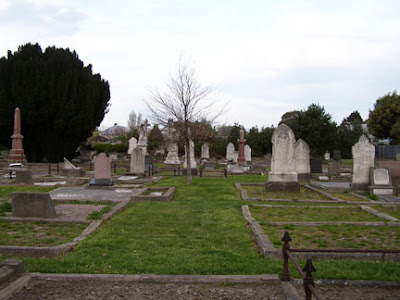
Samuel's unmarked burial plot in the Addington cemetery, Christchurch.
Posted for
Poetry Thursday