It's Thursday, and that means it's time for poetry. Or at least it does, after I spend the day at work, eat dinner, do the dishes and a pile of ironing. Thursdays are turning into a busy day. It wasn't helped by my adventures getting a cup of coffee when I got home. I put the coffee in the cup and held it under the cold tap (I make my coffee in the microwave). The water hit the coffee and shot me in the face. There was air in the pipes, because P had been working on the plumbing. After I cleaned up the coffee from my glasses, the bench, the walls, the floor, the ceiling ... then I made another cup and relaxed for a bit.
I have been reading the three books that are the finalists in this year's Montana book awards, in the poetry section. This is for books published in New Zealand in 2006. They are quite a diverse bunch. Firstly, The Goose Bath by Janet Frame. I have to confess I haven't got very far through this one. Unlike the others, it is a very fat hardback book. Janet Frame, who died three years ago, is one of New Zealand's finest fiction writers. However, although she wrote a great deal of poetry, she published very little of it in her lifetime. As the preface shows, she didn't really feel at ease with poetry, and didn't know how to edit it. She stored all her manuscripts in "the goose bath" which was the large concrete base of a fountain, previously used as a bath for geese. They were left, rather deliberately apparently, for others to edit after her death. The book will undoubtedly be the basis for a PhD thesis or two. However, the poems are often full of false starts, and seem rather raw. There are flashes of brilliant language - it would probably be a good book to dip into, but I have to return it to the library. It is possible that it will win, because of Janet's reputation, but I'm hoping it won't. Not least because there is money attached to the award, and it would be nice to see it go to a living writer.
The second book is One Shapely Thing by Dinah Hawken. This is a slimmer book and contains not only poems, but also two sections from her journals, written after 9/11 when her husband was working at the UN in New York, and in early 2002 when they were together in Geneva. I'm always a bit uneasy about published journals. I see journals as a rather private thing, where one is free to dump all sorts of things without censorship, and it seems to me that they become rather self conscious if edited (as surely they must be) for publication. The journals do however cast some light on her thought processes while she was writing the poems. That helped, because the poems didn't really grab me straight away. I thought they might, because they are often concerned with the natural world, and I usually like poets who write on those themes - Mary Oliver, for instance. Dinah's, though, seemed rather more obscure, and perhaps detached. There is a poem called "The Company of Stones" which was written to accompany an art exhibition, and published in the catalogue. I should like to have seen it there, as I think that my understanding would have been enhanced by seeing the art work that it was written for.
A number of poems were written while she occupied the Poets in Workplaces residency at the Wellington Botanic Gardens. One of my favourite poems from this section describes in its last section an oak which has fallen over and continued to grow, lying down:
We love your love of the horizontal.
We wish that we too
could fall down in a Garden,
stay fallen, and still thrive.
Perhaps with a little more time with this collection, I might grow to appreciate more of her work.
The final, and slimmest volume of the three, is The Year of the Bicycle by James Brown - so titled because it was written when he was Victoria University Writer in Residence - each weekday he cycled to work, and in the weekends he took to the hills. The blurb on the back describes them as "exuberant, intelligent poems". They certainly do not suffer from an excess of adjectives. I think I would describe them as masculine and active. They start on very matter of fact. I find myself starting a poem thinking "well, so what?". And then the poem draws me in with a witty turn at the end, adding a subtle twist to what seemed at first rather ordinary.
For instance, one poem starts:
The fact of the matter is
I was born at Palmerston North Public Hospital
at 12.40 a.m. on the first of April, 1966.
and continues through the history of the poet and the city until we read
Lots of famous people come from Palmerson North.
Alan Gregg, bass player with popular band the Mutton Birds,
was once asked if he had roots in jazz. He replied
that he had roots in Palmerston North.
I have often wanted to use that joke myself,
and last week I got the opportunity when someone asked me
where I thought I was coming from.
I come from Palmerston North. We are a modest people,
but we are fiercely proud of the bustling, go-ahead city
at the heart of the Manawatu Plains.
In sci-fi movies, people often go back in time in order to try to
change history. This is impossible. You cannot change the past.
And nobody from Palmerston North
would want to.
It was once said (if anyone can give me the source of the quote, I'd be grateful), that the word "bicycle" is not suitable ever to use in a poem. Poetry has changed since then, and there are plenty of bicycle poems in this book. Of the three, I think it is the one I'd most like to see win. I have to admit though, that I would like to see next year's batch of finalists - books published in 2007. I have several likely candidates in my collection, all better than this year's finalists - but then, this is probably about the first review I've ever been brave enough to write, and it's only one opinion. (If you click on the links given for the writers, you'll find other views.)
More poetry at Poetry Thursday
Showing posts with label Poetry Thursday. Show all posts
Showing posts with label Poetry Thursday. Show all posts
Thursday, July 05, 2007

Thursday, June 28, 2007
Poetry Thursday: About Leaves and Clouds
Lately I find myself obsessed by skies. Skies that are purest blue, or thunderous grey. Pale grey skies with just a hint of sunlight breaking through like mother of pearl. Sunsets that are flame, or coral, or salmon. Skies that are tinged green where blue meets gold. Clouds like flaked fish, or in wave-like formations. Skies that are never the same from one day to the next.
I think it's the flatness of where I live that makes the sky look so vast. Not for nothing was an anthology of Canterbury poems named Big Sky
I try to photograph the sky, but the format isn't right. Sky photographs should be long and thin, and spread right across the room, instead of being confined to a 6 inch by 4 inch frame. And then, there always seem to be buildings and electricity wires in the way.
I look, and try to remember exactly what the sky looked like, but I never do, except in very general terms. We just don't have the memory for clouds in the same way as we do for faces. There are six billion faces on earth, and the human brain is equipped to distinguish each from the others. (Although I have trouble, myself, with twins). It's just as well that we can't do this except for faces. Our brains would be so huge that our necks couldn't hold our heads up. I'm visualising cartoon figures with tiny bodies and enormous heads. Not a pretty sight.
Thinking about clouds reminded me of how a couple of years back, I was pondering similar thoughts about the shapes of leaves, and wrote this poem:
The Shapes of Leaves
Oak I know, and maple,
three or four varieties.
Chestnut, poplar, willow,
the speckled ngaio, waxy taupata,
and kowhai delicate as raindrops.
A dozen or two altogether,
maybe more.
Think of faces – of the six billion
on earth, they say, most of us
can distinguish each one
and name hundreds
Consider how each tree
bears a cast of thousands - each leaf
as individual as a face,
the tip curved more or less,
a nick, a tear, the pattern of veins
as individual as a thumbprint.
Imagine knowing each one –
think of spring, not as the return
of the familiar, but a welcome
to characters entirely new
Imagine the grief each autumn -
the farewell to countless old friends,
the showers of golden tears
*******************************
More Poetry Thursday contributions here
Thursday, June 14, 2007
Poetry Thursday: Winter
This is my first completely fulltime week juggling two jobs. It's just light when I leave, and dark by the time I come home. We have had frosts the last few mornings, so I stride out wearing a woolly hat, sheepskin gloves and a warm coat. This morning I hung laundry out before I left. The cold bit into my fingers and made them ache. When I arrived home I found that P was planning roast pork for dinner, so I baked some muffins and biscuits to take advantage of the oven being on (one of my power saving measures). After dinner it was my turn to do the dishes. Now I'm ready for bed. So I am posting an old poem from six or seven years ago which seemed appropriate as I gazed at trees in various stages of dress as I walked to work this morning. Many are completely bare. But this tree in our garden is still covered with beautiful scarlet foliage:
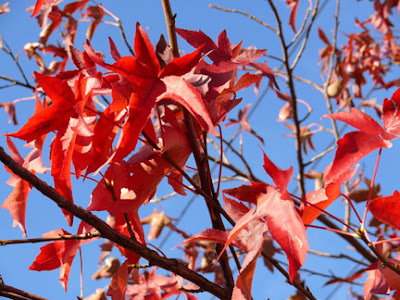
(I think it is a liquidambar, though P. claims it is a maple. But then, all the other maples have lost their leaves already).
Strangely, in the park I drive through on my way to my other job, there are newly planted cherry trees and they are all covered in blossom. But the cold tells me it is definitely winter, not spring. Definitely the time of year for warm flannel nightgowns.
Into Winter
The oak struts
across the stage of the sky
She flaunts her red garments
and tosses them at her audience
winking over her shoulder
The slender birch in the corner
slips her yellow dress from her shoulders
and climbs into bed
While the pines on the hill
keep their prickly green nightgowns
buttoned firmly up to their necks
all through the winter
**************************
More Poetry Thursday here
Thursday, June 07, 2007
Poetry Thursday: Summer Break
The ladies at Poetry Thursday are taking a summer break. This doesn't mean no Poetry Thursday, it just means no prompts, so we are free to talk about poetry in any way we wish (which we are, anyway, since all their prompts are Completely and Totally Optional).
It seems a bit strange to be having a summer break in winter. But then, our winter has been a bit strange so far - remarkably warm. In Christchurch it was six and a half degrees (Celsius degrees, which are almost twice as big as Fahrenheit degrees) warmer on the first day of winter than on the first day of summer. In summer there was Antarctic melt water coming up the coast, and bits of icebergs floating by. So perhaps global warming will mean cold summers for New Zealand. I hope not - I hope last summer was an aberration.
Back to poetry. The Montana New Zealand Book Award nominations have been announced - this is New Zealand's major book award. There are three books in the poetry category, and three in the "best first book - poetry" category. So I decided to borrow them all from the library and see what I thought. It just goes to show how popular poetry is (or isn't) that I was able to get all three nominated books in the poetry category straight off the shelves, without placing a request.
The books are "The Goose Bath" by Janet Frame, "The Year of the Bicycle" by James Brown and "One Shapely Thing" by Dinah Hawken. By next week I may have read enough to give an opinion on them. The awards are for books published in 2006, and judging by two poetry books that I have bought this year, I suspect that 2007 is going to be a better year for New Zealand poetry. We'll see.
In the meantime, the James Brown book reminded me of a workshop our small poetry group arranged with James Brown a few years back, when he was Writer in Residence at the local university.
One of the things we talked about was list poems. I can't actually recall any titles or authors of the examples he gave - I do remember one was a very moving list of "things found on a roof" written shortly after the events September 11. He had us write lists, and then we each contributed one item from our list to a sort of group "pool", after which we wrote poems containing some or all of these items.
The items I used were, as I recall, Wellington, a ginger cat, white curtains and the book "Everything You Wanted to Know about Sex but were Afraid to Ask".
Here is the poem, which relates to a trip I made back to Wellington, the city where I was born and grew up (and where Peter Jackson's film studio is located):
The Whole Story
“Remember the house in the bay” she asks,
“the only one with any flat land?
Peter Jackson bought it. Sometimes he lands a helicopter there.”
I know the one. It’s across the road from the beach
where we used to keep our red dinghy.
I’ll walk round the bays and take a look,
maybe I’ll stop at the dairy and buy an Eskimo Pie.
The cottages nestled against the cliff haven’t changed,
except for new paint, and the four wheel drives outside.
A curtain flaps at a window. On the sill a ginger cat sleeps
beside a book that offers “All You Ever Wanted”.
I reach the dairy. It’s now a café crowded with people.
I turn back. A jogger pounds the sand.
My sister says she once saw Michael J. Fox there,
but it’s only an anonymous short man.
Back at the open window I find the cat has jumped down
into the nasturtiums. Now I can see the whole story:
“To Know About Sex But Were Too Afraid to Ask”.
Thursday, May 31, 2007
Poetry Thursday: Rivers
This is more or less the first poem I wrote, that is, the first poem I was satisfied with from the first poetry workshop I attended as an adult - I'm not counting poems from my childhood and teenage years. (There was a long gap after that while I played at being a scientist and then a stay at home mother).
We had three prompts which I combined in one poem: "drought", "river" and "ice". Since the Poetry Thursday prompt for this week was "rivers", I thought I would share this one.
Drought
Here where the winter rain
froze in the cracks
and pushed until the rocks
came tumbling down
Here where the spring swollen river
with the strength of young love
swept me off my feet
and I fell into the cold, sharp shock
Here now the river has grown old
lies shrunken in a stony bed
the grasses withered on the banks
and the rocks feverish in the hot sun.
****************************
More river poetry here
Wednesday, May 30, 2007
Life Lines
Over at Poetry Thursday, Jim Brock has invited us to share lines of poetry that are particularly meaningful for us. In Jim's words:
lines, by a poet that stayed with you, that you could not let go for the life of you, and then in a paragraph (or two), describe a moment when these words arose in your life in which they brought you understanding, insight, solace, reconciliation, or comfort.
To me, reading this, I felt we were being asked to share not just favourite lines, but lines that whether literally or figuratively, saved our lives. And at first, I couldn't think of anything. I didn't feel that poetry had affected me that much. I've had a comfortable life, after all. I'm a fairly level sort of person. I can balance a cheque book, come up with a rational explanation for most things, and a practical approach to most problems. I was bullied somewhat in primary school, (being a bit nerdy), but I remember my family and my childhood as happy. I think of myself, I realised, as one of those egg-shaped childrens toys with the weighted base, that wobbles when pushed but never falls over.
I have always had enough to eat, a roof over my head, access to medical care when I needed it, books and education. I've been married to the same man for (gulp - is it really that long?) thirty five years. Our children still like us, as far as I can tell.
And then, if I do have difficult emotions to deal with, I don't turn to poetry for solace. When I was younger my approach to crisis was to sleep a lot. More recently, I find the most effective way of getting through is vigourous uphill walks.
Thinking about this, I realised that it's my lack of needing to be saved that poetry has saved me from. My ordinary, steady life. Poetry has taught me to look for the beauty and wonder in things. And the strength, and the power, and to listen to my emotions even when they talk in whispers, and go underground after an hour or so in the spotlight. Poetry reminds me to be human.
As for the lines that stick with me, I can't say why exactly. But here they are:
I married the way moths marry
I married hard
by Olena Kalytiak Davis, from a poem called "In Defense of Marriage"
(I found this poem on the wonderful Poetry Daily website, a few years back, but unfortunately as they only archive the poems for a year, it's not online any more. I believe it can be found in her book titled "And Her Soul out of Nothing".)
For more life lines click here
Thursday, May 24, 2007
Poetry Thursday: Writing About the Past
Since my poetry group are beginning to talk seriously about our next book, I decided to go through my files and print out all the poems that I might potentially include, with a view to editing them and arranging them in an appropriate order. It's interesting to see what topics and themes tend to recur in my writing. I'm thinking that one way of organzing most of my poems would be chronological - not the order in which I wrote them, but the order of the subject matter.
There are poems that stem from my interest in genealogy, and which are either about my ancestors, or about imaginary ancestors. There are others that arise from incidents in my childhood, or from my own children, either when they were very small, or when they were older. Then there are more immediate poems, often about places I have been orienteering, or the hills close to home that I explore on foot. And some are harder to classify, being a mix of recent observations, the beauty of certain words, all sorts of trivia floating around in my head, and a dose of imagination.
Early on in my poetry writing career, I submitted several poems to a certain literary magazine. The rejection letter that came back told me, among other things, that beginning poets often write poems based on nostalgia, but "I prefer the here and now". This set me wondering about the here and now. What is it? If I walk in the hills, and think about what I've seen, and then write about it that evening or the next day, it's not "here and now" any more. It may be the recent past, but it's past. If I sit in a coffee shop, and write about what is in front of me, by the time the words are on paper it is past - even if it's only five seconds. So, everything is about the past. And at the same time, everything is about the here and now - what is here and now in my brain. Any poem is the world filtered through the mind of the writer, and the mind contains it all in the here and now, though it has been gathered up in the past.
Even the words we use were learnt in the past. One of the poems that was rejected was apparently "nostalgic" because it bore the title "What my Science Teacher Told Me". Well, it included a bit of scientific information I had learnt in high school, but it was actually about my thoughts on relationships as I was experiencing them at that time. Our brains like to mix everything up!
This poem, for instance - is it about the past or not? My greatgrandfather is clearly in the past, but the poem is about the experience of looking for the spot where he was buried, which was very recent when I wrote it.
Looking for Samuel
Samuel Arthur Wiltshire 1861 – 1905
I count down rows, across plots
to the number in the cemetery book,
a missing tooth in a jaw full
of crooked gravestones.
What did I think I would find?
I tried to tie an anchor around your neck.
Forgive me. There is nothing to keep you here
No concrete slab to roof you over, keep the rain
from you. No yew tree sending down its roots
to prise your femur from your pelvis,
nor flesh-nourished rosemary
carrying its aroma across town
on the nor-wester. May your bones rest.
Your hollow sockets gaze at nothing
but earth and sky. The rain has long since
dissolved your flesh, trickled rich and brown
through aquifers to creeks and streams.
Old sailor, you mingle with rivers
and return on the ebbing tide
to the sea,
to the sea
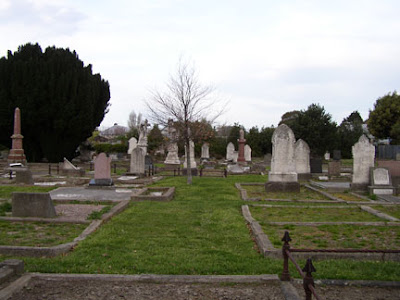
Samuel's unmarked burial plot in the Addington cemetery, Christchurch.
Posted for Poetry Thursday
There are poems that stem from my interest in genealogy, and which are either about my ancestors, or about imaginary ancestors. There are others that arise from incidents in my childhood, or from my own children, either when they were very small, or when they were older. Then there are more immediate poems, often about places I have been orienteering, or the hills close to home that I explore on foot. And some are harder to classify, being a mix of recent observations, the beauty of certain words, all sorts of trivia floating around in my head, and a dose of imagination.
Early on in my poetry writing career, I submitted several poems to a certain literary magazine. The rejection letter that came back told me, among other things, that beginning poets often write poems based on nostalgia, but "I prefer the here and now". This set me wondering about the here and now. What is it? If I walk in the hills, and think about what I've seen, and then write about it that evening or the next day, it's not "here and now" any more. It may be the recent past, but it's past. If I sit in a coffee shop, and write about what is in front of me, by the time the words are on paper it is past - even if it's only five seconds. So, everything is about the past. And at the same time, everything is about the here and now - what is here and now in my brain. Any poem is the world filtered through the mind of the writer, and the mind contains it all in the here and now, though it has been gathered up in the past.
Even the words we use were learnt in the past. One of the poems that was rejected was apparently "nostalgic" because it bore the title "What my Science Teacher Told Me". Well, it included a bit of scientific information I had learnt in high school, but it was actually about my thoughts on relationships as I was experiencing them at that time. Our brains like to mix everything up!
This poem, for instance - is it about the past or not? My greatgrandfather is clearly in the past, but the poem is about the experience of looking for the spot where he was buried, which was very recent when I wrote it.
Looking for Samuel
Samuel Arthur Wiltshire 1861 – 1905
I count down rows, across plots
to the number in the cemetery book,
a missing tooth in a jaw full
of crooked gravestones.
What did I think I would find?
I tried to tie an anchor around your neck.
Forgive me. There is nothing to keep you here
No concrete slab to roof you over, keep the rain
from you. No yew tree sending down its roots
to prise your femur from your pelvis,
nor flesh-nourished rosemary
carrying its aroma across town
on the nor-wester. May your bones rest.
Your hollow sockets gaze at nothing
but earth and sky. The rain has long since
dissolved your flesh, trickled rich and brown
through aquifers to creeks and streams.
Old sailor, you mingle with rivers
and return on the ebbing tide
to the sea,
to the sea

Samuel's unmarked burial plot in the Addington cemetery, Christchurch.
Posted for Poetry Thursday
Thursday, May 10, 2007
Random Acts of Poetry
It's Thursday again! And now that NaPoWriMo has finished, and my second part time job has also finished, I have some free time to get things done. Which means that I am getting nothing done. I guess I can forgive myself for a week of zoning out.
However, among my e-mail was Eric Maisel's "Creativity Newletter". In it he suggests an interesting exercise: "take your medicine". In other words, treat your writing as if it's medicine - not that it's something nasty, but schedule it four times a day - fifteen minutes at 8 am, noon, 4 pm and 8 pm. Once I would have said "I can't write four times a day". NaPoWriMo has taught me that it's easier than you think to sit down and write. And fifteen minutes is not that much. It's possible to write for fifteen minutes in my lunch break, on days when I'm at work - and if I'm working, or driving, at 4 o'clock, well, I can do it when I get home, and again in the evening before bed.
Not that I have written four times a day, but I'm beginning to recognize that it's possible. I've been writing in the morning, mostly my CV and job applications. I've been writing at lunchtime, and this is when the Poetry Thursday randomizer is just what I need. I can't work on editing my poems, because I like to read them aloud when I do that. And I can't work on my family history, because I need all my research material at hand. But I can noodle around and brainstorm for ideas, and that's what I've been doing.
On Sunday I was orienteering, and this is the poem that resulted, using one of Poetry Thursday's random prompts "copper". I wanted to put a Common Copper Butterfly into the poem, but I had to admit that there weren't any. I managed to sneak the word in, anyway.
Running in the Alps
There is nothing spectacular here
except the mountains, which surround
this level basin where we run
in all directions through the pines.
The ground is carpeted with small
unnamed plants – mosses, lichens,
shrubs so low they form a thin cushion
that supports our steps. In the clearings
the fine seedheads of grasses a foot high
gleam copper and gold in the autumn sun.
We make tracks through them, believing
they will spring up again at the next rain.
But I avoid treading on the white flowers
scattered like stars in constellations
among the flat scrub. Tiny flies and midges
dance in the cool still air, and there is no sound
except footsteps and distant cicadas.
My brother once employed a man
who left out little unimportant words
like “not”, when writing his reports.
Let me never assume I know
which are tiny unimportant things.

Thursday, May 03, 2007
A Month of Poems
It was an interesting month. As I squeezed in time to write the daily poem, I contemplated the necessity of being away from the world, and the necessity of being in the world.
I started the day with the prompt in my head, wondering what I would write. Often, I wrote and posted in the morning before work. Sometimes, I set off with the day's prompt in my mind, still wondering what shape my poem would take. And coincidences abounded. On the day that the prompt was "spiral" I was startled by a flock of white gulls spiralling and wheeling in the park. On the day that the prompt was "glass" I went to hear a quilter speak, in a modern building whose facade is a river of glass.
Of course, these are not really coincidences. It's just that starting with a word in my head focussed my attention, so that I was more likely to notice incidences in the world. (And if I didn't, well, there is an even bigger world - the world of memory, of all that I have seen and read. The scope of my poetry expanded enormously due to the influence of the prompts).

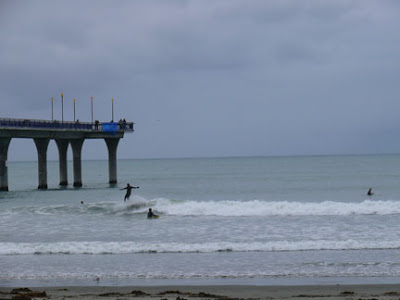
Last Saturday I had lunch in a restaurant overlooking the Pacific Ocean, with a bunch of other writers and artists. We were celebrating the 60th issue of Takahe magazine. I looked out into the branches of a huge macrocarpa tree, and out another window over a beach and sand dunes stretching away into the distance north and south, a pier heading out west towards South America, a hardy bunch of surfers braving the cold autumn waves, a dog running in circles on the sand. The prompt for the day was "circles".
In the morning, I had been to the Arts Centre where Jeanette de Nicolis Meyer was having an open studio. She had been the artist in residence for the past month. There's that period of a month, again. I was mindful of those I had heard of, who had given up work to write a novel, and then spent long periods not writing. I asked her what it was like to have a month of nothing to do but work. She loved it, she said. She would stop work at 11.30 at night, not wanting to stop because of all the ideas buzzing in her head. But yes, she had four days at the beginning when nothing seemed to work, when she didn't have the right supplies, when all sorts of things seemed to combine to frustrate her. The key was to regard it not as a time to produce finished work, but as a time to explore ideas. And the results on the wall certainly suggested she had many ideas to explore.
Much of her work was based on bubble chamber images of the tracks of subatomic particles - full of lines and circles. Ernest Rutherford had once worked in the same building, and she had visited "Rutherford's Den". Those circles almost made it into my poem for the day, but in the end the dog running in circles on the sand won out.
I think I experienced the month in the same way - a chance to try out all sorts of ideas. Some of the poems I will let quietly sink into oblivion. Others I will print out, read aloud, and read aloud again, so that my ear can tell me where the clunky bits are, and my heart and mind can tell me whether I said what I wanted to say. Then, hopefully, I will revise them till I am satisfied, and send them out into the world for possible publication.
And I hope I will put into practice what I have learned - first to take myself apart from the world and write. And then to take myself into the world with new eyes, and notice things. And then to repeat the cycle. Oh, and I learnt that most of the time it has taken me to write one poem in the past has actually been all the drama of not writing the poem - of planning to write the poem. How much simpler to just get on with it!
I haven't written a poem since the end of the month, but it didn't seem like Poetry Thursday without one. So I'm including an older poem - not necessarily one that I consider among my finest, but it fits the season. Our dwarf maple by the pond is startlingly coloured, almost fluorescent, at this time of hear, and I found myself wondering what someone would make of it who had never seen autumn before.
But first, I'd like to invite you to come back on Saturday when I will be hosting Eric Maisel on his blogtour. This is an interesting way to promote a book without all the time, expense, and ozone depletion associated with the travel of a traditional book tour. Eric's book is "Ten Zen Seconds", an interesting book on a simple technique for calming anxieties and increasing focus. It will be useful not just to creative people (his usual target audience) but to anyone. I asked Eric several questions, but the whole tour is seven weeks, so it would be well worth visiting some of the other blogs to see what other hosts have asked him. Find the site for the book, along with the schedule for the blogtour, here. I'll be putting my post up on Saturday evening, New Zealand time, so that it will be early Saturday morning in the US, thus fitting in with both my calendar and Eric's.
And finally, today's poem:
The Amnesiac Discovers Autumn
It isn’t death that surprises him.
Though larger losses
- a parent, a loved pet,
even the dead bird on the garden path
- have slipped beyond
the myopic horizon of his memory
impermanence has its daily reminders.
Shrivelled flowers in the vase,
the spreading brown spot on an apple,
an upturned fly on the window sill.
No, it’s not the way the leaves
turn brown and slip to the ground
that startles him,
it’s the late afternoon
when the maple leaves
turn tangerine and magenta
and melt into the sky,
becoming pure light.
I started the day with the prompt in my head, wondering what I would write. Often, I wrote and posted in the morning before work. Sometimes, I set off with the day's prompt in my mind, still wondering what shape my poem would take. And coincidences abounded. On the day that the prompt was "spiral" I was startled by a flock of white gulls spiralling and wheeling in the park. On the day that the prompt was "glass" I went to hear a quilter speak, in a modern building whose facade is a river of glass.
Of course, these are not really coincidences. It's just that starting with a word in my head focussed my attention, so that I was more likely to notice incidences in the world. (And if I didn't, well, there is an even bigger world - the world of memory, of all that I have seen and read. The scope of my poetry expanded enormously due to the influence of the prompts).

Last Saturday I had lunch in a restaurant overlooking the Pacific Ocean, with a bunch of other writers and artists. We were celebrating the 60th issue of Takahe magazine. I looked out into the branches of a huge macrocarpa tree, and out another window over a beach and sand dunes stretching away into the distance north and south, a pier heading out west towards South America, a hardy bunch of surfers braving the cold autumn waves, a dog running in circles on the sand. The prompt for the day was "circles".

In the morning, I had been to the Arts Centre where Jeanette de Nicolis Meyer was having an open studio. She had been the artist in residence for the past month. There's that period of a month, again. I was mindful of those I had heard of, who had given up work to write a novel, and then spent long periods not writing. I asked her what it was like to have a month of nothing to do but work. She loved it, she said. She would stop work at 11.30 at night, not wanting to stop because of all the ideas buzzing in her head. But yes, she had four days at the beginning when nothing seemed to work, when she didn't have the right supplies, when all sorts of things seemed to combine to frustrate her. The key was to regard it not as a time to produce finished work, but as a time to explore ideas. And the results on the wall certainly suggested she had many ideas to explore.
Much of her work was based on bubble chamber images of the tracks of subatomic particles - full of lines and circles. Ernest Rutherford had once worked in the same building, and she had visited "Rutherford's Den". Those circles almost made it into my poem for the day, but in the end the dog running in circles on the sand won out.
I think I experienced the month in the same way - a chance to try out all sorts of ideas. Some of the poems I will let quietly sink into oblivion. Others I will print out, read aloud, and read aloud again, so that my ear can tell me where the clunky bits are, and my heart and mind can tell me whether I said what I wanted to say. Then, hopefully, I will revise them till I am satisfied, and send them out into the world for possible publication.
And I hope I will put into practice what I have learned - first to take myself apart from the world and write. And then to take myself into the world with new eyes, and notice things. And then to repeat the cycle. Oh, and I learnt that most of the time it has taken me to write one poem in the past has actually been all the drama of not writing the poem - of planning to write the poem. How much simpler to just get on with it!
I haven't written a poem since the end of the month, but it didn't seem like Poetry Thursday without one. So I'm including an older poem - not necessarily one that I consider among my finest, but it fits the season. Our dwarf maple by the pond is startlingly coloured, almost fluorescent, at this time of hear, and I found myself wondering what someone would make of it who had never seen autumn before.
But first, I'd like to invite you to come back on Saturday when I will be hosting Eric Maisel on his blogtour. This is an interesting way to promote a book without all the time, expense, and ozone depletion associated with the travel of a traditional book tour. Eric's book is "Ten Zen Seconds", an interesting book on a simple technique for calming anxieties and increasing focus. It will be useful not just to creative people (his usual target audience) but to anyone. I asked Eric several questions, but the whole tour is seven weeks, so it would be well worth visiting some of the other blogs to see what other hosts have asked him. Find the site for the book, along with the schedule for the blogtour, here. I'll be putting my post up on Saturday evening, New Zealand time, so that it will be early Saturday morning in the US, thus fitting in with both my calendar and Eric's.
And finally, today's poem:
The Amnesiac Discovers Autumn
It isn’t death that surprises him.
Though larger losses
- a parent, a loved pet,
even the dead bird on the garden path
- have slipped beyond
the myopic horizon of his memory
impermanence has its daily reminders.
Shrivelled flowers in the vase,
the spreading brown spot on an apple,
an upturned fly on the window sill.
No, it’s not the way the leaves
turn brown and slip to the ground
that startles him,
it’s the late afternoon
when the maple leaves
turn tangerine and magenta
and melt into the sky,
becoming pure light.
Thursday, April 26, 2007
Poetry Thursday, and NaPoWriMo #24
Today I decided to combine the daily prompt "blaze" with the weekly prompt which was to write a villanelle - OK, the daily prompt is for Wednesday but it is Thursday already in this neck of the woods.
When I try and rhyme, it tends to come out not too serious. And I am just about poemed out with NaPoWriMo, so I decided to stick my tongue firmly in my cheek and have some fun. Jessica suggested that villanelles tend to be about obsession. This one certainly is - and the narrator is definitely not me, I'm not that shallow (I hope!). I've been a bit free with the rules about repeating whole lines, and instead have varied them a bit while keeping the ending of the repeating lines the same.
A Villanelle
I don't ask much, just set my heart ablaze
send flowers, chocolates, tell me you'll be mine
for all of time, oh, shower me with praise
My heart beat faster when I caught your gaze
Your rugged looks, your nose so aquiline,
your sculptured muscles set my heart ablaze.
I've waited by the phone for days and days
I think, although I've lost my sense of time
I long to hear your voice, your showers of praise
I lie about the house in fevered haze
can't eat or sleep, can only write bad rhymes
Surely you know you've set my heart ablaze
She's wrong for you in oh so many ways
You have my number, leave her now, be mine
for what you said I'm sure was full of praise
I'm waiting for the phone to ring, the door to chime
I know you want me, tell me you'll be mine
for all of time, oh shower me with praise
Is it too much to set my heart ablaze?
********
For more villanelles and other poems, visit Poetry Thursday
Thursday, March 29, 2007
Poetry Thursday: More Image Inspired Poetry
I seem to have jumped the gun on the Poetry Thursday prompt. Last week we were asked to write poems inspired by images, and I posted a poem inspired by a Picasso painting. This week we were asked to take it one step further, and try a poem based on a painting - perhaps specifically from the point of view of the model or the painter - what were they thinking? Since that's what I did last week, this week I am posting the poem that was my alternate choice for last week's prompt.
I am happy to say that I was talking to the poetry editor of Takahe magazine at a poetry reading last night, and asked him about his definition of "previously unpublished". I've now established that it's OK for me to submit poems that have been on my blog. Some journals won't accept them. Since Takahe is the only literary journal that has ever published my poems, I now know I can post my poems here and still have at least one possible place to submit them. (Being on the staff probably helps - I do the accounts).
This poem was inspired by a number of things I saw in one particular week. I thought the fence photo showed the name of the fence strainers, but when I checked it didn't show up. Strainrite is the brand name.

(Poem taken down for publication reasons)

Thursday, February 15, 2007
Poetry Thursday: Prose Poems
I've had a busy week so I was glad of the prompt which enabled me to post an old poem from my files. If it is a poem. What makes a prose poem?
I don't think I can answer this, but I believe that it is not really a question that is specific to prose poetry. The question "is it a poem?" is the same question whether it is a piece of writing that has rhyme and metre, or has line breaks, some sort of metre but no rhyme, or whether it is set out in prose (or any variant in between these).
Is it poetry, verse or a jingle?
Is it poetry, or a political statement with line breaks?
Is it poetry or just a rather strange piece of prose?
I don't know.
The first time I found out there was such a thing as a "prose poem" was at the first every poetry workshop I attended. I was browsing a collection of poetry books that were available for our inspiration, and came across the work of Charles Simic. His prose poems are delightfully surreal. I hope you might consider exploring them. In the meantime, here is my own contribution:
Six Blind Men and an Elephant
This is a joke my children used to tell. They would pick some unsuspecting person and ask “I’ve got a riddle for you. What is the difference between an elephant and a hammerfor?” They were just waiting for the question “What’s a hammerfor?” and then they could say “Banging nails in”. We know this joke pretty well by now, so the other day when my daughter asked “what’s a hammerfor?” I said “Banging nails in” almost without thinking and then she asked “what’s a metaphor?” Of course the thing about a metaphor is that it’s really only useful if we know both the things being compared. So I might say for instance that a book is a magic carpet that takes us to other worlds. You know, and I know, dozens of ways that a book is not at all like a magic carpet and that’s why we can appreciate the point of the comparison. And then there’s the old story about six blind men and an elephant. One of them felt the trunk and said it was like a snake. Another had a hold of the tail. “An elephant is very much like a rope” he said. A third, grasping the leg, declared that the elephant was like a tree. And so on. But anyone who hasn’t seen an elephant is left with the image of a snake in a tree which has a rope hanging from one branch, which really doesn’t help much at all. So when I learnt that atoms have nuclei with orbiting electrons, I thought of planetary systems and believed I knew what was going on. Then I learnt that light is particles, called photons, which made some sort of sense, until I learnt about light waves. So which is it, particles or waves? Both, and neither, depending on the mathematics, and that’s when physics started to get confusing. Somewhere around Stage 2 I was completely lost, which is to say, I could do the maths and come up with the right answers, but I just couldn’t picture it any more. That was pretty scary, because up till then I thought I could get a handle on just about anything. And somewhere in the years between then and now, the physicists stopped talking about waves and particles and started talking about tiny strings curled up in about ten or thirteen directions. Now, when I think of Einstein saying “God does not play dice with the universe”, all I can picture is God playing Cat’s Cradle.
Subscribe to:
Posts (Atom)