Pages

Friday, July 02, 2010

Frost, and Making Things


The first of the month came, and I turned the page of my wall calendar both at home and at work. It's that time of the year when the makers of scenic calendars seem to feel the urge to use photos appropriate to the season. The trouble is that New Zealand houses tend to be hard to keep warm, and when I am wrapping up to stop from turning blue the last thing I want is to gaze at a scene of frozen mountains, bare trees and icy rivers.

Next year I need to plan to swap calendars with someone in the Northern Hemisphere, so that in winter I can gaze at Greek Islands, or fields in Provence, or some of Di's wonderful photos of Turkey, or Italy.

My family history writing fizzled out about halfway through June. Without the incentive of an internet site to post to, it's harder to commit to writing every single day. But I still got a sizeable chunk done.

This month, I feel the urge to make things. I haven't indulged in craft for a long time. I have some half finished quilting and knitting projects that probably need a lot more than a month to finish up. I will probably work on one or two, but I am also on the lookout for small projects that I can make in a spare hour or two.

Yesterday, I made one of these small origami books. (I will take photos over the weekend, when I'm at home in the hours of daylight). My version was very simple, with pages of gradated origami paper in shades of green. But I find myself thinking about all the possibilities of stamping the paper, colour washing it, printing it on the computer before I fold it. And i'm trying to work out, if I wrote a poem in one of these books, should I do it before or after I fold the paper, and how would it progress across the pages. Would it twist and turn? If I wrote stanzas onto the pages before folding, how would they rearrange themselves when I assembled the book?

For more detail photos of the book, go here and scroll about halfway down the page.

(The photo at the top of this post is a very frosty pile of leaves by the path outside my house this morning).

Saturday, June 26, 2010

Fighting the Winter Blahs

I can't remember a winter when we've had so much rain going on for so long. Christchurch, after all, is on the supposedly drier east side of the island. I really felt in need of a pick me up. The first step was to ask myself on Friday night, what do I need to get done so that I'll feel as if I have time to go out at the weekend? (And of course, to do it. Little tasks that have been hanging round for a while. It takes more time, I discover when I actually do them, to avoid them than to get them done).

But Saturday dawned grey, drizzly and gloomy. Yet again. Not a day for photographing open air markets or walking in parks. So, I set out to the pharmacy to pick up some repeat prescriptions, then followed my whims:


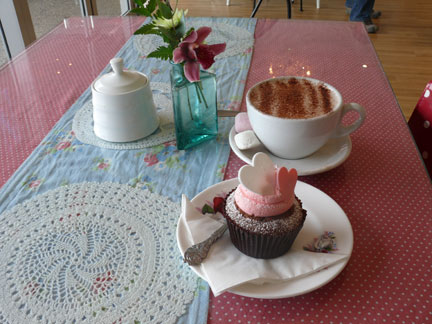
I've been wanting to photograph the interior of the Cupcake Collection for some time. I'm not normally a pretty pink and blue person, but for some reason this china appeals to me. I think it reminds me of my grandma.


Of course, I had to buy something to justify being in there taking photos. (Such hardship!)


And then I browsed in a fabric shop, and looked at patterns, but without finding what I wanted - and in a yarn shop with the same result. I remembered I had been meaning to visit Penny Lane records for quite a while.


I've bought some really cheap second hand CDs. I haven't tried them yet, I wonder what the quality will be like?


This part of Colombo St in Sydenham is interesting, there are quite a few run down, boarded up shops, but the shops that are still there are varied bunch - not the endless "same again" repetition of shops found in malls. Some are of the cheap second hand variety, and some are specialist shops, surprisingly smart and up market looking - like Dance Pacific, which always draws my eye with its collection of ballet costumes, mostly in little girl sizes.

Friday, June 25, 2010

The Process of Change

OK, I haven't been posting much lately. But I was a little surprised to receive my traffic report last week and find my visitor numbers had gone way, way down. And then this week, my report told me I had none. All week. Which was very strange since I had at least one comment.

Then I twigged. It all happened after I upgraded my blog to the "new" (probably a couple of years old by now) functionality. In the process, my site meter had disappeared from the blog. I guess it can't count my visitors if the code isn't there. So I retrieved the "template" I had saved as suggested by blogger, only to find that it didn't seem to include the bits and pieces I had added in, and it was in xml instead of html. Fortunately it turned out I had copied and saved the old html code as well - in other words, don't rely on blogger to save your blog, do it manually. I have retrieved the bit of code and pasted it back. Although blogger insists I have a title to this bit of html. I'm not sure why. I don't really think the little icon needs to be headed "site meter".

And at the same time, at work, we are trying to get to grips with a new computer system which is, as yet, half baked. I can't help thinking that if architects built houses the same way as computer systems are designed we would have some pretty terrible houses.

It's as if someone went out and found a house that was fairly close to what was needed. It just needs a few add ons which the builder will fix. Except that those two or three extra rooms we need? Well, there's no room for them where it would be logical to put them. So they will have to be at the bottom of the garden, over a gully, with a strange maze of overhead walkways to connect them to the main house. Oh, and once you use one of those walkways, suddenly it will reconfigure itself, so you can't use the same doorways again, you will have to do something different. At least, I think that's what's going on.

We are expected to go live with this system in a few days, but it's just not going to happen. It doesn't help that the software designers are in another town, and the head office system that we are supposed to be integrating with is in a third town.

No doubt we will get there in the end.

Saturday, June 12, 2010

Always Start with a Photo


I have been reading Blogging for Bliss after finding it in our library's monthly list of new books (and going on a fairly long waiting list to borrow a copy). One of the bits of advice that I came across was to start every post with a photo, even if it didn't relate to the content of the post. Hmmmm. I have to say that many of the blogs I read and enjoy don't have photos at all. And others have brilliant photos (for instance the wonderful Di Mackey, who is, after all, a photographer by trade.)

The book has an excuse, I suppose, for offering this piece of advice (I think it came from one of the interviewees rather than the author herself). It's aimed at crafters and visual artists, so the readership for their blogs is probably rather visually oriented. Anyway, I do have a photo to offer today. It's that time of year when I don't get too many opportunities to take photos, as I leave for work in the morning just as it gets light and arrive home just after dark. Thankfully, we are nearly at the solstice, and then the days will gradually get longer. The photo above is my offering for Carmi's Thematic Photographic. His theme this week, appropriately, is lit-up night scenes. This one was taken at about this time last year, on an evening when I was heading for Joanna Preston's book launch. I didn't have enough time to go home after work, but did have some free time before the event, so I was dawdling and taking photos as I went.

My family history (see previous post) has reached 5,500 words. I don't think it is going to get beyond ten thousand at the very most. It will still be a full length book by the time I've padded it out with photos and appendices full of genealogical charts. And as I write it, I realise that I need to do a lot of fact-checking. Which is good, because the research is the part that I love the most.

Tomorrow at 6 a.m. England play their first match in the FIFA World Cup. I may get up early - not to watch, but because one of the big genealogy websites is making access to their records free every time England has a game. It's just a pity that most of them are in the middle of the night, New Zealand time. Or 6 a.m on Saturday or Sunday which is definitely sleep-in territory for me, in the usual order of things.

Oh and you may notice I have upgraded my blog at last. Now I can see who my followers are. And some of the things I had in my sidebar have vanished, though I've saved a copy. I fiddled with the old template the hard way, with html. I'm not sure how to put things back the new, "easy" way. But I have corrected some links, and added some more. If you have disappeared, sorry. I'll make further adjustments bit by bit.

Monday, June 07, 2010

Local Genealogy Writing Month

It's been longer than I intended since I last posted here, partly because I have been immersed in writing up the history of my mother's family. I decided that the format of NaPoWriMo worked well for me. And it was a bit of a shock to realise that the year was almost half over, and I hadn't really done anything about any of the projects on my list for the year. So I decided to tackle them in the same way - make a concentrated effort, every day for a month.

I have a very large unwieldy file on my father's ancestors. It's a bit overwhelming, so it was easier to tackle my mother's first. A couple of them were in the Navy (that's how my great grandfather got to New Zealand). I'm discovering small tit bits such as the fact that the ship my great great grandfather served on in the Russian War was commanded by one Edward Tennyson d'Eyncourt, the first cousin of Alfred Lord Tennyson. (The war is now known as the Crimean War, though he served in the Baltic, not the Crimea which is in the Black Sea).
I have new respect for those who tackle National Novel Writing Month. Fifty thousand words in a day is a big ask - there was only one day when I managed even 1000, but then, there are lots of pauses for finding notes, fact checking etc.

I'm thinking of using alternate months to tackle a project in a concentrated way, and use the in between months for more varied bits and pieces. It's not that the writing fills my day exactly, but it fills my head and doesn't leave a lot of room for anything more complicated than laundry, after my day job.

In other news, our small poetry group's book looks as if it may be finally on the way towards layout for publication.

Sunday, May 23, 2010

Big Tent Poetry: A Wordle Prompt

I was sad that Readwritepoem wound up at the end of April. But there are always bloggers to carry on the good work. Among the ventures set up to carry on where Readwritepoem left off is Big Tent Poetry.

I didn't jump right on to the horse to ride bareback round the ring - after writing a poem a day in April, I needed a break. But I love Wordles, and the words given for their third weekly prompt were calling to me, so, a day late, here is my rough draft.

Weaving the Nets

The women sit on the shore knotting their nets.
Each rope is a journey, a cord spun
by their fathers' forefathers,
their mothers' foremothers
as they travelled the world.
The nets are the pattern
that ties us all together
since we were first sapient,
since we came out of Africa.
The men are of water. They came
in their galleys and longboats.
The women are of the earth. Do not think
they were weak, when they were bedded
in a pile of straw, or a forest clearing,
a richly caparisoned horse tethered nearby.
When they fell for the merchant with his rich purse,
the young man with the smooth tongue
who doffed his cap in passing, they were not conquered.
They bend, but they do not crumple
nor capitulate. Their hands are as old and knotted
as the nets they make, while they sing
the fierce song of the generations.
They fondle the ropes, tie another knot.
It is futile to resist the making of the net.
Your dark-skinned sister no glitch in the DNA,
but the proof of an ancient tincture in the blood,
a connection over the waters
and over the centuries.

*****

I think I fitted in all the words, though some may well come out again in the editing.
fondle, purse, crumple, proof, sapient, tincture, pattern, doff, futile, capitulate, glitch, caparison

For more poems using these words, go here

Saturday, May 22, 2010

Free Stuff

I don't buy lottery tickets. I've been known to enter contests offering a free trip to the other side of the world, without any success to date. But in the last year or so I've found out how to enter competitions, and win things, which gives me a great deal of pleasure.

The secret is to aim for the small things. A contest offering a trip to the UK will attract very many entries and generally only offer one prize. But a number of local magazines and newspapers seem to have frequent offers of smaller goodies, often in multiples - for instance, the New Zealand Listener will often offer movie tickets, with fifty double passes in each of three main centres on offer.

I prefer the prize draws that allow on line or e-mail entry, so that it costs me nothing at all to enter. I have received free movie tickets, twice, a Craig Potton handbag sized diary, a free ticket on a Lyttleton harbour cruise, and $200 worth of book vouchers. The entry for the book vouchers cost me a stamp, but all the rest were online entries.

On Thursday night I made use of a voucher I had won for a local Indian restaurant. I had to do a bit more than send an e-mail for this one - it was won in a local radio station's daily trivia contest - though I didn't have to do much. We listen at my workplace, and when I gave the answer, my boss placed the phone call for me, and his wife picked up the voucher in her lunch hour! (They are good people!)

It turned out that the voucher covered about half the cost of a meal for two, given that we had entrees (which in New Zealand is not the main course, it is what you have before the main course), and drinks, and pappadoms on the side. If we had had takeaways instead it would have covered the full cost of two mains.

I haven't been out to dinner in ages, so it was a very pleasant treat.

Though maybe one day I'll win that big trip, and that will be even better!

Wednesday, May 05, 2010

A Few Poetry Things

Performance poet Charlie Dark in New Zealand - video clip here. (It's about seven and a half minutes and comes with an energy efficiency ad before and after, only brief though)

Best New Zealand Poems 2009 here. This has been up for a few weeks, but the NaPoWriMo madness meant I didn't get round to posting until now.

Another new New Zealand poetry site - The Tuesday Poem.

******

I've started looking over my April poems and editing them. I'm pleasantly surprised - I haven't counted, but the number I want to tune up and keep is definitely more than last year's tally. In a few days, I will probably delete some or all of them from the blog in case of future submissions, so if you haven't read them yet and want to, be warned! (Though I can always e-mail them to you, if you are too late).

This evening I read at the final of the Canterbury Poets' Collective's autumn poetry series. The guests - ten of us - for the second half were the poets who had been voted first or second by the audience in one or more of the preceding seven weeks. I read three of my NaPoWriMo poems, suitably tweaked, and they went down well. With no "big name" guests, I was impressed by the quality of the reading - my favourite of the evening being Joanna Preston's five poem sequence, Lucifer in Las Vegas, which I very much hope makes it into her second book. (I very much hope there will be a second book!)

Saturday, May 01, 2010

The Day After

So April and along with it NaPoWriMo is now officially over (or, what I think of as "Bad Poetry Month"). What's next?

This weekend is mostly "breathing space". Time to clean out the fridge, sweep the dust bunnies from the corners, clear the decks. I have also gathered up all my poems into a single file. I hope to visit a number of the other Readwritepoem contributors - something I didn't have as much time for as I would have liked, when I was posting a poem a day. I've fixed up a few embarrassing typos in my poems. I will be off line for half a day or so as I have a brand new reconditioned Apple computer waiting to have all my files copied over to it. My old computer had developed some annoying lines down the screen which have been gradually multiplying, so a faster, bigger computer with lots of space for all my photos, and no annoying lines, will be a great treat.

And then I will be editing. My day 27 poem was voted best of the open mic contributors at last Wednesday's meeting of the Canterbury Poets Collective. As such, I get to read again next Wednesday, so I will be doing some hasty edits to some of the other poems. There are also some deadlines coming up for submissions that I want to consider.

And of course there are plenty poetry prompts waiting for me - I have at least two sets of thirty prompts stored up in case I need them in future. Though I suspect they won't be quite as effective without the deadlines looming over me.

Off to set up the new computer now, see you all in a day or so

Friday, April 30, 2010

NaPoWriMo #30: Not With a Bang but a Whimper

So - April 30 and I am really, really tired. Not so much due to the effort of writing a poem a day, but due to all the other stuff that I have been fitting the poetry writing around.

The April 29 prompt at Readwritepoem (which is April 30 here), was to be inspired by newspaper headlines. So, I looked at our local newspaper and found the headlines very uninspiring. So I went online to New Scientist instead - I have a subscription - and at least I got to catch up with some reading, something I've done little of this month. I jotted down quite a few of the headlines, and just strung some together, more or less, with a very small number of additional words of my own, to come up with this bit of nonsense. Given enough time to collect more headlines, and some more thought, the idea may even have possibilities - there are some pretty strange headlines there.

Not my favourite of the month, but I didn't want to stop one day short of the end.

(All NaPoWriMo poems have now been removed for possible editing and submissions. Contact me if you would like to read them.)

Thursday, April 29, 2010

NaPoWriMo #29

(All NaPoWriMo poems have now been removed for possible editing and submissions. Contact me if you would like to read them.)

The prompt at Readwritepoem was Intuition. This poem may or may not be on prompt - it is something that came to me in an intuitive way as I was arriving home from work.

Wednesday, April 28, 2010

NaPoWriMo #28: Acrostics

At Readwritepoem, Carolee asked us to write an acrostic poem. I'm not a big fan of acrostics - they are the sort of thing that many teachers here seem to have children do in school, always using the letters of their name, and using each letter to start a line describing themselves eg "good friend of James", or "fast runner" etc. I find them indescribably dull.

The problem I have with acrostics is that I always feel that the poem itself has to describe the word that is used to provide the initial letters of the lines. Whatever word I could think of seemed rather limiting, until I thought of "emporium" - one of the two words I didn't use from the Day 22 Wordle prompt (my own prompt).

So, here it is - I doubt I'll bother to do anything with this when the month is out, but at least I haven't missed a day yet.

(All NaPoWriMo poems have now been removed for possible editing and submissions. Contact me if you would like to read them.)

Tuesday, April 27, 2010

NaPoWriMo #27: Scraps from my Notebook

(All NaPoWriMo poems have now been removed for possible editing and submissions. Contact me if you would like to read them.)

Monday, April 26, 2010

NaPoWriMo #26: Overheard Conversations

Today I used the Readwritepoem prompt which was to take the first thing said to me after reading the prompt and use it to spark a poem. Except that I was at the computer, and when I did later join the rest of the family for dinner, I forgot to note the conversation. When I remembered, the first two things that I noted were "It's a post-extinction burst" (a psychology term that the speaker later admitted was slightly mangled) and "What shall I do with my hair?" References to both these phrases turn up in the last stanza.

The form of this poem owes something to the ghazal, although once again I have taken it rather loosely.

(All NaPoWriMo poems have now been removed for possible editing and submissions. Contact me if you would like to read them.)

Sunday, April 25, 2010

NaPoWriMo #25: A Sort of Villanelle

(All NaPoWriMo poems have now been removed for possible editing and submissions. Contact me if you would like to read them.)

The prompt was to take a phrase from the Phrase Finder website and use it to spark a poem. The quote I used is in italics at the head of the poem. This comes apparently from Shakespeare's Henry VIII and is alluded to on Keats's tombstone (which in turn is alluded to by me). Inspired by Joseph, I decided to attempt a villanelle, though I am one stanza short, and I was pretty free with the repeated lines, altering them so much that the repetition consists mostly of the final word.

Nevertheless, I find trying to write in form absorbing - a bit like crossword puzzles or sudoku - even if I'm not often satisfied with the results.

Saturday, April 24, 2010

NaPoWriMo #24: Odd Companions

Sage Cohen's prompt at Readwritepoem was to imagine someone in a place they wouldn't normally be, and use that to write a poem.

At this stage of the month, I am feeling all poemed out. And also, I have a lot of magazines to send out this weekend, and before I get together with the other helpers, I need to prepare a bunch of mailing labels, renewal notices etc., which is keeping me pretty busy. However, when inspiration totally fails to strike, I find the best thing to do is stick with the prompt if possible, otherwise I spend all my time sifting through and discarding too many different ideas.

So, I imagined the ringmaster of a circus in Parliament. Actually, it strikes me that Parliament is pretty much a three-ringed circus anyway, so perhaps this is not as unlikely as it seems - at least metaphorically.

(All NaPoWriMo poems have now been removed for possible editing and submissions. Contact me if you would like to read them.)

Friday, April 23, 2010

NaPoWriMo #23

The latest prompt at Readwritepoem was a Wordle - it was my turn to contribute a prompt and I had been careful to do my best to "forget" the words I supplied, so that they would come to me fresh.

Given that they included words like "fierce" and "flinch" I thought my poem would tend towards the dark side. However today I attended my sons graduation, and much to my surprise I realised I could write a poem about the event and work nearly all of the words into it. (I missed out "emporium" - although I did use "auditorium" which sounds similar to me - and "dizzy". Perhaps I could have worked those in too, but I didn't want to force it).

As you will see, it is autumn here.

(All NaPoWriMo poems have now been removed for possible editing and submissions. Contact me if you would like to read them.)

(Words I used: squall, fierce, crow, pepper, rust, saffron, reverberate, flinch, tendril, tomorrow)

Thursday, April 22, 2010

NaPoWriMo #22: Perfectly Flawed

For the prompt at Readwritepoem

(This piece doesn't have a title yet. It's a little bit of word play incorporating grammar jokes and science jokes among others, and also the fact that averaging out the features of human faces produces a composite that is judged more beautiful than any of the individual faces.)

(All NaPoWriMo poems have now been removed for possible editing and submissions. Contact me if you would like to read them.)

Wednesday, April 21, 2010

NaPoWriMo #21: Heroes

The muse was a bit slow in visiting me today, but late in the afternoon inspiration struck. The prompt was heroes. This poem is about three special women, and others of their kind. I'm really tired, and I suspect it doesn't do them justice, but it's a start.

(All NaPoWriMo poems have now been removed for possible editing and submissions. Contact me if you would like to read them.)

Tuesday, April 20, 2010

NaPoWriMo #20

I didn't use a prompt for this one as none of those on offer really inspired me. I took part in a pub quiz last night - a popular outing here in New Zealand - so I managed to come up with this, which I think may be promising with a little editing.

(All NaPoWriMo poems have now been removed for possible editing and submissions. Contact me if you would like to read them.)

Monday, April 19, 2010

NaPoWriMo #19: Cats

For the Day 18 prompt at Readwritepoem. (Yes, it looks as if I post my responses a day late. That's because of the time difference, when the Day 18 prompt went up, it was close to my bedtime for the 18th, even though it was probably around 12.01 a.m. in the US, so I use it for the following day.)

(I'm not sure what the title of this one is yet)

(All NaPoWriMo poems have now been removed for possible editing and submissions. Contact me if you would like to read them.)
****

OK, I'm writing this in a great hurry, although I have been thinking it over for a few hours, because I've been at work all day, then the supermarket, and am shortly going out for the evening. Usually I write on my coffee break but with a new staff member to show the ropes, I felt obliged to be sociable.

I'm not much of a cat person, but my daughter has a rather intelligent cat (actually, I think the cat has my daughter), and some of the details came from there.

I've been reading the poems of Linda Gregg and was struck by how short and simple many of her sentences were. I tend to write long complicated musings with lots of subordinate clauses, so I tried to simplify the grammar in this one.

Sunday, April 18, 2010

NaPoWriMo #18: Elemental

For Neil's prompt at readwritepoem

(All NaPoWriMo poems have now been removed for possible editing and submissions. Contact me if you would like to read them.)

Saturday, April 17, 2010

NaPoWriMo #17

Nothing like a Saturday with supposedly plenty of free time to write, to induce a bout of extreme procrastination. However, if I'm going to reach the end of the month with a poem a day, I have to get something up quickly, so here goes: (this one is for the readwritepoem prompt to write something inspired by "smells" - in my case, pine)

(All NaPoWriMo poems have now been removed for possible editing and submissions. Contact me if you would like to read them.)
****

Phew! Done, more or less, and it's not midnight yet. Only thirteen days to go. (And then it will be time for some serious revision)>

Friday, April 16, 2010

NaPoWriMo #16: A Song

(All NaPoWriMo poems have now been removed for possible editing and submissions. Contact me if you would like to read them.)
*****

And yes, the rhyme breaks down a bit in the last stanza, plus there is a Jean missing so I need to add another stanza.
The prompt at readwritepoem was to look at poems that had not quite made it, find a line that called to us and to hum it - turn it into a stanza of a song, and add two more stanzas. But of course this poem really needed more than three stanzas.

The four Jeans are real, they are my great aunt and her three cousins. Traditional Scottish naming patterns means that four Jeans is not excessive. My great uncle David was one of six cousins named David - all the eldest sons named for their paternal grandfather. (Correction - the son of his aunt was the second son. The eldest son was named for the paternal grandfather, and second son for the maternal grandfather. With daughters, the order switched so that the eldest was named for her maternal grandmother and second for the paternal grandmother). Great Uncle David could have been one of ten cousins named David, except that his mother's sister had only daughters, and three of her brothers died before reaching adulthood. But that was just the cousins on his mother's side - he had another two cousins named David on his father's side. My own grandfather John had several cousins named John, and there were also quite a few Thomases, but not as many as the Davids.

In looking over my poems, I found the line "there were four cousins each named Jean" and it seemed made for this prompt.

Thursday, April 15, 2010

NaPoWriMo #15

(All NaPoWriMo poems have now been removed for possible editing and submissions. Contact me if you would like to read them.)
****

I ignored the Readwritepoem prompt today, feeling it was a bit too challenging for the time available, and used one of the ideas I have queued in my head instead. I hope that I don't run out before the end of the month.

Wednesday, April 14, 2010

NaPoWriMo #14

(All NaPoWriMo poems have now been removed for possible editing and submissions. Contact me if you would like to read them.)

For Sarah's prompt at readwritepoem.

The first line (which was given) fitted quite well with some lines I had already jotted down. I think it's still a little incoherent - May is going to be a big revision month!

Tuesday, April 13, 2010

NaPoWriMo #13: Secret Codes

This one is written for Carolee's prompt, which was to think of a message, attribute it to an unlikely object, repeat at will and then use one of the lines to start a poem. Rather than just using one, I have used a number of different objects in my poem. Although it's autumn here, the poem ended up with a spring feel to it.
As always, this is a rough draft - it feels as if it needs a little more at the end, but I like the way it's heading.

(All NaPoWriMo poems have now been removed for possible editing and submissions. Contact me if you would like to read them.)

Monday, April 12, 2010

NaPoWriMo: Day 12

Today I went back to using the prompts supplied at Readwritepoem. The prompt, supplied by Angie Werren, was The One You Didn't Choose. Among the rules given were to choose something concrete - so, a thing, rahter than a path not taken. I was thinking of ignoring the prompt again and using another from my store of poem ideas, but then I remembered a travel incident and came up with the following (dashed down in my coffee break, so, it needs a little revision):

(All NaPoWriMo poems have now been removed for possible editing and submissions. Contact me if you would like to read them.)

Sunday, April 11, 2010

NaPoWriMo #11

I suspect there are two sorts of poetry prompts: those that work as a test of ingenuity, which make you feel as if somehow you don't quite measure up, and those that work as an inspiration, drawing out all sorts of ideas that you didn't know you had. Any one prompt of course, can work as either sort for different people - or even for the same person on different occasions.

I've been feeling less inspired by most of the prompts provided at various sites for NaPoWriMo this year, and more as if my ingenuity is being tested. So I've decided instead to work on some of the other poems that are queuing up in my head to be written. Here's today's effort:

(All NaPoWriMo poems have now been removed for possible editing and submissions. Contact me if you would like to read them.)

Saturday, April 10, 2010

NaPoWriMo #10

This one was written using Robert Peake's prompt at Readwritepoem.

He gave a list of words of which we were to incorporate twelve, along with something from another poem that didn't pan out (the chestnuts), something that tastes terrible (I'm sure that a number of things in this poem would taste terrible, if I was foolish enough to try it - the dried seed pod, maybe), and a sound that makes you happy (the chestnuts again).

Okay, I'm being a bit loose on the taste there, but I think I met the rest of the requirements. I'm not wildly excited by this piece but I feel as if I'm getting back on track after yesterday's disastrous piece (which will probably disappear from the blog at the end of the month).

(All NaPoWriMo poems have now been removed for possible editing and submissions. Contact me if you would like to read them.)

Friday, April 09, 2010

NaPoWriMo #9: Not Like a Red, Red Rose

Over at Readwritepoem Jill asked us to make a list of unusual objects, think of our current love or obsession, and use one item from the list as a metaphor for the object of our affection.

I'm glad it's the weekend coming, because I am beginning to flag. I hope with a little more time I can come up with something a bit better tomorrow. In the meantime, I found myself gazing at office supplies on my desk:

(Disclaimer: This poem may or may not be about a current or past love obsession. I approached it more from the point of view of the objects than from the person being written about).

(All NaPoWriMo poems have now been removed for possible editing and submissions. Contact me if you would like to read them.)

Thursday, April 08, 2010

NaPoWriMo #8: Love Tanka

I read somewhere that Zsa Zsa Gabor once said "I know nothing about love, I was always married". Sometimes I feel like that too - having been married to the same man for almost forty years (gulp!), I don't seem to have a great store of romantic incidents to draw on. It's not that there is no love, but everyday steady love is different from "crazy head over heels roller coaster ride falling in and out of love" love. And I don't want to write endlessly about forty year old stories. (I'd rather write about two hundred year old events!)

So, faced with the prompt to write a tanka based on an amusing love incident, what could I write? I hope the following is at least mildly amusing.

(And if it's not, then there are still 22 more days to go)

(All NaPoWriMo poems have now been removed for possible editing and submissions. Contact me if you would like to read them.)

Wednesday, April 07, 2010

NaPoWriMo #7: An Image Prompt

On days like today I wonder why I let myself in for writing a poem a day for a month.
I left home for work in the morning, then from work picked up my daughter who is cleaning out her flat, dropped her on our doorstep with her bags and boxes, and headed off to the Madras Cafe Bookshop for another in the Canterbury Poets' Collective's autumn poetry reading series.

I finally arrived home after nine, ate dinner then turned to the prompt for the day.
This was Readwritepoem's day 6 prompt (since the prompt doesn't turn up here till the evening, I use it for the next day's poem). The task, to take an image and use it as the basis for a poem. I looked at a number of images last night but nothing inspired me - I think because my poetry tends to be ideas based rather than image based. It often includes images but the idea comes first.

However, on my desk at work was a calendar with rather surreal images from painter Andrew Bond. I brought it home with me and used bits and pieces from several images to compose today's poem - many of the images seem to be a protest against the expansion of dairy farming on the dry Canterbury Plains.

I may expand on this piece in the future, however for now this will have to do.

(All NaPoWriMo poems have now been removed for possible editing and submissions. Contact me if you would like to read them.)

Tuesday, April 06, 2010

NaPoWriMo #6

Back to work after the Easter break today and suddenly I don't have all day to sit around thinking about what I'll write. I'm not sure that it makes much difference, if I do have all day I tend to procrastinate and push something out in fifteen minutes or so anyway.

I have this fantasy that I should spend hours carefully crafting my poems, but in the end I think most of them are written like this. Then, the ones I don't care about too much get left, and the ones I do care about get set aside for a while, then I return to them and try to refine them so that my face to face writing friends grasp what I really intended in the first place.

Once again, the prompt at Readwritepoem didn't really inspire me. So I pulled another idea from the stock of ideas that I have been putting off actually writing for the last few months. I suspect most of these ideas will prove to be not that great after all. But at least getting them down on paper at last will free me up for something else to flow (I hope). This is from our trip to the UK in 2007, which I am still processing.

(All NaPoWriMo poems have now been removed for possible editing and submissions. Contact me if you would like to read them.)

Monday, April 05, 2010

NaPoWriMo #5: Not an Inside Out Poem

The latest prompt at Readwritepoem had me stuck: "inside out". In fact, my brain feels rather fuzzy lately, especially over Easter - too much chocolate and not enough exercise. maybe.

Instead I turned to an idea that had been buzzing round my head for a while and not quite made it out as a poem yet. Mark Twain was apparently born in the year of Halley's Comet, and died in the year it next appeared. The poem however is not about Mark Twain.

(All NaPoWriMo poems have now been removed for possible editing and submissions. Contact me if you would like to read them.)

Sunday, April 04, 2010

NaPoWriMo #4: Something Scary

Using the third prompt from Readwritepoem:

(All NaPoWriMo poems have now been removed for possible editing and submissions. Contact me if you would like to read them.)

Saturday, April 03, 2010

An Easter Photo


Nellie meets the new rabbit in town

NaPoWriMo #3: Acronyms

RWP stands for Readwritepoem. It also stands for many other things, as revealed by the Acronym Finder. Today's challenge was to take inspiration from the list of other definitions of RWP. I chose two of them to come up with the following rather raw and unedited effort (guaranteed to be biologically, historically and scientifically inaccurate).

(All NaPoWriMo poems have now been removed for possible editing and submissions. Contact me if you would like to read them.)

Friday, April 02, 2010

Trees #2

Another one for Carmi.

This is a close up of a nikau palm, taken near Punakaiki on the West Coast of the South Island

NaPoWriMo #2: Doing the Shuffle

Now that the US has joined us in the month of April, I have used the first of the prompts at Readwritepoem for my second poem for the month.
The task was to put my iTunes player on "shuffle", write down the first five song titles that came up, and use them in the order they appeared and without alteration, in a poem.

To be honest, it didn't grab me hugely. The trouble is that pop song titles do tend to invite rather cliched love poems (or falling out of love poems). I wanted to break out of the mould, but it would have taken more than a day to come up with something more imaginative. For what it's worth, here it is (the song titles were Let's Do It, Another Galaxy, Truth You Know, When I See You, and Sure Don't Feel Like Love.

(All NaPoWriMo poems have now been removed for possible editing and submissions. Contact me if you would like to read them.)

Thursday, April 01, 2010

Thematic Photographic: Trees


We have some rather odd looking trees in New Zealand. This is a lancewood - Maori name horoeka - taken on the West Coast in January, although we also have one in our garden.

For more tree photos, visit Carmi's Thematic Photographic here

NaPoWriMo #1

Happy April everyone! Once again I have agreed to the challenge of writing a poem a day for the month of April. There are a number of prompt sites on the internet that offer a prompt every day for the duration of the challenge. It's the only way I'd get through it - it saves me from spending half the day dithering over what I'm going to write about. My site of choice is Readwritepoem, which I think offers great prompts.

The only problem is that we in New Zealand are a day ahead of much of the rest of the world. Last year, it was nearly bedtime before the prompts appeared. And I just can't bring myself to say that I am writing "a poem a day for the period April 2nd to May 1st." Somehow, it just doesn't seem to induce the same motivation in me. So for my first effort I pulled out a file where I have saved previous Wordles pulled from the Readwritepoem site, and used several of the words in my poem:

indigo, rust, ocean, congregation, punctuate, numinous

(All NaPoWriMo poems have now been removed for possible editing and submissions. Contact me if you would like to read them.)

Friday, March 26, 2010

Poetry in Autumn

Even before the leaves suddenly started changing colour this week, there were signs of autumn. For instance:

- crocuses in my garden
- chestnuts to pick up, roll around in my palms, and put in my pocket to feel their satiny smoothness at odd moments
cool nights
- mornings that are still dark when I have to get up for work (that will change when daylight savings ends in a week or so, but not for long)
- and of course the Canterbury Poets' Collective's autumn series of poetry readings.

There have been two so far. At the first I had the pleasure of arriving early to have a coffee and a bit to eat with Kay McKenzie Cooke, and to catch up on her news. Kay was one of the three featured readers, and I enjoyed her reading very much. She read from both her first two books (I have the second, but not the first) and also for her next collection which she is still working on - it promises to be another good one. The other two guest poets were local poet David Gregory and a visiting American, Mary Jane Grandinetti. David was rather too modest and only read a few poems. I would have liked to hear more of his tricksy word play. Mary Jane introduced us to short forms, in particular the fib. She edits two online journals for short poetry forms, the Fib Review and the Shot Glass Journal.

The second line-up of three guest poets included two local poets and one from Nelson. Robert Lumsden from, I gather, Singapore, was unable to make it so Sean Joyce substituted for him at the last minute. Sean has the wit and fluency of the Irish - his "Irish pantoum" was a great hit. Tom Weston was the other Christchurch poet, and again I enjoyed his intelligent and thoughtful poems. But Jessica le Bas from Nelson was for me the most memorable. Jessica read two poems from her first collection, but focussed mostly on her second book Walking to Africa. The poems in this book form a connected narrative about her experience of the mental illness of a daughter who became unwell at the age of fourteen. It is a powerful, moving and brave collection. I have to admit, after borrowing the book from the library, I didn't buy it. I thought that it might be one I couldn't face dipping into over and over as I do with most of my poetry books. I hope though, that it finds a wider audience than the usual poetry buying public. Jessica is an excellent reader although she commented that there are poems in the collection that are too difficult for her to read now.

Both evenings had the usual line up of open mic readers in the first half. There is an audience vote for the best, and since this is the twentieth year of readings, the best open mic readers will be the guest poets for the final evening in the series. It looks like being an excellent night.

*****

And, also on the poetry front, I've pretty much decided to sign up for NaPoWriMo at Readwritepoem. I think it's time to remind myself that I can actually manage a poem a day, if I use my two fifteen minute coffee breaks. (Bad poems probably, but still poems, with potential for revision).

Sunday, March 07, 2010

Monochromatic: Seals at Kaikoura


Here's another photo for Carmi's monochromatic week at Thematic Photographic. This one's not from our recent road trip, but from last September. It was taken just north of Kaikoura (a popular destination for whale-watching, etc) when we were returning from a holiday in the North Island. There wasn't a lot more colour than this in the original photo - just variations on grey - blue greys, beige greys etc.

When I was pulling this one out of the files I remembered a letter to the editor of our newspaper a week or so ago. A Brazilian tourist was saying that he had a wonderful time in New Zealand, but...

He went on to complain that our roads were single carriage way, even near the big cities. He seemed to think we should upgrade them all. Well - except for Auckland, where there are real traffic problems - we seem to get around OK. Even if we sometimes have to wait patiently to pass a slow campervan or truck. We only have four million people, the traffic problems are not huge. And I think most New Zealanders would think that if we have spare money, it should be spent on health and education rather than a lot of unnecessary multi-lane highways (except in Auckland, where, as I said, there are real traffic problems. Although not as bad as London).

The point of all this? Well, when I took this photo I was standing on State Highway 1. The equivalent of the M1 in Britain. Except that the M1 is a multi-lane highway where the view is of nothing but other cars whizzing past at high speed. If you can see the countryside at all, it is mostly embankments or hedges blocking any wider view.

OK, I wasn't actually standing on the road. I was at least a foot from the side of the road. And yes, the traffic here in the South Island is less than the North Island, but there's plenty of places in the North Island, too, where you can just pull onto the shoulder on the side of the road and stop to take photos.

I have a huge file of seal photos, those pups are just so cute. (New Zealand fur seal, the Maori name is kekeno)

Friday, March 05, 2010

Thematic Photographic: Monochromatic

Looking over my travel photos, I find that those taken in low light - mostly in the evening - seem to call the most to be rendered in black and white. Earlier in the day, strong colour calls to me. In the evening, it's the moods, the shapes, the contrast of tones that ask to be photographed. Here are a couple that didn't have much colour to begin with - and what they had, I have removed in Photoshop. The first, I showed in colour a few posts ago. The second, a shot of Lake Wanaka in the evening (while we waited for our Indian takeaways to be ready), I haven't shown before.


More monochromatic photos this week at Carmi's Thematic Photographic here.

Thursday, March 04, 2010

Virtual Book Tour: Anatomy for the Artist

Perhaps it's just a coincidence, but both times that I've agreed to participate in Readwritepoem's Virtual Book Tour, the book for the month has been a chapbook that is essentially one long poem. Is the longer poem becoming more popular?

This month it is Molly Gaudry's Anatomy for the Artist, which you can read free online at Blossombones. Each small section/stanza begins with the phrase "we take me apart", and the poem tours the body discussing all the ways in which it is taken apart:

We take me apart--

by form and function of muscles

...by bones of the upper limb...


etc

There is a narrative hidden in the work, although it doesn't appear immediately - but the tension builds, and by the end the narrative has become clearer, with the narrator taken apart both anatomically and emotionally.

It's writing that takes me out of my comfort zone, and I didn't think I would like it at first, but it certainly grew on me by the end and I felt the force of the underlying story. And I am a sucker for scientific vocabulary - there was plenty to satisfy me there, such as cruciate ligament of knee and many others.

A few niggles, though. In particular, there are one or two places where the anatomical terms seem wrongly placed. Going back to find them, there are not many. But they certainly stuck out on first reading, making me ask "what's that doing there?" eg the symphysis pubis appears in a section beginning "we take me apart by muscles of the upper limb".

The second point is not so much a niggle as a curiosity to hear how one would read the work out loud. It makes heavy use of italics, and I always wonder how one would read a work like this and have it retain its sense. I wonder if two voices would work? There are sections that I read over about three times - once straight though, once reading the italicised bits only, and once reading the unitalicised portions only, and I felt that deepened the reading considerably.

I'm not much of a fan of reading online. I'm happy to read short poems on the screen. For something this length, I prefer to print it out so I can read it in comfort in a squishy armchair. The reader on the website did allow me to print it, but not very easily. I had to click through page by page, but couldn't jump pages and it would be the same for reading - if you get to page ten and want to check back to page 1, you can't just select page 1 but have to go back one page at a time, or use your browser history to jump back. Jumping forward would be even harder. And you can't just print the whole poem at one click - you have to print separately each time you turn to a new page.

That annoyance over, I enjoyed reading my printed out version - and the anatomical drawings on the cover and on the footer of each page are a delight.

Friday, February 26, 2010

The Vertical Lawn


An "installation" at the front of the Canterbury Museum as part of the Christchurch Floral Festival. It's made of real grass growing in a felt backing, with water trickling down to keep it fresh and green (though it seems to be withering a little at the top).

A detail:


Posted for this week's Thematic Photographic: The Grass is Always Greener

(Something seems to have gone wrong with my Photoshop settings. These pics are way smaller than I intended, but it's late at night so I'm not going to try and fix it right now).

Update: fixed it!

Tuesday, February 23, 2010

Hokitika Beach

The West Coast has about 2000 mm of rain every year - more in the south. It's possible to go there and find glorious sunny weather, but it's best to be prepared for rain. While we were there, we experienced a pattern of rain at night and sometimes into the morning, clearing in time for warm sunny afternoons, and clouding over again by the evening.

It was sunny and hot while we were at Shantytown, but by the time we arrived at Hokitika that evening it had clouded over again, so our excursion to the beach to watch the sunset was rather doomed to failure. This is the best we could manage:


But despite the lack of sunset, the following two photos really appealed to me (even though the second one is technically rather unsharp, due to the low light and lack of a tripod):


Monday, February 22, 2010

Shantytown

Shantytown is a tourist attraction near the main West Coast town of Greymouth. It reconstructs a mining village of the 19th century, with a small section of historic railway, gold sluicing and panning demonstrations, old style shops etc


For $5 a time, visitors can try their hand at gold panning - the gravel is carefully preloaded with flakes of gold which you get to keep in a small glass vial. Look carefully and you will see the gold flakes among the rust of the pan.


A display of old style scales in one of the shops


This weka was wandering around in the bush (the New Zealand term for "forest") near the end of the railway. Here in Christchurch, we live on the edge of a large plain which has been cleared for farming. Consequently, the birds we see are mainly introduced birds, as native birds mostly prefer forest. It was a delight on the West Coast to see these flightless birds wandering around everywhere. They are very cheeky and curious, and like the kiwi are flightless. I took many photos, this was the one I liked best.

Sunday, February 21, 2010

Seagull, Bruce Bay


Heading south from Fox Glacier, the road suddenly arrives at the coast at this rather wild and windswept bay. This is the main tourist route on the West Coast (it is the only through route on the West Coast). Nearly every tourist who passes by, whether in a campervan, car, or perhaps even a bus, must have stopped at this beach. Someone built a driftwood and stone sculpture, and as these things do, the trace they left behind sparked its imitators, so now the beach is crowded with driftwood and stone structures.


The seagull posed beside one of these structures as if to say "look what I made". It is as far as I can tell a young red-billed gull. We have red-billed gulls and black-billed gulls which are very similar to each other. The difference is not in the colour of their bills but in their feet. Young red-billed gulls have black bills but red feet. Young black-billed gulls have red bills but black feet. (When adult, they do in fact have the same colour bills as their name). The situation is complicated by the fact that they are now interbreeding. The brown markings on the wings are an indication of immaturity, it will lose those in adulthood. I thought they toned beautifully with the stones.

Friday, February 19, 2010

Lake, Mountain, Tree

Last week I managed to squeeze out a few days' leave from work and head off on a road trip. My daughter has a friend visiting from the UK and we thought she should see more of the South Island than just Christchurch, so the four of us (husband, self, daughter and friend) headed over the Alps to the West Coast, down the coast and back through the Haast Pass and up the middle of the island on the east side of the Alps to Christchurch.

I have been spending the past few evenings sorting and editing photos and uploading some to an online site for printing.

Here are a few for a starter:


Knowing less now, and alone
These things make for me
A gauge to measure the unknown
- Lake, mountain, tree
Sings Harry


- Denis Glover

Sunday, February 07, 2010

Road Trip

We're off on a road trip in a few days. My daughter has a visitor from the UK, and we thought it would be good to show here some of the South Island besides Christchurch. So we are heading for the West Coast in hopes of seeing some of the spectacular scenery (glaciers, rainforest etc) through the famed West Coast rain. It seems that it doesn't matter which country you are in - New Zealand, Scotland, the US - it rains on the west coast.

In the meantime it seemed fitting that Carmi's topic for Thematic Photographic this week is On the Road. Obviously I have no photos of the west coast yet, so here is one from our last road trip in the far north of the country. And yes, this is a legal road. The remains of a car buried by sand show what happens if you don't check the tides before setting out.


For those not in the know, the beach is Ninety Mile Beach, which is actually 55 miles long.

Tuesday, February 02, 2010

Poetry x 12: February

There's more I could say about my January reading,but I need to get on with February. This month I am reading All of it Singing: New and Selected Poems by Linda Gregg. The challenge for the month is to read a book recommended by another blogger. Again, I'm stretching it a little as it takes time to order online and the selection of poetry available at our library or locally isn't huge.

It was Dana whose blog introduced me to Linda Gregg, though not to this book in particular. I decided that it counted.

If anyone hasn't chosen a book yet, you may be interested in one of my recommendations:

Mount Clutter or Twigs and Knucklebones by Sarah Lindsay
or And Her Soul out of Nothing by Olena Kalytiak Davis

There are poems in all three books that just blew me away.

Enjoyable, But Is It Really Poetry?

The title of this post was the heading on a review of a local anthology of prose and poetry in The Press, the main Christchurch newspaper. It had me spluttering in my morning coffee.

I haven't read the anthology, but I do have an idea of what it contains, having seen the submission guidelines, and flipped through the finished book. The reviewer seems to be breaking what I understood to be a fundamental rule of reviewing, that you review a book for what it is. You don't complain of a science fiction novel that it is not a romance, or of a book of light verse that it fails to follow modern semiotic techniques (whatever they might be). This reviewer, instead of actually reviewing the poetry, jumps on his soapbox:

How strange that the poetical traditions of rhyme and thythm, which go back well over six centuries ...seem to have disappeared without trace.

He then says Of course, I am not maintaining that rhyme and regular rhythmic patterns are necessary for poetry which seems to me to be a bit of a cop-out, given that he fails to review the poems on any other basis than their lack of thyme and rhythm. Further, he suggests that it is not particularly difficult for any reasonably literate person to produce this kind of thing. That comment seems to me not only to disparage most contemporary poetry, but also prose. If poetry becomes easy to write once presented in irregular lines with no rhyme, then surely he is saying that prose is easy to write too? He gives no recognition to the fact that not all sequences of words produce the same effect and that words have to be chosen equally as carefully for their sound and meaning whether they are presented as prose, unrhymed unmetrical verse, or rhymed and metrical poetry.

As I said in my earlier post on the poets of 1951, I began to feel that at that point the tradition of rhymed verse had reached a dead end. One of the reasons that the rhymed verse of 1951 sounds so much less modern to me than the unrhymed verse is that the unrhymed version makes much more use of normal speech rhythms, or at least something that could pass for it. The poets who still wrote in rhyme and meter still seemed to use some of the old techniques of inverting normal word order to make it fit. It's the "Procrustean" technique - if it won't fit the form, chop it about and rearrange it until it does. (Procrustes, apparently, was known for chopping or stretching his guests to make them fit the bed).

Besides Denis Glover, reviewed in my previous post, I read Adrienne Rich's first published collection "A Change of World" and Mary Stanley's "A Starveling Year". The latter was a 1994 reprint - she attracted little attention in her time, and it was republished, with additional poems, at a time of renewed interest in some of New Zealand's earlier women writers. The original was published in 1953, but it went to the publisher in 1951, so I stretched the rules. It was her only published work, whereas Adrienne Rich, of course, went on to have a long and distinguished career.

Checking over the two books, I find that Rich for the most part does not use inversion of word order. Mary Stanley sometimes does. Overall, there are fewer examples than my first impression - which goes to show how strongly the technique colours our impressions of a poem - invert the word order and it immediately stands out as being what the traditionally-minded seem to think of as "poetic".
For example
I by all my imperfections stand accused

the water-walking god in greed
exploratory fingers thrusts


Other passages, while staying with normal word order, nevertheless sound very formal:
put off constricting day (Would you invite your husband to bed with those words?)

Cut off by tides we here are islanded
also by time and graver circumstance


When contemporary poets, rarely, choose rhyme and metre, it sounds different. There is often more use of enjambment. The rhymes may be slant rhymes. They manage something far more difficult than what was expected of earlier generations of poets - they make the lines sound much more like everyday informal speech, so that the rhyme and metre seem to intrude less. It's difficult to do. When it comes off, it's lovely - some of my favourite contemporary poems are rhymed. (And it's not that I don't like the old ones - I do, but I wouldn't expect a modern poet to write like Keats or Hardy or Frost, any more than I would expect a modern novelist to write like Jane Austen or Charles Dickens.) Here's a recent example of rhymed verse at the Poetry Daily website - look for the abba rhyme scheme.

And one more thing - rhymed poetry, particularly poetry that concludes with a rhyming couplet, just sounds so damned sure of itself. In today's more complex world, it's not always appropriate to end a poem with what seems like a declaration that "I know this, and that's that!" A poet who wants to end "well, perhaps..." will find it a lot easier to do so without rhyme.

Sunday, January 31, 2010

Poetry x 12: Sings Harry


There can't be many New Zealanders who haven't come across Denis Glover's poem "The Magpies" - very likely in primary school. That may be a pity, because it is liable to be dismissed later on as rather simple and childish, with it's repeated chorus

quardle oodle ardle wardle doodle, the magpies said

The more adult point of the ending to the story will probably be a little lost on most children with it's story of rural hardship and land lost to "mortgage corporations".

(That's a magpie in the photograph above, the same as the Australian bird of the same name, but different from the English one - larger and more agressive).

And there are other Glover poems which I enjoyed in my younger years, which also seem quite simple -
Drift, drift upon the beach
Dead man's bay and dead man's reach


And another entitled "For a Child"
which begins
Cave Rock is made of toffee
and the sea of lemonade


But ends in rather more barbed fashion

And wistfully the children sit
While Army trombones teach
That only Christ, not Cortes,
Can land upon the beach
At Sumner when the seas roll in.
At Sumner on a Sunday.


(The Army in question, of course, being the Salvation Army - whose bands rarely at the beach these days).

Both "For a Child" and "Drift" appear in Glover's collection "Sings Harry" published in 1951. But it was the title sequence which particularly interested me. I'd never looked really closely at the "Sings Harry" poems before. Again, they are apparently simple poems. On the evidence of the text, Harry is a rural character, probably unmarried, now elderly and living a simple life:

Once I followed horses
And once followed whores,
And marched once with a banner
For some great cause,

sings Harry.
But that was thistledown planted on the wind.

The device of the irregularly repeated refrain sings Harry in these verses is interesting. The poems read perfectly well without it, many then becoming sequences of regular four line stanzas. But the phrase "sings Harry" distances the poet from the poems a little. Without it, they might be taken as autobiographical. Clearly they are not. Glover was born in 1912, whereas Harry remembers Uncle JIm going off to the wars and being killed in the Transvaal -presumably around 1904. He is an older man than Glover. Still, I can't help wondering how much of his own feelings and attitudes Glover puts into the character.

Harry is a mountain man, but in other poems in the collection, and even in the "Sings Harry" poems, Glover's love of the sea shows through

From the cliff-top a boy
Felt that great motion,
And pupil to the horizon's eye
Grew wide with vision


I enjoyed this collection. Perhaps Glover was half-referring to himself when he wrote the first in the book:

These songs will not stand-
The wind and the sand will smother.

Not I but another
Will make songs worth the bother:

The rimu* or kauri* he
I'm but the cabbage tree*.

Sings Harry to an old guitar


The Sings Harry songs have been set to music, and I believe they will last longer than the author might have expected.

*The Maori have a saying when someone of stature dies: A mighty totara has fallen. Like the totara, rimu and kauri are majestic giants of the forest, particularly the kauri. The cabbage tree is a palm tree native to New Zealand, quick growing and common (we have one in our garden).

Thursday, January 28, 2010

Thematic Photographic: Water


Something cool for a hot summer day.

For more water in all its forms visit Carmi here

Poetry x 12

The challenge that Dana set over at My Gorgeous Somewhere was to read a poetry book for each month of 2010. January's was to be a book published in the year that we were born.

Of the responses I have seen to this prompt so far, everyone is younger than me. Some of them are younger than most of my children. So it's not surprising that the poetry I have been reading, published in (I admit it!) 1951, seems less modern than that most of the other participants are reading. Actually, I was surprised at how un-modern it feels. After all, in high school we read T S Eliot (I was a big fan), and most of that was a good deal older - for instance, The Love Song of J Alfred Prufrock was published in 1915. It seems then, that the traditionalists hung on quite a bit longer.

I read a New Zealand classic, Denis Glover's Sings Harry, followed by Adrienne Rich's first book A Change of World (not in our local library, but included in her Collected Early Poems which is. Then for good measure, I started delving into another little-known New Zealand poet, Mary Stanley, whose book The Starveling Year was not published until 1953 - however as some of the poems in it were written in 1951, I thought it was close enough.

If I get round to it, I will comment on these in more detail in the next few days. All of these poets in 1951 were writing in fairly conventional forms - generally rhymed, and if not, at least in fairly equal line lengths with traditional metre. And I began to think that rhyming poetry had at that time pretty much come to the end of the line.

These days, I love to find a well-crafted modern rhymed poem. I see no reason to think that rhymed poetry is dead. But my overwhelming sense from reading rhymed poetry 1951 style is that freer verse forms didn't come a moment too soon. I think that the more conversational forms of free verse have actually revitalised rhyming poetry. The rhymed poems that I love now sound quite different to these mid-century versions - much less stiff and formal. There are poets now who seem to combine the best of both worlds - the heightened sense of structure and rhythm that well-placed rhyme gives, and the sense of flow that arises from the less strait-jacketed free verse forms. Or - since I've hardly made an exhaustive study - maybe I'm just talking through my hat.

Sunday, January 24, 2010

Where's Summer?

This magnificent crop of mushrooms has been growing in our backyard most of the summer. It must be something to do with all the damp grey weather we have been having.


Yesterday after a night of heavy rain, things cleared for a while, so I headed into the hills, starting in the dry valley then up into the wind and mist. Returned wind-tossed but well-stretched.

I've been doing quite well with my "sort of goal" (no New Year's resolutions around here) to get more exercise. Other projects such as family history and poetry have been languishing. Fortuitously, I received Jennifer Louden's newsletter this week in which she talks about how lesiure time pursuits. She says (referring to Winifred Gallagher's book Rapt) that Sunday noon is the unhappiest hour in America. There are useful tips on creating the conditions needed to achieve flow in leisure time activities.

I'd like to link to the article but it's not on line. If anyone is interested, I can forward the e-mail to you.

A couple of quotes:

You have to resist the seductive pull of shadow comforts and time monsters (the things you do that don't really nurture or engage you) to get into flow.

..You can lose yourself to shadow comforts and time monsters in the gaps between planned activities.


(That would be computer games, then?)

I've been pondering the idea that since I work - using my brain in a fairly concentrated way - for thirtyeight hours a week, and have other responsibilities as well, I shouldn't create extra obligations for myself by feeling I must write poetry, record the family history and so on. This newsletter helps me to look at those "extras" in a different way and brings me back to the idea that it is more relaxing and renewing to take time for writing than not.

Monday, January 11, 2010

Mt Cavendish

I once wrote in a poem "After Christmas, all the days fall off the calendar". It's been pretty much like that around here. I've been on holiday from one job, the other is only a day or two a week, and I've had plenty of time to blog or do just about anything else, but no real sense of urgency about it. Back to work full time next Wednesday, and it feels like time to get back into some sort of routine.

One of my Christmas presents was an annual pass for the Christchurch tram and gondola. These two businesses make their money by charging high prices to tourists, but for locals the annual pass is an amazingly cheap deal. I asked for one because I fugured that if I use the gondola, I can walk in the hills without having to walk up the hill - and I can easily access a greater variety of tracks than the ones I usually walk in. (I could drive around the Summit Road, too, but that's a bit circuitous - the gondola is more direct).

I'd been waiting for a day that was not too hot, and not too windy (the gondola sometimes closes down if the wind is too strong). Finally I went up on a still but overcast day which seemed just right. I was expecting terrain like this:


(That't the gondola terminal perched on top of the hill).

In fact much of the route in the direction I went was more like this:


- a path under the steep bluffs, with plenty of shade from the native bush. This is not quite typical, because it's wide and level here. Much of the path tracked up and down the steep hillside, so it was a bit tougher than my usual walking track.
View of Lyttelton - the harbour on the opposite side of the hill from where I live - from the track:


Another favourite shot:


And because Carmi's theme for Thematic Photographic this week is What I Did on Vacation, this re-entry into the blogosphere will also serve as my contribution for this week.