
I've been missing my paper scissors for ages, and finally bought a new pair. Then today I started rummaging through our box of wrapping paper (we reuse the good bits), and there was the old pair, along with two big rolls of sellotape.
Then this evening I returned home from work and checked to see if my husband had brought in our rubbish bins. We get three - a large one with a yellow lid for recycling, a middle-sized one with a red lid for rubbish, and a small one with a green lid for compostable organic waste. (Just like the Three Bears!). The green one goes out each week, and the other two alternate. We live at the end of a cul-de-sac, and off the end of the end is a private lane with eight houses up it. The waste trucks don't go up there, so all the bins from about ten houses end up on the pavement right outside our house, and they tend to get muddled up.
So - I saw that P had brought in our yellow bin, but I couldn't see the green bin. There were one of each left in the street, but they had a different house number on them. So, thinking they might have taken ours by mistake, I took theirs up to check. No, they didn't have ours, they hadn't brought theirs in yet. Then I went to every other house, and couldn't find anyone who had taken an extra by mistake.
So - I told P that our bin was missing, and he said "I brought them both in". But it isn't there, I replied. And then he showed me. He had put the small bin inside the large bin, like a Russian nesting doll, and they were indeed both there by our back door. Now I feel very foolish for bothering all the neighbours!
On another tack, I love Carols by Candlelight, but this made me go "huh?" - Carols by Glowstick. I'm slowly getting used to the idea. Granted, they look very pretty, and don't blow out or go out if it rains, and don't pose a fire risk to small children - but it just doesn't sound quite right.
Currently listening to a free downloadable mix tape from World Sweet World, a New Zealand indie craft/sustainability magazine. Check it out, there is nothing else quite like it.
Tuesday, December 22, 2009

Monday, December 21, 2009
Facebook Knows All About Me
I have never, never in my life been anywhere near Facebook. I wasn't especially surprised to get two invitations recently to befriend certain people on Facebook. What did suprise me was the rest of the message which listed various other people on Facebook who I supposedly knew.
This means that entirely without action on my part, Facebook has a pretty good profile of the range of people I have contact with in various ways - a bunch of poets, some distant relatives I've contacted on genealogy matters, people I've worked with on various committees, and so on.
How does this happen? I had to ask my offspring to explain it to me. Apparently when you join Facebook, you can tick a box and Facebook will rifle through your e-mail address list, store the addresses, and check to see if any of them are also on Facebook. Which may seem like a good idea at the time, but it means that you are giving out information that your contacts may well have considered private, to be stored by Facebook forever plus a hundred years or so.
It all makes me rather uneasy.
Saturday, December 19, 2009
Musings from the Garden
If the future of the planet depends on us all learning to grow our own vegetables, we're doomed. Today I picked the best of the half dozen cabbages I've been trying to cultivate. I planted them back in April - autumn here - so they've been growing for eight months. The one I picked had the biggest heart, big enough to fill the palm of my hand, and it was solid feeling, so I decided it really wasn't going to grow much bigger. It was just about enough for three of us.
Meanwhile, at the greengrocer I could have bought a cabbage for around $1.50, and it would have been the green vegetable portion of four meals.
So - considering that I paid $3.25 for a punnet of six seedlings, and that of the other five, two have no heart at all, and three have hearts so tiny that I'd be lucky to get even one more meal out of them, I'd say my efforts have not been very successful. It's a good thing that we're not charged for water. And that I didn't spend any money on compost, fertiliser etc - or tools for that matter, since we have garden tools anyway.
Then there are the lettuces. I thought it would make more sense to buy seeds than seedlings, since it's much cheaper. Or would be if I hadn't bought seed raising mix to start them off in. Of course I ended up with far more than I needed. Eventually I planted out about a dozen, and at first I checked on them every night, and made sure they had enough water. But P has the automatic sprinkler system going, and we've had rain in the last week, so I hadn't checked for a few days. Then when I did go to see how they were getting on, they had vanished. Completely. Not even a single withered stalk to be seen.
On this occasion, I suspect slugs. In the past, I've had flower beds destroyed by blackbirds digging for grubs, and I've lost a whole crop of pansies to a marauding human. That was in a previous house, which had a grass strip and a narrow flower bed between the front stone fence and the pavement. The pansies were disappearing one by one, and I couldn't figure it out, until the neighbour told me she had seen a woman stop by, dig out a plant and pop it into her handbag!
So - back to the vegetables. To be honest, I suspect it is actually more sustainable (i.e. lower carbon footprint) not to grow your own. If a market gardener can get cabbages to the market at $1.50 each and still make a profit, he has to be doing it pretty efficiently. A large crop all in one place will probably need less water than a few in a garden bed, where the sprinkler system waters some of the path and lawn as well. Then, there are no plastic punnets to dispose of (or little foil packets if you're buying seeds). Sure, the cabbages travel to market by truck, using fuel, but there are a lot of cabbages in that truck per gallon of petrol. It really doesn't make too much difference whether I drive to the garden centre or the supermarket - except that the supermarket is closer. In fact I often walk to the supermarket.
As for farmer's markets, each grower there grows in smaller quantities, and many of the shoppers at a farmer's market seem to have travelled further to get there, so I suspect the fuel per cabbage is considerably higher than it is for those at the local supermarket.
If you want pesticide free organic vegetables, it may make sense to grow your own or buy at the Farmer's Market. If your carbon footprint is all you're concerned about, then it wouldn't surprise me at all to learn that the local supermarket is the best choice.
(I may just try again with the lettuces though. I don't want the slugs to beat me!)
Thematic Photographic: Abstract

I don't think any photo is really "abstract" - although I gather in "artspeak" abstract is not quite the same thing as "non-representational". Abstract, as I understand it, represents a real image in an "abstracted" way so that much of the detail is stripped out, and only certain essentials remain - although the artist's view of what the "essentials" are may not be the same as the viewer's.
With photography, unless you do a lot of image manipulation, it is tricky to "abstract" a subject. Selecting a detail by using close-up, or blurring the image, are two possibilities that come to mind as ways of making an image without it being obvious what it is an image of.
The above image is probably a bit easier to identify, although I find it more intriguing in thumbnail size, where the overall pattern becomes more striking than the individual items (overlapping magazines) that make up the image. Not quite abstract perhaps, but it is what I thought of when I read Carmi's theme for this week - abstract. Do visit him for some alternative views on the subject.
Sunday, December 06, 2009
Thematic Photographic: Different
I've been doing a lot of gardening lately, so it's natural that it should be on my mind. Christchurch prides itself on being "the Garden City". Not every garden is the same - there are formal English-style gardens, gardens full of flowers, green gardens with native New Zealand plants, Japanese style gardens, low maintenance gardens with areas of pebble or bark mulch, and so on. But there are certain features that are consistently the same - for instance,it's pretty much a given that the front garden is ornamental, and edible gardens are confined to the back yard. Which is fine if your back yard is on the north side of the house - the sunny side in the southern hemisphere. But if your street frontage is on the north side, as ours is, growing vegetables in the back yard is more of a problem.
We don't have a large backyard. There is a very abundant grapevine along one fence, and a narrow strip alongside the garage where my husband grows tomatoes every year - other than that, the backyard is mostly taken up by a weedy patch of lawn, and a clothes line which gets no sun in winter. So when I decided to try growing more vegetables, I had to get inventive. I've planted red frilly lettuces in a flower bed in the front - I plan to intersperse these with blue lobelia - and I've planted capsicums in pots. I also found room in the back garden to try some other varieties of salad greens - mizuna and sorrel - in an old stainless steel laundry tub, and I have planted a few snow pea seeds in another small plot.
I have a large sunny flower bed in front which is full of a particularly invasive plant that was sold to me as a "good ground cover". I've decided that this is the year to clear the bed completely and to eradicate it (which will probably involve weed killer somewhere along the way, rather reluctantly). Next year, I may plant pumpkins or other veges among the flowers in this bed.
All this reminds me of this exuberant garden I photographed a few years ago. As a front garden, it is not at all typical of a Christchurch garden, with everything in together and not much regard for tidiness or order. But it made me smile (it must have looked even better when the scarecrow had all his face).


For more photographs on the theme "different" visit Carmi here.
Wednesday, December 02, 2009
Bad Solutions to Complex Problems
One more building photo as an excuse to talk about something that's been on my mind lately. I recently approached a post office that I visit often from a different direction than usual, and came across this striking building:

even more striking on the side that faces the river. The reflections of the poplar trees that line the river put me in mind of the Hanging Gardens of Babylon. The building looks green, but is it really?

- Just like the Emissions Trading Scheme that our government has been discussing recently. Actually, I believe the legislation was first passed by the previous government, and our current government is busy tinkering with it, and trying to get its amendments passed before the Copenhagen Climate Conference.
Some time back, it seems that the government decided that the choice was between an ETS and a carbon tax, and they rejected the latter. Are those the only two ways to reduce emissions? Both are ways of punishing the high emitters - a trading scheme is perhaps slightly better in that it provides rewards for those who reduce emissions, as they can sell their carbon credits. But there are already inherent rewards for reducing emissions. For instance, I would be very happy to be able to halve the fuel bill for my car, or the power bill for my home. Paying less is a reward for being more efficient. To buy a more fuel-efficient car, however, would cost me a good deal more short term than I would save (maybe I would save in the long term). And to reduce my power bills - after we have tried all the easier and more obvious measures - might cost tens of thousands of dollars in modifications to my house - installation of double glazing, solar heating etc, rearrangement of rooms to catch the sun, more insulation and so on.
Financial penalties will bring about changes in behaviour, sometimes. For instance, when our supermarket started charging for plastic bags, it's amazing how many people found it easier to remember to take their reusable bags along on each shopping trip. But they had an easy choice - buy a bag or take one of their own. On the other hand, the ETS, we are told, will add three and a half cents a litre to fuel prices at the pump. But most of us drive because we need to drive to get where we are going. (I walk to work on the days that I work close to home, and it's not raining - and on the other days, I calculate that it will take me four times as long to get to work by bus, and cost me as much in bus fares as in petrol). Here in New Zealand, our fuel prices rise and fall by much more than three and a half cents as our exchange rate fluctuates, and it doesn't affect behaviour very much. Higher fuel prices will also mean more expensive food, but we still have to eat. So we will have less left over to save, which means less to invest in new companies, which may develop new energy efficient technologies.
OK, I'm being a little simplistic here. Still, I don't believe reducing emissions means a choice between two "punishments". And we have to remember that reducing emissions is the goal, not just punishing polluters. One thing that our government has done that I believe will make a difference is to bring in a subsidy for home insulation. There are many more things that could be done. What about ensuring all new government buildings, schools, etc are designed for energy efficiency? What about buying only fuel efficient cars to drive our politicians around in? What about investing more in scientific research into energy efficient technologies? This might not only reduce our country's emissions, but prove an excellent export earner. Our current record of support for scientific research is so dismal that few young people are going into science, and most of those who do have to travel overseas to find work. I'm sure a little brainstorming would come up with many more ideas, at least some of which would be workable.
It's not even a matter of whether man-made global warming is a reality or not. If it isn't (and I somehow doubt that is the case), we will still benefit from warmer houses, from lower government costs in the long run due to more efficient buildings, from the increased export earnings from technology, and so on.
Let's discuss the real problem and find real solutions.
(and visit Carmi's Thematic Photographic for more photos of buildings. Carmi is an excellent photographer and also usually has something thoughtful to say, to go along with his photos.)
Monday, November 30, 2009
On Colour and Beginners Mind

It wouldn't take a very perceptive reader of my blog to notice that there haven't been any new poems for quite a while. Since before we went on holiday in September, my poetry writing has taken a back seat. I've been reading poems, and reading books about poetry, and I even made a list of poems that I want to write, finish, or revise - a list which reached twenty, I think - but I haven't done any actual poetry writing.
Instead, looking at a number of things I've been doing, a common theme seems to be colour. I've taken photographs, browsed in fabric shops, bought flower seedlings for my garden, potted up hanging baskets (yellow pansies and blue cascading lobelia), cut little bits of fabric and sewn them together again. A quilt is gradually taking shape.
I'm almost back where I started with quiltmaking. In the beginning, it was a way of using leftovers from my dressmaking to make covers for beds. Not cheaper than a store-bought blanket, but more colourful and more personal. Gradually, I got caught up in the whole quilt group and quilt show scene, and I started worrying about whether my quilts were "good enough", and trying to make artistic wall-hangings. Now I've decided to retreat from that, and just enjoy the colour and pattern again (though I have bought enough "proper" quilt fabric over the years not to use dressmaking scraps - and I no longer make clothes very much, since sadly, it is expensive compared to buying cheap imported clothes made in China).
With photography, too, it seems much easier and more stress-free to post the results of my explorations on my blog than to post my poems, since I'm under no illusion that the results qualify me as a "photographer". I am just exploring what interests me, and sharing the results. As for gardening, anyone looking at my garden can see that I am very much a beginner.
All this I hope is "filling the well" and I will get back to poetry again sometime soon. Christmas time is summer vacation time here, so a few weeks off work may be the opportunity I am waiting for - or not.
The above photograph is a glimpse of the Lava Bar and adjoining Volcanic Cafe in Lyttelton, the port town for the city of Christchurch. It also qualifies as a building photo for Carmi's Thematic Photographic.
Friday, November 27, 2009
Thematic Photographic: Buildings
When I was growing up in Wellington, we spent many holidays in Christchurch, where I live now, because it is where all my father's family lived. We had no car, and not a great deal of money, but an overnight ferry ride took us from one city to the other, we had no accommodation costs, we got to see all our grandmother and all our aunts and uncles, and to revisit all our favourite attractions.
But sometimes it rains, even on holiday, and I remember visiting this building quite often:

Back then, the two buildings which flank it in the photo would not have existed - on the left is the Christchurch Police Station, and in the rear, the Central Post Office, which is no longer a post office, but is being renovated to become the new Civic Buildings. (The mail sorting centre has left the central city for big new premises near the airport).
This door tells the story (sorry, the inscription is not very clear):

though the building is no longer the Public Library, either.
And this is not really a story about my childhood holidays after all, but about something I have noticed about buildings, and their builders. All the modern buildings are labelled in such a way that the sign can easily be removed when the occupants move on, and the building is turned to another purpose. But the Victorians, the makers of this city, were much more confident. It seems they did not envisage a time when their enterprises would fail, and so the buildings are labelled in a much more permanent manner. Some of their institutions survive - they merely outgrew their premises (like the library). Others, like H Pannell's Boot Emporium, have long since ceased to exist. I've been looking for them in the last few months, and photographing them. Here's one of my favourites:

The Christchurch Horse Bazaar (now a restaurant) - an attempt has been made to remove the building's former name, but traces remain.
For more on the "building" theme, visit Carmi at Thematic Photographic
Wednesday, November 25, 2009
Artists and the Recession
A link on Poetry Daily led me to this article on how artists are faring in the recession.
According to the New York Times, artists (in the broadest sense of the word, including writers, musicians, painters etc) are already a struggling group, as two thirds earn less than $40,000 a year, and only six per cent earn more than $80,000 a year. That didn't strike me as very remarkable. When those figures are translated into New Zealand dollars, it would probably be true of all New Zealanders in all jobs that two thirds earn less than $40,000 a year, and fewer than six per cent more than $80,000 a year.
As for artists, if there are any at all earning that much, they would be pretty unusual. (Except that the article included architects, who I think of as professionals rather than artists - more akin to engineers.)
My guess is that artists in New Zealand are doing the same thing in the recession as they do at any other time - working a day job in another field to survive. And yes, I include teaching as a different field. Even if you are teaching creative writing, or art, teaching is not the same as doing.
Monday, November 23, 2009
Don't Leave Town Till You've Seen the Country
The title of this post is an old advertising slogan designed to encourage New Zealanders to see their own country before heading off overseas. I'm alternately envious of those who seem to travel frequently to foreign countries, and slightly smug that at least I am not contributing to carbon emissions (but more often envious than smug, I'm afraid).
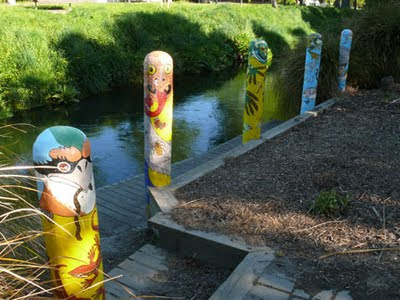
Still, every so often I happen across something that reminds me that it would take a lifetime to fully explore my own city and country. For instance, walking from work to the library a few weeks back, I happened on these wonderful painted posts on a riverside kayak landing place:
And then, I was in a part of the city that I don't often find myself in, and heard unaccustomed music coming from what looked like an ordinary church building - it was Sunday morning around 11.30. From the notice board I gathered that there was a Coptic Orthodox church service in progress. In fact, it had been in progress for nearly two and a half hours (something that would tax the endurance of this mainstream Presbyterian). The door was open, I could hear Middle Eastern sounding chanting and glimpse icons on the front wall. Two youths came outside, skylarked around a bit and went back in. Others came in and out. I would have liked to take photos, but it would have been too intrusive, and the interior was a bit dim for my camera anyway.
So, I listened for a few minutes and went on my business...
Still, every so often I happen across something that reminds me that it would take a lifetime to fully explore my own city and country. For instance, walking from work to the library a few weeks back, I happened on these wonderful painted posts on a riverside kayak landing place:

And then, I was in a part of the city that I don't often find myself in, and heard unaccustomed music coming from what looked like an ordinary church building - it was Sunday morning around 11.30. From the notice board I gathered that there was a Coptic Orthodox church service in progress. In fact, it had been in progress for nearly two and a half hours (something that would tax the endurance of this mainstream Presbyterian). The door was open, I could hear Middle Eastern sounding chanting and glimpse icons on the front wall. Two youths came outside, skylarked around a bit and went back in. Others came in and out. I would have liked to take photos, but it would have been too intrusive, and the interior was a bit dim for my camera anyway.
So, I listened for a few minutes and went on my business...
Sunday, November 22, 2009
Recent Reading
As mentioned in a previous post - my latest fiction reading was The Quickening Maze by Adam Foulds. This book was shortlisted for the Booker Prize, and the Guardian review piqued my interest, so I checked our library catalogue to find that as usual they did not let me down. (In fact, our library seems to be excellent at stocking all fiction nominated for various literary prizes - unfortunately when it comes to poetry, it's another matter entirely).
The Quickening Maze is based on historical characters - it deals with the period in the life of the poet John Clare when he was a patient in the asylum of Dr Matthew Allen, a man who had progressive notions on the treatment of mental illness. Alfred Tennyson also features in the book , bringing his brother Septimus for treatment.
It was the story line featuring the two poets that intrigued me from the review, but in the end the highlight for me was not so much that poets were featured, but that Foulds is himself a poet, and that it shows in the language. Sensitive descriptions abound, but it is always appropriate to the story, and he doesn't let words run away with him to the extent that it detracts from the flow of the story.
For example the patient Margaret is visited by an imagined angel:
There were feathers in the clearing, three of them, connected at their shafts, a scrap of torn wing. They stood on one edge, shuddering like the sail of a toy boat in the breeze. Around them the dark leaves and frail flowers of bluebells that glowed here and there where the sun struck through.
Margaret sat and heard the wind pouring in the leaves overhead. She had fallen in the river once, as a child, and heard the rushing deafness of drowning. But she had been saved. The flowing of the air around her seemed to intensify, to grow louder, until it was so powerful it reversed her breath. It almost lifted her from the ground.
The wind separated into thumps, into wing beats. An angel. An angel there in front of her. Tears fell like petals from her face.
Although it was the poetry connection that attracted me in the first place, what impressed me most was the handling of mental illness. Each of the patients is sensitively depicted, and each is quite unique, differing in their frailties and delusions from each other. It is not a long book, (unlike the eventual winner of the prize, Hilary Mantel's Wolf Hall, but I found it a many-layered and satisfying one.
Thursday, November 19, 2009
Thematic Photographic: Orange
I've had great intentions lately of posting more often, and in particular, I did intend to come back to my blog several times last week and put up new photos for Carmi's Thematic Photographic.
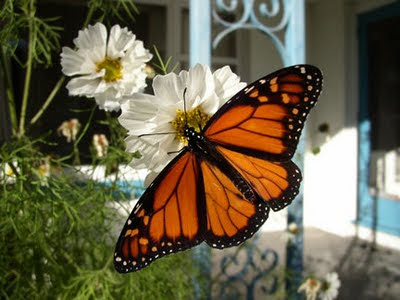
I have to admit it, though, it probably won't happen. So, when Carmi announced this week's theme, orange, I decided to post a whole bunch of photos in one go. Interestingly, most of my favourite orange photos seem to have some blue in them.
One of my earliest favourites taken on my first small digital camera:
Shipping containers stacked in the rail yard between my home and the city:

Boats in the port of Lyttelton:

Kayaks on the beach at Paihia (clearly not summer as this is a holiday resort which would be crowded in season):

All this blue and orange reminds me, I must finish this small quilt sometime:

I have to admit it, though, it probably won't happen. So, when Carmi announced this week's theme, orange, I decided to post a whole bunch of photos in one go. Interestingly, most of my favourite orange photos seem to have some blue in them.
One of my earliest favourites taken on my first small digital camera:

Shipping containers stacked in the rail yard between my home and the city:

Boats in the port of Lyttelton:

Kayaks on the beach at Paihia (clearly not summer as this is a holiday resort which would be crowded in season):

All this blue and orange reminds me, I must finish this small quilt sometime:

Friday, November 13, 2009
Thematic Photographic: Travel

On my bookshelf I have part of my grandfather's travel diary from the year he and my grandmother went Home. The way it was pronounced, we were in no doubt that it was spelt with a capital letter. All older New Zealanders referred to the UK as Home, whether they were born there or not. (In fact, my grandmother was born in Scotland, and while my grandfather was born in New Zealand he had many British cousins).
Travel was a leisurely matter in those days. My grandfather had started work at the age of 14, and so at the age of 54, after 40 years service in the Post Office (his war service also counted), he was able to retire. My grandparents' trip took a whole year, leaving New Zealand by ship, stopping off for a week or so in Sydney, then on to the UK, where they stayed up to a month or so in one spot with friends or relations, took day trips by bus, and spent a few weeks on a bus tour of Europe, before returning to New Zealand, again on board ship, via South Africa, where they stopped for some weeks to visit my grandmother's "Uncle Joe" (George).
When we visited the UK in 2007, it was a much more rushed affair. We had not quite four weeks, and, wondering whether I would ever return, we tried to cram as much as possible in the time available. This made for both amazing memories and at times, a somewhat stressed feeling. When Carmi announced his theme for Thematic Photographic this week was travel, I wondered how I would choose from around seven thousand photographs from that trip, and many more from holidays in New Zealand and Australia. After all, holidays are when we have the most time to take photos, and the most desire to record our memories. However, a while back I selected a number of photographs from the UK trip and put them in a folder from where they cycle on my computer desktop, changing every thirty minutes. And this is one I have come to love. It was one I took at one of those rushed moments, knowing we could only stop for a few minutes at this spot in the Lake District, but there is something about the light in it that makes me feel peaceful at the same time as I remember the rush.
Thursday, November 12, 2009
A Free Afternoon
At one of my two jobs, I had four hours left of my annual leave, and knew that my boss would prefer me to use it up before the Christmas break, to start fresh for next year. I'd been waiting for something special to turn up to use it on, but that didn't seem to be happening. So instead I had one of those afternoons that reminded me that "nothing special" can actually be special after all.
First I walked home from work as usual, then I walked to the hairdresser and had a long overdue haircut and a pleasant chat to my (male) hairdresser. After I commented on my increasingly grey hair, and the fact that I still feel as if I am about 38 inside, he surprised me by telling me he is 69! Once, he would have looked very old to me - now he still looks quite young. I intended to take my car to the hairdresser, but forgot and walked. It was, after all, a beautiful day. So, I walked home, then collected the car, and went off for a bit of retail therapy. I bought new sports shoes suitable for off-road walking, a pedometer, and a couple of Christmas gifts, did a lot of browsing, filled the car with petrol and ended up at the library to return my library book due today. (Review to follow).
Then I decided to shout myself to a drink in the library cafe (iced chocolate, which was my drink of choice, but as it was getting towards their closing time, they had stopped serving hot drinks anyway). I spent a pleasant half hour or so over my hot chocolate, browsing one of the library's latest magazines. I love that they keep them on the shelves for a month before they can be borrowed, so it is easy to browse the latest issue, and somehow it feels much more of a treat to read it in the library than to but it and read it at home.
While I was reading a voice said "hello Catherine" and I looked up to see a local poet of my acquaintance, with his wife. I explained about the half day off, and he said "you don't have to apologise", to which I said "oh no, I'm saying what a pleasure it is." And it was, but I suspect that secretly a part of me really did feel I had to apologise or at least explain. Something to think about...
All in all, it feels like an afternoon very well spent.
Wednesday, November 11, 2009
Red #4: Going Postal
It didn't seem as if red week was complete without something to represent our daily mail. Unfortunately in New Zealand post offices seem to becoming fewer and fewer, as many are shut down, and others are converted to a small counter in a stationery shop, pharmacy or other unlikely store. And our street letter boxes are no longer emptied between 6 p.m. Friday night and 6 p.m. on Monday (to save paying weekend rates of pay, presumably, although no one seems to pay shift allowances or overtime pay any more, anyway).
When we were in the UK in 2007 it was great to see that every small village still seemed to have their village post shop. This cheery example is in the Scottish village of Aberfoyle, the nearest village to where we stayed for a week.

I also have a photo somewhere of a yard full of bright red "Postman Pat" vans.
For more red-themed photos, visit Carmi here.
Monday, November 09, 2009
Red #3

I love the way this red seat echoes the red flowers. Photograph taken in the fabulous garden of Josie Martin, Akaroa
For more "red" photos, visit Thematic Photographic here.
A Week of Poetry
There was a feast of poetry to enjoy in Christchurch in the past week - if I'd been so inclined, I could have gone out to poetry events on Wednesday, Thursday and Friday evenings and again on Saturday afternoon. As it turned out, I was way too tired on Wednesday evening for an event that started at 7.30 p.m. and, I was told, wouldn't really get going until around 9 or 9.30. This was the launch of Catalyst #8, a local poetry magazine that leans towards publishing younger poets (although not exclusively). A pity, because I'd seen a friend's contributor's copy, and it is a beautiful production.
I also passed on Friday evening's "Poetry for Pudding" , an open mic event (although when I went last month, we had to manage without a microphone). And on Saturday afternoon, the New Zealand Poetry Society launched their anthology - although the NZPS is based in Wellington, there were so many Christchurch poets included that they held the launch here. I, however, spent a very productive weekend in my garden, which left me feeling a bit stiff by Sunday evening. (I'm not sure if the garden actually looks much better to the casual observer, but I at least know what I achieved).
That left Thursday evening which I did manage to attend, believing it was probably the pick of the bunch. (No slur intended on the poets at the other events). Thursday's event was a fund raiser - "Poets for Samoa" - which featured some of Christchurch's best Pasifika and Palagi (white/European/ethnic designation of your choice) poets. It was the initiative of Christchurch born Samoan performance poet Tusiata Avia who read alongside Danielle O'Halloran, Ben Brown, James Norcliffe, Bernadette Hall and Fiona Farrell. The evening was chaired by Samoan playwright Victor Rodger, who did an outstanding job of introducing the poets, and of describing his time in Samoa after the tsunami with a wonderful mix of seriousness and humour.
I hadn't heard Danielle O'Halloran's poems before. We're a small country, and I've been to a lot of poetry events, so it's a pleasure to discover a new (to me) writer. Though I'm fairly familiar with all the other readers, some of the poems they read were less familiar to me. In particular Fiona Farrell read a newly written poem, "Falling" about her experience of waiting late at night in Heathrow Airport for a delayed flight, and seeing tsunami images on the television screens in the departure lounge.
Good poets are not always good readers and performers of their work, but these six were all excellent, whether leaning more towards the "reader" or "performer" end of the scale. An excellent evening, which raised the highly creditable sum of $700 towards tsunami relief.
Saturday, November 07, 2009
Red Revisited

Red art on the wall of the entrance to the underground car park at the Christchurch Art Gallery (I haven't checked lately to see if it is still there).
The text comes from members of the public who offered responses to the following questions: What is a political idea or situation you feel passionate about? At what point would you initiate or join a protest about this? What would shift you from though to action?
For more red themed photographs, visit Carmi here.
Friday, November 06, 2009
Thematic Photographic: Red
I haven't joined in the fun at Carmi's Thematic Photographic for a while, so this week I thought I would play along. The theme for the week is "red".

This flower captured at the Lyttelton Farmer's Market is a waratah, which is an Australian flower. I have noticed quite a few around in florist's shops lately.
If you like colour, check back here during the week for more "red" images, and drop in at Carmi's, too.

This flower captured at the Lyttelton Farmer's Market is a waratah, which is an Australian flower. I have noticed quite a few around in florist's shops lately.
If you like colour, check back here during the week for more "red" images, and drop in at Carmi's, too.
Tuesday, November 03, 2009
A Poetic Emporium

"H Pannell's boot emporium" - now a Thai restaurant

Johnson's grocery - a traditional style grocery with a wide range of specialty goods
I seem to have been spotting the word "emporium" everywhere lately ( and it has joined my "favourite words" list). On the inside flap of Michele Leggott's new poetry collection, Mirabile Dictu, she says
If the effect is of a kind of poetic emporium I would be very pleased, having learned that the word reached us through the Greek emporos , traveller or merchant, from poros , a journey, a porosity, passing from one thing to another.
It's not a book that is a quick and easy read. There is a lot crammed onto the shelves of these poems. Leggott does nothing to help the reader by way of footnotes or endnotes (I suspect that if she was inclined to such explanations, they would fill as many pages as the poems, at least). Additionally, there is no punctuation other than slightly larger than usual gaps between some of the words, one assumes to indicate a pause or breathing space.
In one poem for instance, she refers to the "sky-blue stick" which I understand to be the tokotoko or talking stick presented to her as Poet Laureate.
Te Kikorangi we could call it
almost as good as the blue from Kapiti
we eat when the good times roll
I recognise as referring to the Maori word for blue, which is also the name of a blue cheese made by the Kapiti cheese company - but how many more references pass me by unrecognised?
In the next poem, she begins
somewhere in Canada Sharon Thesen
is driving a car
and google tells me that Sharon Thesen is a Canadian poet, who presumably from the context of the poem, appeared at a literary festival in Wellington, which switches abruptly from Vancouver to Oriental Bay, and visits various locations around Wellington - Otaki, Island Bay, Red Rocks - before returning Sharon to Kelowna and Okanagan, while encompassing (among others) Lucy Jordan, Tamara de Lempicka, Eliza Hannay, Frances Boldereff, and Finnegans Wake. (Google them yourself, if you don't recognise them!)
Many of the poems have fragments in italics which I assume to be quotes, but again (without resorting to google), there is nothing to indicate who or what she is quoting. I'm not sure whether or not it detracts from the poems to miss half the references, as I'm sure I do.
These are poems better appreciated detail by detail than in their entirety. The overall effect at times can be a confused jumble, if taken too quickly. The endings are not particularly strong, leading to a "so what?" reaction at times, but as in Johnson's grocery, taken item by item, line by line, there is much to delight. It's a book I'll be trying to absorb for quite a while yet.
Subscribe to:
Posts (Atom)