Living in such a dangerous and wounded world we need the best community building and peace making wisdom we can get hold of. My experience is that every religion and every culture has gifts to offer for the healing of our divided humanity. It's an ongoing task that requires disciplined listening, compassion and empathy. The death dealing divisions that so distort the human family have visited New Zealand. Stop, look, ponder.
Police Commissioner Bush said: "Let's not imagine the danger is over." He was referring to the day of the horror but the words have a larger significance. The danger is present as long as we live in ignorance of the wisdom, dreams and values of those who belong groups other than our own, as long as we are content to have our lives shaped by bigotry and hatred.
- Dr Keith Rowe, a former president of the New Zealand Methodist Church and of the NZ Council of Christians and Muslims.
For more of his comment see here.
Reading stories from other countries seemed trivial to me sometimes, but less so now. I recall a writer from South Sudan, a Christian nation, writing a story from the perspective of a North Sudanese Islamic fighter. A Kuwaiti woman wrote with sympathy from the perspective of a teenage suicide bomber. And many other writers have given me new perspectives on different cultures. We need to listen to these stories. We do not need to listen to hate-filled ranting. "What is your story, how did you get here" is a very different question to "what is your platform".
Events last Friday came horrifyingly close, geographically. But white privilege is real, and I was never in danger. Sadly that was not true for many fellow residents of my city, who made their homes here, often leaving countries where violence is a fact of everyday life, because they thought it was a safe country.
Monday, March 18, 2019
Sunday, March 10, 2019
Mozambique: Woman of the Ashes, by Mia Couto
For some reason, in comments on Ann Morgan's blog, there have been suggestions that Mia Couto is not the best author to read for Mozambique. I'm not sure why. Maybe because he is white, and there is a feeling that authors of indigenous descent would better represent the country?
However I have previously read and enjoyed his books, and besides, after starting on this project, I soon realised that actually buying around 200 books to read was too big a financial commitment (especially in New Zealand where shipping costs from the UK or USA add considerably to the price of most books), so I need the help of the library. Mia Couto it is then, that's what is on our library shelves.
Woman of the Ashes is his latest and while I found it an interesting enough read, I wasn't quite as gripped by it as by some of his earlier books. It is a historical novel, apparently the first part of a trilogy set in 1894 when Ngungunyane, the last emperor of the state of Gaza, has raised an army to resist colonial rule. The book alternates between the voices of Sergeant Germano de Melo, a Portuguese, and the young girl, Imani, who has been appointed to act as his interpreter.
I found the book a little choppy at times. There are flashes of magical realism which come and go in a blink, making it more difficult to get absorbed in the story. I found Imani's part of the story a good deal more compelling than Germano's. While he acts for the Portuguese authorities, he has actually been exiled to Mozambique as punishment for taking part in a rebellion. He tells his story in letters to his superior, and I think this is what distances him somewhat from the reader.
By comparison, the book that I read for Madagascar - Beyond the Rice Fields - I found a much more compelling and fascinating book. However, I enjoyed this one enough that I will probably read parts 2 and 3 when they become available.
Woman of the Ashes was translated from the Portuguese by David Brookshaw and published by Farrar, Strauss and Giroux in 2018
Labels:
Mia Couto,
Mozambique,
world reading
Saturday, March 09, 2019
Kosovo: My Cat Yugoslavia, by Pajtim Statovci
I could have managed without reading a book by a Kosovan author, as it is only a partially recognised state. (It is recognized by 113 UN member nations, but not fully recognized by Serbia, from which it claims independence).
However, this book kept popping up on my radar, and it looked interesting, so when I spotted it on the library shelves I decided to give it a go. The narrator, Bekim, is a Kosovan refugee in Finland, where his family fled when he was a child. He is now living on his own apart from his pet boa constrictor, which he allows to roam his apartment, even though he is terrified of snakes.
Then one night in a gay bar, he meets a talking cat, who moves in with him. What evolves from that meeting is a journey in which Bekim eventually returns to Kosovo to confront his past.
I initially thought that the cat of the title was Bekim's companion, the talking cat. But nowhere in the book is he mentioned by name, and there are other cats - the small black cat who becomes the companion of Bekim's mother, Emine, after she leaves her husband, and the cat that Bekim briefly adopts in Kosovo, although cats are despised animals there. It seemed in the end that the cat of the title is a metaphor for the whole of Yugoslavia, although it would be hard for me to put the comparison into words, as to how the narrator is explicitly comparing his troubled country to a cat.
This is the story of Bekim's mother, Emine, as much as it is Bekim's story, from her marriage at the age of 16 to a young man who is handsome and wealthy, but whom she scarcely knows. Despite being unsure at first, I found it thoroughly absorbing.
Pajtim Statovci himself left Kosovo for Finland at the age of two, which made me have reservations about the suitability of this book to represent the country. Nevertheless, it is a book as much, or more, about Kosovo as about refugees in Finland.
My Cat Yugoslavia won the Helsingin Sanomat Literature Prize in the category Best Debut, in 2014. It has been translated into 11 languages and was published in English by Pushkin Press. It was translated from Finnish by David Hackston.
Labels:
Kosovo,
Pajtim Statovci,
world reading
Friday, March 01, 2019
Oman: Celestial Bodies, by Jokha Alharthi
Like Kuwait, Oman has changed rapidly in recent decades as it emerged as an oil-rich nation. Economic change was accompanied by societal change, and this book traces the stories of one family during these changing decades.
It is focused on Azzan and Salima's three daughters - Mayya, Asma and Khalwa. Mayya has a secret love, who shows no interest in her, so she resigns herself to accept marriage to another man. Asma marries from a sense of duty, while Khalwa waits years for the cousin to whom she believes herself betrothed, who has emigrated to Canada where he lives, unbeknown to her, with another woman. Their lives and loves are richly depicted. But this is not just the story of the three women, but of the men of the family too, and of their other relationships. We learn of Azzan's harsh childhood, and of Mayya's husband Abdallah's life, and love for her, which is not returned.
Azzan has a secret relationship with a Bedouin woman Najir bint Shaykha (Qamar - the moon). The title of the book seems to reflect the idea of women as celestial bodies, or perhaps celestial bodies as women. A quote from an old book says "Of all the celestial bodies, the moon is closest to the matters of this lower world." And throughout the book this idea of celestial bodies gives resonance to the events that take place.
I enjoyed following the lives of the family members over several generations, and discovering lives that are richer and more complex than westerners with a superficial knowledge of Arab countries might imagine. In particular, although the three sisters were clearly expected to marry and to be subject in many ways to their husbands, the book reveals them to have greater autonomy than the reader might at first think.
Jokha Alharthi has written children's books, short fiction, and three novels in Arabic. She teaches at Sultan Qaboos University in Muscat and has completed a PhD in Classical Arabic Poetry in Edinburgh (There are many quotes from classical Arabic poetry throughout the book).
Celestial Bodies won the 2010 Best Omani Novel award. It was translated from Arabic by Marilyn Booth, and published in Britain by Sandstone Press in 2018, with support from the Anglo-Omani Society and Creative Scotland.
Labels:
Jokha Alharthi,
Oman,
world reading
Wednesday, February 20, 2019
El Salvador: One Day of Life, by Manlio Argueta
One Day of Life is a shocking book, and although it is set around the time of its publication in 1980, it seemed very relevant as the news talks of caravans of refugees from Guatemala heading for the United States border, and of American pressure for a change to the political regime in Venezuela.
In 1980 El Salvador was ruled by a brutal right wing government, backed by the United States. There had been fifty years of military rule. Fear of Communism seems to have been behind the US intervention, but this book suggests that for the majority of the peasants, it was not a political leaning towards Communism that motivated their resistance to the military regime, but a simple desire to have enough to eat and to feed their children.
The main narrator of the book is Lupe (Guadalupe), the matriarch and grandmother of a peasant family. The book follows her day from 5.30 a.m when she gets up and starts her chores, through to 5 p.m when the events related come to a resolution of sorts. From time to time, the point of view shifts to other characters, including her daughter Maria Pia, granddaughter Adolfina, and "the authorities" who are in fact, young peasant boys recruited to do the dirty work of the regime. And the action is not strictly limited to one day, as Lupe reflects on the events that have led to this day, and the hardships that the peasants experience.
Although there is a resolution, there is no happy ending. But Lupe endures her hardships with a sort of resignation. As the book says "better not to keep on thinking because it can embitter one's life".
One Day of Life was banned in El Salvador because of its negative view of the government, and the author had to go into exile in Costa Rica where he lived from 1972 to 1993 before returning to El Salvador. It was translated from Spanish by Bill Brow and published by Vintage International.
Labels:
El Salvador,
Manlio Argueta,
world reading
Sunday, January 27, 2019
Greece: Achilles' Fiancée, by Alki Zei
I was surprised how few books from modern Greek authors were in our library, but I had a couple marked on my "to be read" list. And then this turned up on the new books display, so I decided to give it a try.
At the start of the book the narrator, Eleni, is on a train in Paris with her friends Eugene, Panos and Stephanos. This train, however, is a film set and the friends are working as extras. Eleni recalls her first long train ride, Athens to Piraeus, and then other train rides, as over the course of several weeks, the filming continues.
The Achilles of the title is a guerilla, leader of the resistance against the German occupiers of Greece during World War II, and later against the British and against the Greek government during the civil war that followed. Eleni was known to all the resistance members as "Achilles' fiancée". The book follows her story through times of imprisonment in Greece, exile in Tashkent where Greek political refugees fled, then to Moscow and eventually Paris where the book is set, sometime after the right wing military coup in Greece in 1967.
But Eleni, though a communist, grows from a young girl following what she is told, to a woman who thinks and acts for herself, and does not blindly follow the party line, even when pressured to do so by Achilles.
For a short time, I found the structure of the book a little confusing. However it quickly became clear that during breaks in the filming, Eleni is in the present as she chats to Eugene, and while the filming is taking place, she is remembering the past. The words "cut" and "sound camera action" clearly delineate the time changes. I quickly became absorbed in the story and was fascinated both by the personality of Eleni and by the events in the modern history of Greece about which I had only a vague awareness previously.
Achilles' Fiancée was first published in Greece in 1987. This edition was translated by Anatoli Fitopoulou and published by Bookboom in 2015.
Alki Zei was born in Athens in 1925. Her books are mainly based on her personal experiences, and she herself spent time as a political refugee in the Soviet Union and Paris. While the book is semi-autobiographical, however, it felt universal in the humanity and stories of the characters, both the main characters and the many others who form part of their story.
Labels:
Alki Zei,
Greece,
world reading
Monday, January 14, 2019
Kuwait: The Hidden Light of Objects, by Mai Al-Nakib
When I can find only one book from a particular country, the quality can be a bit hit and miss. That wasn't a problem with Mai Al-Nakib's luminous short story collection, The Hidden Light of Objects. Ten "vignettes" alternate with the ten stories in this collection, which give a vivid picture of life in Kuwait as it develops from a traditional fishing village into a cosmopolitan oil-exporting nation, and then, with the Iraqi invasion, becomes a place of horror and war, and increasing fundamentalism.
There are objects a-plenty to carry the weight of the title. In "Chinese Apples" a young girl collects story objects - objects about which she spins imaginative tales which she relates to her younger sister. The story is a lamentation for the loss of her mother, the loss of innocence. In "Amerika's Box" another young girl, named in gratitude for America's role in resisting the Iraqi invasion, has a box in which she collects objects that represent America to her. But her name gradually becomes a liability as attitudes towards America change, particularly after 9/11. And there are many more significant objects in other stories - a compass, a diary, a stamp bearing the image of an elephant, a straw hat with a red ribbon.
While these stories are set against a background of Islam, it is a far less intrusive presence than in books I have read from other Middle Eastern countries. The characters in these books have an abiding interest in the wider world, in literature, culture, music and so on from all around the globe. If the young girls take up wearing the burqa, it is with reluctance and under pressure from an increasingly fundamentalist school and social environment. One senses that the author, too, has a liberal outlook on life.
Mai Al-Nakib was born in Kuwait in 1970. She holds a PhD in English literature from Brown University in the US and teaches postcolonial studies and comparative literature at Kuwait University. The Hidden Light of Objects was published in 2014 by Bloomsbury Qatar Foundation Publishing and won the 2014 First Book Award from the Edinburgh International Book Festival.
Labels:
Kuwait,
Mai Al-Nakib,
world reading
Wednesday, January 09, 2019
There is a Country: New Fiction from the New Nation of South Sudan
It's been a while since I posted here and in that time I have read far less than usual. I have been involved in house hunting and currently with one home purchased and one not yet sold, I have two gardens to maintain. Plus, I have been reading some books that are not related to my "Round the World" project. And then there was Christmas..
Still I do have a few books to catch up on reviewing, and this slim volume from South Sudan is one of them. South Sudan only became an independent country in 2011,, and the book was published in 2013 so it was fairly quick off the mark. However it is now out of print and hard to locate, and I haven't come across any alternatives. The conditions there are likely to make it difficult for anyone to publish a full length novel for some time.
There is an interesting introduction written by the editor, Nyol Lueth Tong, who was born in South Sudan but later became a refugee in northern Sudan and Egypt. At the time the book was published, he was at Duke University in the United States.
In the introduction he says "The North has been painted as Islamic and Arabic, while the South has been characterized as Christian and African, and regionally part of East Africa... In reality, however... in the South, more than sixty languages are spoken, and although both Islam and Christianity are practiced, local belief systems dominate the spiritual realm. Moreover, the last several decades of war have forced millions of Southerners to flee their homes... South Sudanese culture, in other words, is a strikingly hard to define thing."
It may be hard to define, but this collection makes a strong contribution towards introducing it to the world. It is to be expected that many of the stories focus on conflict, although unexpectedly, one, "Holy Warrior" by David L Lukudu takes the viewpoint of a soldier for the North Sudanese army. Others show the life of women and teenagers displaced by the fighting. Romantic relationships also feature in several of the stories.
A couple of pieces were different from the rest. "Lexicographicide" by Taban Lo Liyong is an unusual experimental piece which discusses the writing of a dictionary of the Zed language, the language of a fictional island of 125,000 people. The other piece, which ends the volume, is in verse. "Tall Palms", by Arif Gamal, is an excerpt from a longer work "Morning in Serra Mattu: A Nubian Ode". It is a narrative and lyrical work featuring a large boa constrictor, and forms a satisfying contrast to the fighting in the rest of the book.
"There is a Country" was published in 2013 by McSweeney's in San Francisco.
Labels:
Nyol Lueth Tong,
South Sudan,
world reading
Monday, November 05, 2018
Ecuador: The Devil's Nose, by Luz Argentina Chiriboga
I really wanted to like this book, having searched intensively for an alternative to Jorge Icaza's Huasipungo, which seems to be the default choice for Ecuador. When I heard that Chiriboga's book was the first book by an Afro-Ecuadorian woman to be translated into English, I was intrigued.
Unfortunately I was disappointed. The book was short but very repetitive, so that it could in fact be quite a bit shorter. It tells of a group of Jamaicans brought to Ecuador to work in the construction of a railroad between Guayaquil and Quito. In the process, they had to conquer the Devil's Nose, one of the most dangerous peaks in the Andes. In the first chapter, we are told countless times in various ways that the men were leaving their families behind in order to earn money to make a better life for them. This sort of repetition is presumably present in the original untranslated text. I wondered if the author had a personal interest in this group of men, and wanted to tell an ancestor's story, but didn't have sufficient material and was trying to spin it out. Other faults may be due to the translation. I felt that it was perhaps a too literal, word for word translation which often made it very hard to understand the sense of the story. And even where the translation makes sense, it is often stilted or awkward English.
All this is a shame, because I sensed that there was an interesting story to be told here - and if one reads quickly, it is easier to get an overall impression of the story than by slowing down and trying to make sense of every sentence.
The other strange thing about this book is the prominence given to the translators, Ingrid Watson Miller and Margaret L Morris. Of course it is important to give translators their due. But it seems very odd that the "about the authors" page at the back of the book gives biographies of the translators without mentioning the original author at all.
This translation was published by Page Publishing Inc, New York in 2015. There is no mention given of when it may have been originally published in Spanish.
Labels:
Ecuador,
Luz Argentina Chiriboga,
world reading
Friday, October 26, 2018
The Gambia: Reading the Ceiling, by Dayo Forster
On her eighteenth birthday, Ayodele has a decision to make. She has decided to do The Deed. But which one of four possible men will she do it with? The ramifications of this decision will lead to different futures for her. "Reading the Ceiling" follows three possible stories for Ayodele, introducing the reader to the range of experience of modern African women.
While there are commonalities between the three different stories, each has very different outcomes. In one, Ayodele studies in England, and returns to work in the Gambia. In another, she travels the world, working in development in Mali and elsewhere. In a third, she stays in the Gambia as a single mother without tertiary education, raising her son, but eventually finding well paid employment and making a successful life for herself.
When my children were younger they sometimes read books in a series called "Choose Your Own Adventure". Every page or so, the reader was faced with two choices: "if you do this, turn to page 72. If you do that, turn to page 43". Although written in the first person, not the second person, this novel reminded me a little of those books. Eventually I realised that the reason was that both are written in the present tense. This gives an immediacy to the narration, and also elevates action above feelings, although feelings do play a part too. At any rate, I found it an engrossing read, and was absorbed in wondering as each story drew to a close, how the next alternative would work out differently for Ayodele.
Dayo Forster was born in Banjul, the capital of Gambia. Like her heroine in two of the stories, she left Gambia to study at the age of 18, because at that time there were no universities in the Gambia. Reading the Ceiling was published by Simon and Schuster, UK in 2007 at which time she was living in Kenya.It was shortlisted for Best First Book in the 2008 Commonwealth Writers’ Prize-Africa Region.
Labels:
Dayo Forster,
Gambia,
world reading
Friday, October 19, 2018
Tanzania: Gravel Heart, by Abdulrazak Gurnah
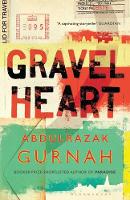
Tanzania is a country that was created out of an amalgam of Tanganyika on the mainland and the island of Zanzibar. I knew something of life on the mainland through friends who have worked as volunteers there, but this book is set in Zanzibar, a semi-autonomous region of Tanzania, which is largely Muslim.
Salim grows up there in the 1970s. When his father moves out of the family home, he lives with his mother and her younger brother Amir. Amir becomes a senior diplomat in London and offers Salim a home there and an opportunity to study.
This is not, however, really an emigrant story, even though Salim spends may years in London. It is more about the events that caused his father to move out, and the secrets arising from them. Eventually Salim returns to Zanzibar for his mother's funeral. There he reunites with his younger half-sister, and with his father, who tells him his story.
The narrator of the novel is Salim, but in the last part of the book Salim is relating what his father told him, which to me seemed to add a certain amount of detachment to the story as we are hearing it at two steps removed. Other than that, I found the novel interesting both as a story, and as an insight into the history of Zanzibar, and of the events of the 1970s when the country was in some turmoil through political revolution. I would be happy to read more from this author, though I would also like to find other Tanzanian writers from the mainland, to give some perspective on the rest of the country.
Abdulrazak Gurnah was born in Zanzibar in 1948. From 1980 to 1982 he was a university lecturer in Nigeria. He then moved to England, to the University of Kent and has been based in the UK ever since.
Gravel Heart was published by Bloomsbury in 2017.
Labels:
Abdulrazak Gurnah,
Tanzania,
world reading
Saturday, September 29, 2018
Peru: The Neighbourhood, by Mario Vargas Llosa
Since the author of this book is a Nobel prize winner, it seemed as if it would be a good choice for Peru. I found, however, that it wasn't really to my taste. It's not a badly written book, but there is a lot of sex, and some of it is very graphic. It starts when Marisa shares a bed with her friend Chabela, after Chabela is caught too close to curfew at Marisa's house and stays the night. There, they discover an attraction for each other. In the meantime Marisa's husband Enrique or Quique, a rich businessman, is being blackmailed after scandalous photos of him at an orgy come into the hands of the gutter press. Quique turns to his lawyer friend Luciano (Chabela's husband) for help.
I felt at first that there wasn't a lot of character development. In the end though, the sex, much of which seems somewhat gratuitous at first, became more important to the plot and setting. The action takes place in the final days of Alberto Fujimori's presidency and as well as the newspaper staff and the two couples, takes in the director of intelligence services, the "Doctor". I began to be more interested in the book for what it revealed about the political situation, the terrorist insurgency, and the lives of Peruvians, both rich and poor, at the time.
Vargas Llosa has written a good many novels over his career, and although I am not familiar with most of his work, it seems unlikely that he would win the Nobel Prize if he was a "one trick pony" so I am thinking it might be worth exploring a bit more to see if some of his other work is more to my taste.
Labels:
Mario Vargas Llosa,
Peru,
world reading
Friday, September 07, 2018
Australia: The Swan Book, by Alexis Wright
I haven't stopped reading, but there were all sorts of books piling up on my "to be read" list that didn't fit into my round-the-world project. Wonderful non-fiction books, poetry and all sorts of others. And there were books from countries that I had already read a book from. This is one of them. However, it is from "another Australia" - quite different to the others I have reviewed here, as the author is an indigenous Australian from the Waanyi nation in the highlands of the southern Gulf of Carpentaria.
The book is set in a dystopian future Australia heavily impacted by climate change and by pollution from mining and other activities. Oblivia (full name Oblivion Ethylene) is a young aboriginal woman who has been gang raped and rescued from her refuge in a hollow eucalyptus tree by an old white woman, Bella Donna. They live together on a rusting hulk of a ship which has been dumped by the army, along with many others, in a drying up swampy lake in the middle of a detention camp for other indigenous people, both those whose traditional land it is, and those relocated from the cities.
The ship is surrounded by swans which have come from the south (they do not traditionally live in this area). Oblivia does not speak but has a special rapport with the swans. As her story unfolds, she becomes the wife of the first Aboriginal President of Australia, Warren Finch. She is taken to live in the city where she lives a beleaguered life, sequestered in a tower apartment. All sorts of strange characters find their way into her story - three genies, a talking monkey named Rigoletto, an old harbour master who may or may not be a ghost. And always the swans are a haunting presence, guiding Oblivia's journey.
This story is not mythical in the Western sense. It is an interweaving of worlds, the world that we would see on the surface, and the spiritual world of ghosts and nature, which is just as real. In this reality, a story is not something that is told but is an integral part of each tribe and each creature, and it must be walked rather than read. (Or perhaps it is "read" in the land). Nevertheless, there is also plenty of white European culture woven into the story - in particular, the stories and poems of swans which are woven throughout. It is both a lyrical epic, and a powerful protest against what we are doing to the earth, and against the treatment of the indigenous people of Australia.
If you are also trying to read a book from every country, and you would like to choose something non-"Western" where possible, then I would highly recommend this as a choice for Australia.
Labels:
Alexis Wright,
Australia,
world reading
Wednesday, August 01, 2018
Eritrea: Heart of Fire, by Senait Mehari
This memoir bears a subtitle on the cover: "From child soldier to soul singer". This slightly over-hyped subtitle is, in part, what has led to controversy over the book, as various commenters have pointed out that the author was never a child soldier. She did not in fact, claim that she herself fought in battles. She did however write an account of her childhood in which she was abandoned at birth by a mentally distressed mother, raised in orphanages for several years until her paternal grandparents fetched her back, and then went to live with her father and his third wife.
When she was six, her father sent her along with her two elder half-sisters, to a camp of the Eritrean Liberation Front (ELF). They had been fighting in a civil war against Ethiopia, in a battle for Eritrea's independence. However by this stage they were fighting more against another Eritrean group, the EPLF, as the two groups contended for power within Eritrea.
The younger children in the camp did not have to fight, but they did do a lot of the hard work in the camp, and were also taught to carry and fire guns. Things did not go well for the ELF, and eventually Senait's uncle managed to rescue her and her sisters, and took them to live with him in Sudan, before her father, now living in Germany, sent for the girls.
Senait did not get on well with her father and at the age of fourteen left home to live on the streets. The memoir continues on to describe how she managed to teach herself music and become a recording artist.
I found it hard to decide for myself how much of the controversy over the book may in fact be correct, and how much may be the result of certain interest groups not wanting to admit that child soldiers did in fact exist. It is entirely possible of course that there are errors in the book even without the deliberate intent to exaggerate - after all, I would have to say that my recollections of events that took place when I was six years old would not be entirely accurate, even without the complicating factor of trauma to overcome. Then, in order to make a coherent story from a chaotic set of recollections, facts may have been manipulated slightly to align better with each other. I cannot believe though, that the story was entirely fabricated - there must be at least a good proportion of truth in there.
At any rate, I found it to be fascinating reading, and I learnt a good deal about the recent history of Eritrea, and its independence from Ethiopia. And incidentally, I found that one doesn't have to be white to have racist attitudes - Senait's mother was Ethiopian while her father was Eritrean, and apparently the darker skinned Ethiopians were looked down on by the lighter skinned Eritreans (and the Sudanese in the story, who were mostly Moslem, taunted the Eritreans, who were not only of a different skin tone, but also did not dress in a suitably modest manner).
Heart of Fire was translated from German and published in London by Profile Books in 2006. (I have returned the book to the library and didn't, unfortunately, note the name of the translator)
Labels:
Eritrea,
Senait Mehari,
world reading
Friday, June 29, 2018
Latvia: Soviet Milk, by Nora Ikstena
Latvia was one of the countries on my "fairly hard to find" list, so I was delighted when this newly published title turned up at our library. Soviet Milk covers the lives of three generations of women - chiefly, a mother and daughter, but the grandmother and step-grandfather also make an appearance. None of these four are ever named - they are referred to as "my mother", "my daughter" and so on, depending on who is narrating. The book is written in short sections which switch narrators back and forth between the mother and the daughter. I was several sections in before I realised this, although perhaps it should have been obvious. Once it was clear, the story was easy to follow.
The mother was born at the end of World War II, shortly before Latvia was taken over by Soviet Russia. The daughter was born in 1969, and the novel covers the years up to 1989 and the fall of the Berlin Wall, with the Latvian people looking forward to the possibility of becoming and independent nation again. The mother is a doctor, but she is a deeply flawed and troubled character, and it is the grandparents' influence which has a stabilising effect on the daughter, who lives with them when her mother takes up a study opportunity in Leningrad. She returns from there disgraced, and is banished to a country health centre, where her daughter joins her for some years before returning to Riga to stay with her grandparents and attend high school.
It is a quiet, mostly undramatic story, but I found it compelling. It offers a clear picture of life in Latvia under Soviet rule, and the difficulties that entailed for the Latvian people. It is not a long book, so it was quick to read.
Soviet Milk was published in 2018 by Peirene Press and translated from Latvian by Margita Gailitis. It won the 2015 Annual Latvian Literature Award for Best Prose. Nora Ikstena was born in 1969 (like the daughter in the story) in Riga, Latvia. She studied at the University of Latvia, moved to New York, and on her return she helped establish the Latvian Literature Centre.
Labels:
Latvia,
Nora Ikstena,
world reading
Wednesday, June 27, 2018
Iran: The Enlightenment of the Greengage Tree, by Shokoofeh Azar
This is a somewhat sprawling novel which tells the events in the lives of a family in Iran after the Islamic Revolution in 1959. After the father's workshop where he makes classical Iranian musical instruments is raided and set on fire by revolutionaries, the family leaves Tehran for a quiet rural area. However, even there, they are not safe from the changes that the revolution brings.
The story uses the lyrical magic realism style of classical Persian storytelling. It is full of ghosts, jinns, spirits, mermaids and other creatures. While tragedy after tragedy befalls the family, the style of story telling and the fantastic elements in the narrative lighten the tone and make it bearable, even as the family face the loss of all they hold dear - their culture, literature and way of life, and their lives themselves.
Despite the complexities of the plot (it is not until chapter five that there is a sudden twist, and we start to realise the depth of the tragedy that has occurred), I enjoyed this book very much. The depictions of the kind of lives that cultured Iranians lived before the revolution was intriguing, given how Iran is portrayed in the media today as a repressive Islamic state. The family are depicted as book lovers, and the classical books named are from many cultures both Western and Iranian. The Blind Owl, an Iranian classic that I read earlier, is one that gets a mention. I found the blind owl hallucinatory and confusing, but this one is clearer, perhaps because it was written for a more western audience. One thing that struck me as a little odd was the narrator referring to her parents as "Mum" and "Dad" rather than using the titles that would be used for them in Iran. This is probably, again, because it was published in Australia for a western audience, but I felt that it constantly jolted me slightly out of the atmosphere of the story, and that a western audience could well handle Iranian titles for the narrators parents - after all, many other Iranian words are used. A small niggle - but it's the first book I've read in the course of this project in which this niggle has arisen.
Shokoofeh Azar was born in Iran in 1972. She studied literature at high school and university, and later worked as a journalist for an independent newspaper. In 2004, she became the first Iranian woman to backpack and hitchhike along the Silk Road. In 2010 she was forced to leave Iran, and was accepted as a political refugee by Australia in 2011. The Enlightenment of the Greengage Tree was published by Wild Dingo Press (Melbourne, Australia) in 2017.
Labels:
Iran,
Shokoofeh Azar,
world reading
Wednesday, June 20, 2018
Iraq: I'jaam, by Sinan Antoon
This is a slim book, but a fascinating one. There is a preface which explains the meaning of the title. Arabic script is written with dots which elucidate the meaning of the phonetic characters. Without dots, the meaning has to be deciphered from context and syntax. The dots were added to eliminate ambiguity. For instance, the word which undotted reads bayt (house) can also be read as bint (girl), banat (she built), nabt (plant), thabt (brave), and so on, by placing dots in different ways.
The text of the novel is supposedly written by an unnamed narrator, being held in prison and tortured for political reasons. It has been written without dots, and has been given by officials to a "qualified personnel" to add the dots and report on the manuscript's content.
The book is both grim and lyrical, as the narrator slips alternately between dream and reality, between nightmare, hallucination and the actuality of his current circumstances. Footnotes which give alternate readings of some words and phrases add extra layers of meaning, and allow for barbed satire at the expense of the regime depicted.
I found far fewer books from Iraq than from neighbouring Iran, but this one seemed a very good place to start. Sinan Antoon was born in Baghdad in 1967. He studied English literature at Baghdad University and moved to the United States after the 1991 Gulf War. He teaches Arabic literature and culture at New York University.
I'jaam was published in Arabic by Dar al-Adab in Beirut in 2004. It was translated into English by Rebecca Johnson and Sinan Antoon and published by City Lights Books in 2007.
Labels:
Iraq,
Sinan Antoon,
world reading
Monday, June 11, 2018
Kenya: The Dance of the Jakaranda, by Peter Kimani
The Jakaranda Hotel of this novel is located at Nakuru, where the expatriate British, McDonald, had settled after arriving in Kenya to supervise the building of the railway from Mombasa on the coast, to the other side of the country, at the beginning of the twentieth century. McDonald's wife, Sally, had arrived at the house that he built for her and promptly left again.
In 1963, as Kenya is gaining its independence from Britain, Rajan, the lead singer in the hotel's resident band, is kissed by a mysterious woman in a dark corridor. He is unable to forget her. This novel unravels his story, and that of the woman, and their shared history, along with McDonald, the missionary Rev Richard Turnbull, and Rajan's grandparents Babu and Fatima, who had come to Kenya from the Punjab along with many other Indian labourers to work on the railway.
This is an epic story which is not just a family saga but reveals the unfolding story of the birth of Kenya as an independent nation. I found it compelling reading, with richly drawn characters and a fascinating setting. There was just one little niggle lurking in the background - I couldn't make sense of the timeline. There seemed to be some faulty arithmetic at work. If Rajan's father, Rashid, was born around 1903 as was described, and left Kenya at the age of eighteen - or not much more - to live in Britain, having fathered Rajan before he left - then Rajan couldn't be as young as he was supposed to be in 1963. And there were other anachronisms - the chief of which was the description of Babu having a "black polythene bag" - also around 1903, long before the invention of polythene. Or was it a figure of speech? It wasn't quite clear. These concerns weren't intrusive, for the most part, but did have me putting down the book to go and fact check from time to time.
This railway still exists today - I found a fascinating account of a journey on the railway at this website.
Peter Kimani is an award winning Kenyan novelist. He teaches journalism in Nairobi, and is a Visiting Writer at Amherst College in the United States.
The Dance of the Jakaranda was published in the United Kingdom in 2018 by Telegram under license from Akashic Books, New York
Labels:
Kenya,
Peter Kimani,
world reading
Friday, May 25, 2018
Italy: The Sense of an Elephant, by Marco Missiroli
I borrowed this book from the library because I found the title (and the blurb on the back) intriguing. I wondered where it was going at first. After all, all the secrets seemed to be revealed in the first few chapters, so it wasn't a mystery. It centres round an ex-priest, Pietro, who has taken a job as concierge in an apartment block in Milan. We soon learn that Lica, the father of one of the families in the building, is his son. So I wondered how the tension would sustain itself as there didn't seem to be much to reveal. It turns out, this is not quite the "feel good" story that it seems to be at first. There are surprises to come, not least at the end, and moral dilemmas that left me with plenty to think about.
I wondered about the translation - do Italians refer to a "concierge" or do they have their own word for it? We don't seem to have an English equivalent, but to refer to Pietro as a concierge seems to lend rather a French flavour. Then, the building is frequently referred to as a "condominium" which sounds very American to me, and modern, though in other ways I pictured the building as much older. (The blurb on the back refers to it as a "palazzo" - much more Italian sounding).
I enjoyed the book, and found the characterization complex and interesting. Pietro has two old friends in Milan, the gay lawyer Poppi who found him the job, and his tarot-reading friend Anita. There are also flashbacks to his past life in Rimini, and his relationship with Celeste. And then there are other inhabitants of the apartment building including Paola and her adult son Fernando, who has the mind of a child.
The Sense of an Elephant was translated from Italian by Stephen Twilley and published by Picador in 2015. It was originally published in Italy ,where it won the Campiello Prize, in 2012.
Labels:
Italy,
Marco Missiroli,
world reading
Wednesday, May 23, 2018
Somalia: The Orchard of Lost Souls, by Nadifa Mohamed
I found this a really interesting book to read shortly after my pick for Ethiopia (scroll down a couple of posts). It is set in the north part of Somalia, near the border with Ethiopia and about ten years later than Maaza Mengiste's book. So there were noticeable resonances between the two stories.
The Orchard of Lost Souls focuses on three women (or rather, two women and a girl). All are strong, independent characters. Filsan is a young female soldier, sent north to Hargeisa from Mogadishu to help suppress the rebellion growing in the north. Kawsar is a widow. Nine-year-old Deqo was born in a vast refugee camp outside the city. She is brought with a troop of refugee children to dance at a political rally. When she forgets the steps, frozen in fear, she is dragged aside by the woman in charge of the troop to be punished. Kawsar intervenes and Deqo runs off, leaving Kawsar to be arrested. At the police station the soldier Filsan beats her savagely. Thereafter she is crippled and confined to her house, unable to tend to her beloved orchard. The paths of the three characters separate but, like channels of a braided river, they come together again later in the story.
Apart from the beating Kawsar receives in the police station, I found this book not nearly as brutal as Mengiste's. We see the city emptying out and suffering from the war, but the portrayal of political oppression is not as extreme, perhaps because the city is remote from the capital where the leaders live. There are certainly some brutal passages, for instance when Filsan is sent to take part in an action to destroy water reservoirs in surrounding villages, because the tribesmen are suspected of aiding the rebels. However, these are not quite as central to the story as in "Beneath the Lion's Gaze", and the focus is more on the tenderness between the three women that arises as events unfold, leading to a much more hopeful ending, at least for the central characters.
The north of Somalia, where the book is set, has been declared to be an independent state, the Republic of Somaliland, since 1991. So for anyone wishing to include Somaliland as a separate country, this would be a good book to read. However its independence is not officially recognized, and it is not on the list of countries recognized by the United Nations that I am following. Nadifa Mohamed was born in Hargeisa in 1981 and moved to London with her family in 1986, shortly before the events of this book. This was intended to be a temporary move, but it became permanent when the war broke out. She did not return to Hargeisa until 2008.
The Orchard of Lost Souls is her second book and was published by Simon and Schuster UK Ltd in 2013.
Labels:
Nadifa Mohamed,
Somalia,
world reading
Subscribe to:
Posts (Atom)