The Weight of Calves
after Mandy Coe
A calf estimated to weigh
thirty million tonnes
split from the Tasman Glacier.
If this was its weight,
imagine if you can, its size, ice
more voluminous than water.
And imagine its age:
I’m told the residence time
of glacier water may tip
one million years. All
those old molecules, trapped
for aeons, waiting release
into Brownian motion.
The world’s reservoirs
leaking. Greened plains lapped
by cattle. The weight.
The birth of a calf is assisted
by gravity. Maternal groans
as the glacier labours through rock
and the calf drops,
torn from terminal ice. An echoing crash.
A wave. Turquoise light. Hard
shards slice water. The calf
part-submerged, melting. Freshwater
mingles with saline.
Calving into water causes a splash;
into oceans, raises the level. Collapse
the ice sheets and tides will lift
six metres perhaps. Think of that.
Cows and calves
where they never should be.
Weighing heavy.
Karen Zelas lives in Christchurch. A former psychiatrist and psychotherapist, she returned to university, taking creative writing papers at Canterbury University in preparation for giving up her day job. Since 2004, her poetry has been increasingly widely published within New Zealand, including in Landfall, Poetry New Zealand and Takahē, and broadcast on radio. It has also appeared in Australian ezines Snorkel and Eclecticism and recently been blogged by Interlitq (UK). Several anthologies contain her work. In 2009 she was the recipient of a Creative Communities grant. She is editor of the anthology Crest to Crest: Impressions of Canterbury, prose and poetry (Wily Publications, 2009).
Karen’s first novel Past Perfect was published by Wily Publications in 2010, and is to be released as an ebook by Interactive Publications this year.
For the last five years, Karen has been Fiction Editor of Takahē literary magazine and chairs the Takahe Collective Board. She is married with children, grandchildren and a child-substitute: a miniature poodle.
Karen's book, Night's Glass Table, was the winner of the 2012 IP Picks Best First Book Competition run by IP (Interactive Publications), Brisbane. It is to be launched in conjunction with the Christchurch Writers' Festival at 4.30 - 6pm on Thursday 30 August, as part of an extensive reading tour through NZ. Books can be purchased online, including e-publications, via the IP website (click on "Store"), or directly at the Night's Glass Table mini-site.
Tuesday, August 28, 2012

Tuesday, August 21, 2012
Tuesday Poem: Looking Back, by Aleksandra Lane
Looking Back
Something must have disappeared
from that day. A little sun veneer,
surface of light stolen
by the swooping hands
on your watch
perhaps. All around us
the grass was dazed dry
and the trees above were moving
in small fits, like children
not yet acquainted
with their own bodies,
but still painfully aware of their will.
We willed each other away
and then willed the other too quickly too
close again. Between us
there were no words, only children
unmade and children undone. It seemed
nothing was missing
at the time – that something
must have disappeared just now in me
explaining the day
must have lost a tooth
in that grass, in those clouds –
a little milkiness
never to be found again.
Looking Back is taken from Birds of Clay, Aleksandra Lane’s first book in English, after two published in Serbian. Aleks moved to New Zealand in 1996, and completed her MA in Creative Writing at Victoria University’s Institute of Modern Letters in 2010, receiving the Biggs Poetry Prize. Her poems have been published in Jacket2, Sport, Turbine, Takahe, Snorkel, Side Stream and Swamp. She lives in Wellington and is studying for a PhD in English at Massey University.
I enjoyed reading Birds of Clay, a varied collection which contains a range of forms - a number of prose poems, free form poems like Looking Back, but also more traditional forms such as the rather edgy villanelle "Knife". I was attracted to Aleks's beautiful although sometimes surreal imagery. I found some of the poems rather mystifying at first, but they reward careful re-reading. A book to be savoured. My thanks to Aleks for allowing me to choose a Tuesday Poem from her collection.
For more Tuesday Poems, visit the main hub site.
Tuesday, August 14, 2012
Tuesday Poem: The Annunciation, by Rhian Gallagher
The Annunciation
Tintoretto
This is no swallow, no butterfly.
Feathered with Concorde power
Titanic bulk, breathlessly aerobic
Gabriel dives in under the lintel,
wings swept back behind Olympic shoulders
he tilts like a display pilot
and just clears the entrance.
Mary pulls up under the impact
cherubs sail on the draught
like a herd of sky-diving babies. Outside
Joseph grapples with a bit
of four by two, oblivious to the super-human
frequency. The earth's in a bad way.
As to Gabriel
you can see he's not going to help
pick up the pieces, he's not even going to land,
message delivered on a rush of air,
no buttering up of Mary,
his beautiful arms poised towards heaven
before he back-flips out of there.
- Rhian Gallagher
*********
Rhian Gallagher recently won the New Zealand Post Book Awards poetry category for her second collection of poems, Shift. This is her first with a New Zealand publisher - her earlier collection, Salt Water Creek (where The Annunciation appeared) was published by Enitharmon Press in the UK, where she lived for eighteen years.
While there are many fine poems in "Shift", it is often the first poem that I read by a new author that most impresses itself on my memory, and that is the case here. I read The Annunciation when it appeared on the Poetry Daily website, and it led me to seek out more of Rhian's poetry, which I enjoy immensely.
Rhian suggested that it might be hard to find a copy of Salt Water Creek now, but I did find it listed on both the Fishpond and Amazon websites. Shift is much more readily available, and both books are well worth reading.
For more Tuesday Poems, visit the main hub site.
Tuesday, July 31, 2012
Tuesday Poem: Empiricism, by Roger Hickin
Empiricism
a wayfaring stranger who climbs
a steep village street
an old embroidress who’s lost her needle––
stranger stoops to help her look
but soon gives up–– lo siento
needle nowhere to be seen
wizened stub of a woman opposite
watches squatting on her doorstep––
está loca she informs the stranger––
the embroidress is nuts
she’s got no needle
a few doors up a younger woman points
at woman two–– take no notice of her
she advises–– está sorda
she’s stone deaf doesn’t hear
a word you say
all this–– perhaps a comedy routinely played
to confuse the wayfaring stranger
who threads his way
up the narrow street
inclined to doubt
wanting to believe
in the existence of the needle
********************
Roger Hickin has worked as a visual artist and exhibited regularly throughout
New Zealand since 1985. Although he has written poetry since the 1960s, his main preoccupation was with sculpture & painting until the early 2000s when poetry began to demand more serious attention. A poem about a moribund rooster is still recalled by some who heard it at a reading in the public bar of the City Hotel, Dunedin, in 1983.
Two collections of Hickin’s poetry, Waiting for the Transport and The Situation & other poems, appeared in 2009. His Cold Hub Press publishes poetry by New Zealand & international writers. He lives in Governors Bay on Lyttelton Harbour.
Thanks to Roger for permission to use this poem which appears on the Phantom Billstickers' poetry posters. I took a stroll up to a nearby main road on National Poetry Day to have a look at the posters there and spotted this one. It's a strange place to post them as there is not much foot traffic, mainly cars and heavy trucks thundering by on their way through to the port at Lyttelton. I thought it was an appropriate day to give the posters a bit of attention.
For more Tuesday Poems visit the main hub site - check out this week's post, and the poets in the sidebar.
Tuesday, July 24, 2012
Tuesday Poem: William McGonagall
Montrose
Beautiful town of Montrose, I will now commence my lay,
And I will write in praise of thee without dismay,
And in spite of all your foes,
I will venture to call thee Bonnie Montrose.
Your beautiful Chain Bridge is magnificent to be seen,
Spanning the river Esk, a beautiful tidal stream,
Which abounds with trout and salmon,
Which can be had for the catching without any gammon.
Then as for the Mid Links, it is most beautiful to be seen,
And I’m sure is a very nice bowling green,
Where young men can enjoy themselves and inhale the pure air,
Emanating from the sea and the beautiful flowers there,
And as for the High Street, it’s most beautiful to see,
There’s no street can surpass it in the town of Dundee,
Because it is so long and wide,
That the people can pass on either side
Without jostling one another or going to any bother.
Beautiful town of Montrose, near by the seaside,
With your fine shops and streets so wide,
‘Tis health for the people that in you reside,
Because they do inhale the pure fragrant air,
Emanating from the pure salt wave and shrubberies growing there;
And the inhabitants of Montrose ought to feel gay,
Because it is one of the bonniest towns in Scotland at the present day.
- William McGonagall (1825-1902)
I have just finished a series of Joanna Preston's Reading for Writing classes, one of which took the topic of "Bad Poetry". Of course, the poets studied had to include the immortal William Topaz McGonagall. There is something curiously encouraging about studying bad poets, when struggling to write good poetry! And of course, working out just why it is bad can offer useful guidance as to what to avoid in one's own writing.
The classes were held at the Sydenham room of the Christchurch South Library. Bad news when I picked up the newspaper this morning - ongoing inspections of council facilities have revealed that the library is at only 10 to 20% of new building strength due to earthquake damage, and it has been closed. It was the first library branch to reopen after the February 2011 earthquakes and has been a lifeline in so many ways - as a library, art gallery for community groups, cafe and meeting place, City Council service centre, learning centre and educational facility and so on. The award winning building was completed in 2003 - showing that the impact of the quakes extends beyond the old, unreinforced masonry buildings that were the first casualties.
Presumably Joanna will be looking for a new venue for her next series of classes. I hope she finds one as they are well worth attending - most of the class members were repeat attendees, since there is something new to learn every time.
For more Tuesday Poems visit the main hub site. This week, poems from the finalists in the poetry category of the New Zealand book awards are posted there, and other participants are linked in the side bar.
Tuesday, July 10, 2012
Tuesday Poem: Controversy, by Ursula Bethell
Controversy
There is perpetual contention
Between the guardians of the dwelling house and the demesne.
Shall the garden be a paradise,
And the inside of the cottage a shambles?
Or contrariwise, the garden a wilderness,
While we preserve the image of a Dutch interior?
While one cries out 'The wash-up waits!'
The other murmurs wistfully 'The lawns! The lawns!'
Tell me now, what is your dream -
The neatest apartment in Knightsbridge?
Or in a deep glade of Eden a booth of green boughs?
Ursula Bethell (1874-1945)
Ursula Bethell was born in England and came to New Zealand with her parents as a small child. She returned to England to complete her education and stayed there for 25 years. She then returned permanently to New Zealand and purchased Rise Cottage on the Cashmere Hills in Christchurch, where she wrote the bulk of her poetry, celebrating her beloved garden and the views of the plains and mountains.
At the weekend I went to view the latest exhibition at the Christchurch Art Gallery. The fact that the gallery has been closed since the earthquakes has not stopped the staff from finding ways to mount exhibitions. This one, Reconstruction: Conversations on a City is installed on display stands placed along Worcester Boulevard next to the gallery. It contains reproductions of photographs and paintings showing buildings and gardens of Christchurch in the past (more and less recent) and as they are now.
On one of the stands there were images of gardens along with the above poem by Ursula Bethell, which is what prompted me to choose it for my Tuesday Poem this week. For more Tuesday Poems, visit the main hub site.
Tuesday, July 03, 2012
Tuesday Poem: On First Looking Into Chapman's Homer, by John Keats

On First Looking into Chapman's Homer
Much have I travelled in the realms of gold,
And many goodly states and kingdoms seen;
Round many western islands have I been
Which bards in fealty to Apollo hold.
Oft of one wide expanse had I been told,
That deep-browed Homer ruled as his demesne:
Yet did I never breathe its pure serene
Till I heard Chapman speak out loud and bold:
Then felt I like some watcher of the skies
When a new planet swims into his ken;
Or like stout Cortez when with eagle eyes
He stared at the Pacific - and all his men
Looked at each other with a wild surmise -
Silent, upon a peak in Draien.
John Keats (1795 - 1821)
Poets have often been inspired by painters and sculptors. In Christchurch at the moment we have an example of the reverse process - Michael Parekowhai's installation "On First Looking Into Chapman's Homer" pictured above, which represented New Zealand at the Venice Biennale. Part of this exhibit, which explores themes of exploration and discovery, is now at the Art Gallery's temporary room above the Ng Gallery in Madras Street. The rest of it - two enormous bronze bulls on grand pianos - wouldn't fit into the room (presumably it was the narrow stairway that was the problem) - and stands on a vacant lot opposite. One of the more interesting uses of the many demolition sites around the city.
John Keats himself was of course, inspired by another work of literature - translations of Homer's Iliad and Odyssey by George Chapman. In this poem Keats likens his discovery of the translation to the Spanish explorers who first reached the Pacific Ocean on the edge of the isthmus of Panama - in the region then known as Darien. (It was in fact, Balboa, not Cortez, who discovered the Pacific - one of the more famous literary errors).
I was struck when preparing this post by the dates of Keats's life - he died at the age of around 25. What might he have achieved if he had lived longer? There is hardly time for juvenilia in a life so short.
For more Tuesday Poems, visit the main hub site.
Tuesday, June 26, 2012
Tuesday Poem: Chiaroscuro

Chiaroscuro
Five o'clock. The bright interiors
of freight forwarders' warehouses
framed in the dusk like a Rembrandt nativity
on an old postage stamp. No camels.
No baby. Planes overhead. Men with forklifts,
ordinarily wise, load cargoes
for distant lands. A single soft flake
lands on my windscreen.
The evening's first star
grows brighter in the sky.
*****
Just after winter solstice seems an appropriate time to post this poem, which is a winter poem, and could also be a Christmas poem, except of course that here in the southern hemisphere Christmas comes in mid-summer.
I used to work near the airport, and in winter it was getting dark when I left the office. A sudden glimpse of a lit warehouse, which somehow reminded me of the painting on the postage stamp shown above, inspired this poem.
It was first published in the Christchurch Press daily newspaper, and later appeared in Flap: the Chookbook 2.
For more Tuesday Poems, visit the main hub site for links to all the participants.
Sunday, June 24, 2012
A Trip to the Library
The temporary Christchurch central library is situated just north of the cordoned red zone, where a lot of demolition work is going on. So - I never know what things will look like when I go to change my library books.
Here is a small park (actually I think it was used as the set of a children's TV show) just along from the library three weeks ago

and here it is when I went yesterday

I felt incredibly sad to see just how many buildings are disappearing, and there are more to come.

Another from three weeks ago - the tall building behind the crane is the Price Waterhouse tower - soon to be completely gone.
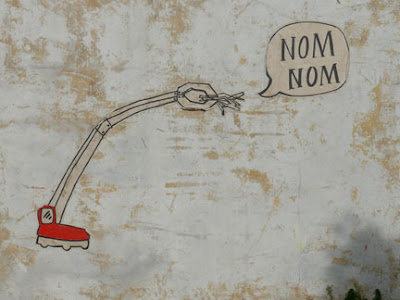
A bit of Christchurch graffiti humour.
There is a new temporary central library opening tomorrow, further south - I may try that one next time, both to see if they have more books (there are still a lot unable to be retrieved from the damaged main library), and to see if the surrounding streetscape is a little less depressing.
Here is a small park (actually I think it was used as the set of a children's TV show) just along from the library three weeks ago

and here it is when I went yesterday

I felt incredibly sad to see just how many buildings are disappearing, and there are more to come.

Another from three weeks ago - the tall building behind the crane is the Price Waterhouse tower - soon to be completely gone.

A bit of Christchurch graffiti humour.
There is a new temporary central library opening tomorrow, further south - I may try that one next time, both to see if they have more books (there are still a lot unable to be retrieved from the damaged main library), and to see if the surrounding streetscape is a little less depressing.
Wednesday, June 20, 2012
Tuesday Poets do Flash Fiction
I have been nursing a cold - sleeping in, then huddled under a pile of quilts working my way through Wolf Hall, which is a very fat book. In the meantime,for your reading pleasure, many of the Tuesday Poets are celebrating flash fiction this week.
And over at Helen Lowe's blog, she has chosen Learning Italian, one of my poems, for the Tuesday Poem this week. Thanks, Helen!
And over at Helen Lowe's blog, she has chosen Learning Italian, one of my poems, for the Tuesday Poem this week. Thanks, Helen!
Tuesday, June 12, 2012
Tuesday Poem: The Beautiful Morning by Fiona Farrell
The Beautiful Morning
On beautiful mornings,
flowers fling up their
bright skirts, trees wink
and children run from
their parents' hands to
stand in the crack that
has opened overnight
outside the kitchen.
They jump in.
They jump out.
In and out
as if it were a crocodile.
The earth lies still and
lets them jump
in
and out
of its open mouth.
On beautiful mornings
the front of the bagel shop
falls down flat on the street.
The pub slumps in the gutter.
And the church across the
road lays down its heavy
cross. It spreads itself in
tiny pieces, no bigger than
a man's hand
among the daffodils.
- Fiona Farrell
******
Fiona Farrell's poem "The Beautiful Morning" was published in Catalyst, volume 9 and also in The Broken Book which was last week shortlisted in the general non-fiction category for the New Zealand Book Awards. The Broken Book is the book that Fiona was writing when the 2010 and 2011 earthquakes struck Christchurch. Originally a book about walking, it has lovely passages which ramble in the way one might do when taking a leisurely walk about the countryside. However the earthquakes changed the nature of the book, and interspersed with the prose are a dozen or so poems which interrupt the text in the same way that the earthquakes have disrupted all our lives.
I loved the way that The Beautiful Morning set beauty alongside destruction in such a matter of fact way. And I found the whole book really absorbing to read, a worthy contender for the book awards. (With the poetry shortlist being restricted to three books, it is nice to see a little extra poetry sneaking in to another category).
It was a good week for Fiona last week - as well as her book being shortlisted, she was made an Officer of the New Zealand Order of Merit on the Queens Birthday honours list for her services to writing.
For more Tuesday Poems visit the main hub site.
Wednesday, June 06, 2012
Snow Day


We don't usually get snow this early in winter but it fell heavily all day today. Unlike many people I did manage to get to work as it is not too far from my home. All the buses stopped at 11 a.m. Most schools and many businesses were closed. The garden in the photo is next door to the place where I work, and I took the bird photographs through the window at lunchtime. The large flower panicles belong to a cabbage palm (ti kouka in Maori) and the little waxeyes were all over them. I'm guessing that they need to eat a lot on cold days to keep up their body heat.
I did get to come home a little early so as not to be on the icy roads when it was getting dark. And our usual Wednesday bridge night was cancelled so I have tackled some long overdue housework - nothing like being active for keeping warm. Back to work in the morning, if the snow stops overnight as forecast.
Tuesday, May 29, 2012
Tuesday Poem: Written in the Churchyard at Middleton in Sussex
Written in the Churchyard at Middleton in Sussex
Pressed by the moon, mute arbitress of tides,
While the loud equinox its power combines,
The sea no more its swelling surge confines,
But o'er the shrinking land sublimely rides.
The wild blast, rising from the western cave,
Drives the huge billows from their heaving bed,
Tears from their grassy tombs the village dead,
And breaks the silent sabbath of the grave!
With shells and sea-weed mingled, on the shore
Lo! their bones whiten in the frequent wave;
But vain to them the winds and waters rave;
They hear the warring elements no more;
While I am doomed - by life's long storm oppressed,
To gaze with envy on their gloomy rest.
- Charlotte Smith ((1749 - 1806)
I have been reading a small book, "101 Sonnets from Shakespeare to Heaney" edited by Don Paterson and published by Faber and Faber. It has been a revelation - there is a very interesting introduction which discusses that old question "what is a sonnet?" (the answer - it has fourteen lines - probably) and goes on to explain why the sonnet in particular is a perfect shape to contain human thought.
This is followed by the sonnets, from 101 different poets, many familiar, but others new to me. One of these is Charlotte Smith. Years back when I studied poetry at high school, it didn't occur to me that we were not taught any female poets. If pressed, I could have named Christina Rosetti ("Goblin Market") and Elizabeth Barrett Browning ("Sonnets from the Portuguese") and if I thought even harder, I might have remembered Eileen Duggan, whose poem "The Kingfisher" was thought suitable for primary school children - but that was it, against the dozens and dozens of male poets that were taught to us or at least mentioned.
There are of course many contemporary women poets - and I've gradually become aware of earlier ones - Emily Dickinson, Margaret Cavendish, Anne Bradstreet, Amy Lowell and others - but hadn't come across Charlotte Smith before picking up this book. The sonnet form became highly popular in England during the Elizabethan period, but then fell into disregard. It was largely due to Charlotte Smith that it became popular again among Romantic poets such as Wordsworth. For this, she deserves to be much better known.
Tuesday, May 15, 2012
Tuesday Poem: from Kitchen Sonnets
Kitchen Sonnets 3
Sometimes I feel ten years old, watching you
in the kitchen. You are mixing mash for the hens.
I will feed them, gather the eggs, carry them
carefully into the house. Did you ever wonder
how eggs in the nest bear the warm weight
of the hen and do not break? Here I am now,
older than you ever were. I don’t feel wise,
but astonished to have arrived in this body.
Every year there is more I do not know.
There is so much I would still ask you, but
you would not know the answers, even if you could speak.
I am the child who has run ahead on the path.
I glance over my shoulder, you are no longer there.
I am as strong as eggshells, and ready to break open.
**********
Since Mother's Day has just passed, I decided to repost this which is one of three "Kitchen sonnets" first published in Takahe magazine and later in Flap: the Chookbook 2. My mother died fairly young, and I have been older than she was for several years now. So this is posted in her memory.
For more Tuesday Poems visit the main hub site.
Tuesday, May 08, 2012
Tuesday Poem: The Poker Players
The Poker Players
A cold wind has passed
down the street on horseback,
shooting up the town,
lashing his whip.
The poker players have made
their declaration: “I’m out”
and flung down their hands
of various golden suits.
Leaves lie in drifts - the spade-like poplars,
lobed maples, and willow
pointed like diamonds.
The players stand about the saloon
grey and gaunt,
against a background of imperturbable green.
Kowhai, manuka, ake ake;
the natives are still in the game.
They are keeping their cards close to their chests.
- Catherine Fitchett
*******
It seemed a good time to post something seasonal. This is also fitting because I have been playing cards a lot over the past year - bridge, not poker. New Zealand native plants - of which three are named in the poem - are mostly evergreen (not just the conifers), as opposed to the imported English varieties common in Christchurch, such as willows, oaks, chestnuts and poplars. "The Poker Players" was first published in the Christchurch Press and also appears in Flap: The Chookbook 2.
Tuesday, May 01, 2012
Tuesday Poem: A Brief for the Defense, by Jack Gilbert
I came across Jack Gilbert's poem "A Brief for the Defense" a few days ago, after finding a reference to it in an interview with Jack Gilbert posted at the Poetry Daily website.
A google search revealed a few Youtube videos, but none of them turned out to be the author reading it, and I didn't like the rather overwrought voice of the young woman in one of them - so rather than embed the video, I am just posting the link to the text.
The central message of the poem "we must risk delight" is a powerful reminder, at a time when we seem to be surrounded by bad news in Christchurch - more and more buildings that will have to be demolished, a growing housing crisis, lack of progress on insurance issues, and so on. All of which pales into insignificance compared with problems elsewhere in the world. Gilbert's poem addresses all this very powerfully.
I am aware that asking readers to click links to another site risks losing attention on the internet - but click the link anyway, the poem is worth it.
Tuesday, April 24, 2012
Tuesday Poem: The Herbert Plot, by Jenny Powell
The Herbert Plot
for Donna Demente
As if you were chasing summer
and taking an apartment on the Riviera
or travelling on a tour of galleries
and architectural treasures,
you announce a stopover
at Herbert, ticket purchased,
documentation all in order,
the plot written and waiting
for an opening, there on those
green hills. Not highland hills
or Emerald Isles but Mount Charles
where the heart's land rises
hill upon hill and in their bones
history rattles. The slow gaze of time
wraps a hundred shades of love
and sorrow in a convergence
of yellow and blue, the last echo
of life tumbling down to the sea,
lifting into the requiem of night,
Donna, Donna, Madonna.
- Jenny Powell
******
A week or so back I had the pleasure of attending the launch of three new chapbooks published by Cold Hub Press. Among them was Jenny Powell's new collection , Ticket Home. Jenny was kind enough to give me permission to use a poem from the collection as my Tuesday Poem this week. I have been enjoying reading her poems very much. As often happens, to navigate the difficulty of choosing among them, I settled on one with personal resonances - I remember stopping off at the Herbert cemetery referred to in the poem some years ago, to search for the graves of my great great uncles and their families. It is a lovely small graveyard on a hillside shaded by pines and other trees. Donna Demente is an artist and gallery owner from Oamaru. Jenny says "The poem was inspired by an exhibition of work by Donna Demente in Oamaru's Forrester Gallery. I didn't want to think about her chosen place. As with many things we don't want to consciously consider, the unconscious has a way of retaining them, hence the poem."
Jenny Powell is a Dunedin poet who has written five individual collections of poetry. She has worked with other poets to produce two collaborative collections, 'Double Jointed' and 'Locating the Madonna.' Her latest collections are 'Vietnam: A Poem Journey' (HeadworX, 2010) and 'Ticket Home' (Cold Hub Press, 2012).
For more Tuesday Poems, visit the hub site to check out the main post for the week, and to visit other Tuesday Poets linked in the sidebar.
Sunday, April 22, 2012
Beckenham Mural

This mural appeared on the brick wall of the pharmacy in Beckenham (a suburb near me) in the last week or so. Some of the buildings depicted were destroyed in the earthquake, including those on the now vacant lot next to the wall. I suspect the appearance of the mural means that nothing will be built there any time soon.
It was estimated that, to replace all the buildings that were destroyed, a new one would need to be completed every four days for the next ten years. And ongoing insurance problems are slowing the rebuild. It will happen, eventually, but in the meantime it is good to see artwork like this to brighten up the city.
Wednesday, April 18, 2012
Tuesday Poem on Wednesday
Ozymandias
I met a traveller from an antique land,
Who said: Two vast and trunkless legs of stone
Stand in the desert. Near them, on the sand,
Half sunk, a shattered visage lies, whose frown
And wrinkled lip and sneer of cold command,
Tell that its sculptor well those passions read,
Which yet survive stamped on these lifeless things,
The hand that mocked them, and the heart that fed:
And on the pedestal these words appear:
"My name is Ozymandias, King of Kings:
Look on my works, ye Mighty, and despair!"
Nothing beside remains. Round the decay
Of that colossal wreck, boundless and bare
The lone and level sands stretch far away.
- Percy Bysshe Shelley 1792 - 1822
I find this vision of ancient ruins keeps popping into my mind, with the growing number of demolitions around our city, and the controversy over the future of the Christchurch Cathedral. So I thought I would post it for my Tuesday Poem this week, though I am a day late due to some rather late nights out.
Meantime, at the main Tuesday Poem website, the Tuesday Poets have been building a collaborative poem for our second birthday. We have constructed it by contributing a line each in turn. It was great fun to do (and challenging, as well).
Tuesday, April 10, 2012
Tuesday Poem: Easter, by George Herbert
Easter
Rise heart; thy Lord is risen. Sing his praise
Without delayes,
Who takes thee by the hand, that thou likewise
With him mayst rise:
That, as his death calcined thee to dust,
His life may make thee gold, and much more, just.
Awake, my lute, and struggle for thy part
With all thy art.
The crosse taught all wood to resound his name,
Who bore the same.
His stretched sinews taught all strings, what key
Is best to celebrate this most high day.
Consort both heart and lute, and twist a song
Pleasant and long:
Or, since all musick is but three parts vied
And multiplied,
O let thy blessed Spirit bear a part,
And make up our defects with his sweet art.
I got me flowers to straw thy way;
I got me boughs off many a tree:
But thou wast up by break of day,
And brought’st thy sweets along with thee.
The Sunne arising in the East,
Though he give light, & th’ East perfume;
If they should offer to contest
With thy arising, they presume.
Can there be any day but this,
Though many sunnes to shine endeavour?
We count three hundred, but we misse:
There is but one, and that one ever.
George Herbert (1593 - 1633)
This seemed an appropriate song to post as my Tuesday Poem this week. There is an extensive discussion of the poem at Patrick Comerford's blog here.
Subscribe to:
Posts (Atom)