Pages

Saturday, July 30, 2011

A Month of Photos #8


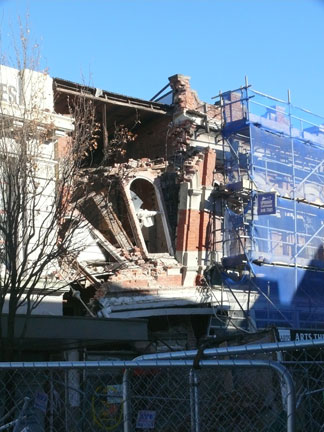
Someone has been putting giant bandaids on damaged buildings around the city..

Friday, July 29, 2011

A Month of Photos #7


Once a week I go to clear a Post Office Box which is theoretically located in the Central City. But since that is still cordoned off, the box has been relocated to a temporary site, which also serves as the base for the postal rounds for a large part of the east of the city.

There are often a few bicycles lined up there, but this morning there were a large number. You can see that there is still some snow on the ground - which may be why these bikes weren't out with the posties, as they usually ride on the pavement to reach the letter boxes, and many of the pavements are still very icy.

I have a weakness for anything that makes a repetitive sort of pattern..

Thursday, July 28, 2011

A Month of Photos #6


There's still quite a bit of snow about. I just had time to stop on the way home and snap this shot looking over a nearby park, before it got dark.

Wednesday, July 27, 2011

A Month of Photos #5


Yesterday morning was spent shovelling snow from our driveway so that I could get my car out to go to work. It wasn't helped by the fact that the road had been cleared by a digger which left big banks of snow blocking the foot of the driveway!

My muscles are still aching. But on the underside of one of the slabs of snow, I found twigs arranged to form this smiley face.

Tuesday, July 26, 2011

Tuesday Poem: Rapanui, by Barbara Strang


Rapanui

This year for the first time
we can walk right
up to the rock, she said.

I love this texture
the red knobbled base,
the curving basalt upstands,

see that bush
clinging on a high ledge -
amazing how plants survive.

If we could like mice
enter those crannies in the base
we'd be safe.

And do you know the true name
for this rock, she said?

Not answering
he turned away.

-Barbara Strang

*************

I have been enjoying Christchurch poet Barbara Strang's new collection, The Corrosion Zone, which is published by Headworkx.

'Rapanui' is the Māori name for Shag Rock, meaning the great stern-post. The rock was a sentinel on the way to Sumner beach, but unfortunately it fell down in the earthquake of 22nd February, 2011. Visiting Sumner a week or two ago and seeing the rock in its present state put me in mind particularly of this poem. The photo at the head of the column shows the rock as it is now.

And here is a stunningly beautiful photo of the rock as it was.

Also among this week's Tuesday poems is another of Barbara's poems, Fatigues, at Tim Jones's blog. For more poems, visit the main Tuesday Poem hub site. (Check out the links in the side bar).

Monday, July 25, 2011

A Month of Photos #3


Snow Day!

Sunday, July 24, 2011

A Month of Photos #2


I had to walk round to the corner store to get milk this morning. I took some photos of the local library and shops - that is, of the demolition progress - but this caught my eye. The standard method around here of identifying which house is hosting a child's birthday party.

We can use a few smiles!

Saturday, July 23, 2011

A Month of Photos: #1 Front Row Seat


One of the blogs I visit quite frequently is Susannah Conway's. For the second year, Susannah is running the "August break" in which she posts a photo a day, and encourages others to do the same, as a break from writing wordy blog posts. It's a summer thing. Except that it isn't summer here, and anyway I will be away for the last week of August with unreliable internet access. But I like the idea of posting a photo a day for a while, so I thought I would start now, which gives me just time to get a full month in before I go.

I'll try to make it a sort of daily diary, posting a photo taken that day. But since there's not much daylight left when I get home from work, I may not always keep to that.

This photo in fact was taken yesterday. I drove past this scene without a camera, and took a trip back to get the photo. The stadium in the background was upgraded at huge cost for the forthcoming Rugby World Cup. Since it was damaged in the earthquake, it has not been used, and there is speculation that in fact the ground is so badly damaged that it may never be used again.

Of course it's not the ground as such that's the problem, it is whether or not it can bear the weight of several large multi storey grandstands. I think back to the days when my Dad took me to watch the rugby, and we stood on the sideline, or ran up and down, shouting "come on blues!". I had no idea back then what the game was actually about - I'm not much more knowledgeable about it now, either.

National Poetry Day

The US gets National Poetry Month, but here in New Zealand we get one day. For some reason, Poetry Day events in Christchurch always seem to be held in the day time. If I lived in Auckland, Wellington, Dunedin or a number of other places, there would be evening events to go to. But for the last few years I have always been working on a Friday and hence unable to participate.

At last I have Fridays free. Which means I was able to attend the reading held at the University Bookshop - a wonderful shop that I would frequent more if it weren't for the issue of parking, as all parking on campus is permit only. It was a treat to be in a proper bookshop, one that doesn't give prominence to cookbooks and "biographies" of sports stars. And a treat to hear readings from local poets Kerrin Sharpe, James Norcliffe and Tusiata Avia, followed by a performance by singer-songwriter Adam McGrath of The Eastern.

There were earthquake poems, of course. But not too many. Tusiata Avia read her poem describing her drive to pick up her daughter from her inner city preschool, in grid-locked traffic after February's quake. Her journey turned into a hero's epic, in which her street turned into a river (that part at least, would not be exaggerated at all). Hordes of drowned wildebeests made an appearance, and she drove for five days. It was a powerful poem, full of emotional truth if not literal truth.

James Norcliffe's earthquake poem referred to "The Death of Seneca". It's always hard to remember poems hear once, however the phrase "the earth shrugged" sticks with me. Jim's poems, he said, were rather dark, but the commentary that comes with them is always spiced with humour, and the audience had plenty of opportunities to laugh.

Kerrin Sharpe spent a year at the International Institute of Modern Letters in Wellington. A number of her poems were set in Wellington. I particularly enjoyed "Sewing the World". Her mother, apparently, was a milliner. This poem was full of references to stitches such as feather stitch - but also to the streets of Wellington - a bonus for me as I spent the first half of my life there, and each street name triggered a visual picture in my mind. Although there is nothing in the way of straight forward fact in Kerrin's poems - she has a magical way of looking at the world.

Afterwards I browsed the bookshelves and found a small selection of "Revived Editions" i.e. second hand books. Most of the city's second hand bookshops have been casualties of the earthquake. So I was delighted to find some excellent poetry books here at very reasonable prices, and brought three home with me.

Monday, July 18, 2011

Tuesday Poem: Clock-O'-Clay, by John Clare

Clock-O'-Clay

In the cowslip pips I lie,
Hidden from the buzzing fly,
While green grass beneath me lies,
Pearled with dew like fishes' eyes,
Here I lie, a clock-o'-clay,
Waiting for the time o' day.

While the forest quakes surprise,
And the wild wind sobs and sighs,
My home rocks as like to fall,
On its pillar green and tall;
When the pattering rain drives by
Clock-o'-clay keeps warm and dry.

Day by day and night by night,
All the week I hide from sight;
In the cowslip pips I lie,
In the rain still warm and dry;
Day and night, and night and day,
Red, black-spotted clock-o'-clay.

My home shakes in wind and showers,
Pale green pillar topped with flowers,
Bending at the wild wind's breath,
Till I touch the grass beneath;
Here I live, lone clock-o'-clay,
Watching for the time of day.

John Clare (1793-1864)

**********

A year or so back I read Adam Foulds' novel The Quickening Maze - or is it a novel? It reads as one, but focuses on real people - the poets John Clare and Alfred, Lord Tennyson, and the doctor who treated both John Clare and Tennyson's brother Septimus. How much is truth and how much fiction I am not sure, but it is a compelling book.

John Clare was known as "the peasant poet". He was feted for a time, but never really fit in with the literati of the day, or with the rural society into which he was born. He spent the last part of his life in an asylum, gradually losing his grasp on reality.

Somehow his poems are ones I missed out on when studying 19th century English poets at high school. Reading the novel led me to seek them out. This one rather appealed to me, even before a google search led me to the meaning of "clock o'clay" which is, apparently, 19th century Northamptonshire dialect for a ladybird.

Saturday, July 16, 2011

City Farmyard


Some would-be farmers in the city keep chickens. And others...

I spotted the cow when I was out and about yesterday. Actually, it's fiberglass. But it made me smile.

Also making me smile are a couple of poetry acceptances recently. I'm a bit reticent to give the details until I see the poems in print. Earlier in the year, I had an acceptance that somehow didn't eventuate. The (online) journal appeared, my poem wasn't in it. Since it was the last issue before going into recess for a while, at least I feel that I can safely send the poem elsewhere.

I've been sending the poems out, but I haven't been writing anything new for a while. I figure that rather than waste time moping around not writing poems (which can take a lot of energy, it seems), it's better to do what takes my fancy. Walks on the beach to take photos. Home baking. Today I made it to a fabric/craft/homeware store where I bought thread and curtain tape, the first step to making some new curtains. I'm tired of the ones that threaten to disintegrate every time I grab hold to open or close them. And curtain making is one thing that doesn't need to go on hold while insurance claims are settled.

Monday, July 11, 2011

Christchurch Earthquake Photos


A collapsed building in High Street.


The Hotel Grand Chancellor or "Leaning Tower of Christchurch". Demolition will take about a year, one level at a time.


Workmen taking down the damaged dome from the Cathedral of the Blessed Sacrament.


A view of High St through a statue outside the Christchurch Polytechnic. This statue was erected as part of the 6th Scape Biennial of Art in Public Spaces, which never happened due to the first quake on September 4th 2010.


Signs on the fence behind damaged buildings in High St.

While the rest of the country suffered wild weather and tornadoes, Christchurch basked in winter sunshine over the weekend. I took a break from running errands to explore a little further into the city, just to see how far I could get before coming up against the inevitable cordons.

We used to play a board game with the children called "The Amazing Labyrinth". It was a simple sort of roll the dice and navigate a pathway game, except for one feature - at each turn, the player took a loose piece of the board, and used it to shove a row of similarly loose pieces, so that the pathway changed, blocking routes that were previously open. Christchurch feels a bit like that at the moment. You never know when a tower will suddenly be declared potentially unsafe, and a street is closed off while it is inspected. Or there is flooding of low-lying riverside streets due to an exceptionally high tide. Or perhaps a street opens up once demolitions of dangerous buildings have been completed.

There are about 1000 buildings on the yet-to-be-demolished list.

Yesterday my daughter admired my shoes and asked where I bought them. I couldn't remember the exact shop, but I knew what area, and that the shop undoubtedly is not there any more.

We had visits from our insurance company and the EQC (government earthquake insurance agency) last week. No dollar figure yet, but we do have a long list of what will be fixed. The insurance company will take care of the driveway and all the walls and fences. EQC will jack up and level the front of the house, re-hang the doors that don't work, fill in all the cracks in the interior walls and ceilings, replaster the ceilings, repaper the walls, fill in the cracks in the exterior walls and repaint. And rebuild the chimney. Although there is some scheme whereby we can have a clean heat appliance instead, given that it's not actually legal to use an open fire any more. Some time within the next month we will find out their estimate for the cost. If it's less than $100,000, we go on the long list for their preferred contractor to manage the repairs. If it's more, they give us a cheque and our insurance company covers the balance.

I'm not in a hurry - if we get it fixed and there's another big aftershock, we could be back to square one. So waiting a year or so seems like a very good idea just now.

Tuesday, July 05, 2011

Tuesday Poem: Australian Poetry Library

I'm feeling a little lazy today - so instead of posting a poem, I have a link to offer:
The Australian Poetry Library has over 42,000 poems by more than 170 poets for you to choose from, all free to view online.

Monday, July 04, 2011

Weekend Pleasures

1. Three days of beautiful sunny weather. It has been unusually warm for the middle of winter.

2. Saturday was only the second day since February 22nd that there were no aftershocks felt in Christchurch.

3. Shoes! I went to a shoe outlet sale and stocked up on sensible leather shoes at bargain prices - then added to my purchases a ridiculously frivolous pair of summer sandals in "citrus" - a sort of lemony lime colour. I think it is the first ever pair of shoes that I have bought in a non-neutral colour, but they were so cheap that I thought the smiles they give me justified the purchase.

4. I had a very long soak in a warm bath. I expected to feel a little guilty - we are supposed to be limiting water use still, and not creating too much grey water, because of drainage issues. But in fact it brought me so much pleasure that I didn't feel guilty at all. I won't be taking another one for a while, though.

5. I went to a craft fair on Saturday and enjoyed browsing among the stalls. Lovely to look at, but not so much to buy - many of the stalls seemed to be aimed at the doting grandmother market, and I don't have any rug rats to buy for. I did bring home some brochures particularly for fabric stores that sell online.

Monday, June 27, 2011

Tuesday Poem: Sea Call, by Hone Tuwhare

Sea Call

Let the radio pip and shudder
at each dawn’s news

Let the weatherman hint
a gaunt meaning to the chill
and ache of bone:
but when the new moon’s bowl
is storing rain, the pull of time
and sea will cry to me
again.

And I shall stuff my longing
in an empty pack
and hasten to the secret shore
where the land’s curve lies
clad in vermilion – and the green
wind tugging gravely.

There let the waves lave
pleasuring the body’s senses,
and the sun’s feet
shall twinkle and flex
to the sea-egg’s needling
and the paua’s stout kiss
shall drain a rock’s heart
to the sandbar’s booming.

- Hone Tuwhare
reproduced by permission of the estate of Hone Tuwhare

I was about eleven or twelve when I fell in love with John Masefield's poem, Sea Fever. It spoke to a solitary young girl who spent a great deal of time at the beach, swimming, clambering over rocks and dabbling in rock pools - elements of the poem such as "the call of the running tide"... "the flung spray and the blown spume, and the seagulls crying" were very familiar to me.

Sea Fever though, speaks of a mariner, leading a "vagrant gypsy life" far from shore.

Hone Tuwhare's poem Sea Call seems to me to express something of the same longing in a more shore-bound way, closer to my childhood experience. There are some beautiful images in here - the land's curve clad in vermilion (surely a reference to the red blossom of coastal pohutukawa trees), the sun's feet which twinkle and flex, the paua's stout kiss. I was unfamiliar with this poem until I heard it read at the launch of the Phantom Billstickers Poetry Poster series. I was delighted to be able to bring home a small size version of the poster on which it appears (coming soon to a lamp post near you!) It was to be read by Hone's son Rob, but Rob's flight from Auckland was unfortunately cancelled due to volcanic ash, so another reader took his place.

My thanks to Rob for permission to reproduce the poem here.

For more Tuesday poems go to the main hub site, where there is a poem posted each week. Further poems can be found on the blogs of the participants listed in the sidebar there. Biographical details and more of Hone Tuwhare's poems can be found at the Hone Tuwhare Charitable Trust website linked to his name above.

Thursday, June 23, 2011

Hurry Up and Wait

Today was the day when the government made a major announcement on the future of homes in Christchurch. The earthquake didn't just damage homes - it damaged the land beneath. There are large areas now where the land is so damaged that it can't be rebuilt on. It has become prone to flooding, and all the underground services are wrecked - "munted" is the slang term that has become very familiar lately - sewage, water and so on. To repair the land would require all the homes in the area - damaged or not - to be demolished, so the ground can be compacted, in some cases raised up to three metres, and all the underground services completely replaced. Also, in some areas it had been proposed to sink giant stone walls into the ground along the river banks to prevent lateral spreading. This is where the land moves sideways and develops huge cracks, usually towards the river as there is nothing to stop the sideways movement there. Only when the land repair is complete could the houses be rebuilt. This would mean at least three years, probably five or more, before the residents could return to their homes.

So, the city has been divided into four areas. Red zone residents - about 5000 homes - are being offered an immediate compensation package by the government so they can sell up and move on. The orange zone of another 10,000 homes requires further assessment, in particular because the June 13th aftershocks changed the situation yet again. Some of this zone will become red and some will become green. The green zone is OK to rebuild on. The white zone - mainly the hill suburbs - has not yet been assessed. The hazards in the white area are more related to rockfalls than flooding.

Our house, as expected, is in the green zone. And the landcheck website told us, earlier today, that this meant repair and rebuilding could now proceed. Yeah right, I thought, but we haven't even seen an insurance assessor yet, let alone had a payout. (300,000 insurance claims take a while to work through). Strangely, when I went to check the exact wording, I found it had been changed! It no longer says that repair and rebuilding can proceed immediately, just that we should talk with our insurer and EQC (the government earthquake insurance) about repairs. It also advises that some work should be delayed until ongoing aftershocks settle down.

I can't honestly say that if we were offered settlement today, we'd be in a hurry to begin work tomorrow. Plastering cracked walls and ceilings for instance, seems a little crazy when there is a 30% chance of another aftershock bigger than 6.0

So - for those in the red zone, a settlement offer will arrive within eight weeks, orange will have to wait several more months to be reclassified red or green, white will have to wait an indefinite time to get any sort of classification, and everyone but red will have to wait while the backlog of claims is processed and then until the ground stops shaking so that there is actually some point in fixing things up.

And while our house is zoned green, I was shocked to discover just how much of our area is zoned orange, including neighbours just three houses down the street towards the river, all the houses along the river just around the corner, and the house we lived in before we moved to our current house.

We had been planning to add on to that house to accommodate our growing family, and then spotted this one for sale, and decided it was so much easier just to move to a larger house rather than go through the problems of adding on. It was a lucky find, being large enough for a family of four children (later to be five), and only two blocks away.

I don't know whether to feel fortunate that we moved, or sad for our friends and neighbours still in limbo waiting for a final answer.

Tuesday, June 21, 2011

Tuesday Poem

North American Periodic Cicada

It will happen like this:
after the struggle, he will leave in haste,
return with a spade and dig
a shallow grave in the quiet woods.
The victim, who lived alone,
will not be missed until the neighbour
sees the overflowing mailbox,
knocks on the door a week later.
The assailant is long gone.

Or, it will happen like this:
he will dig a shallow grave.
Too shallow. A boy will walk with his dog
through these woods. The dog will sniff
the freshly dug earth, paw at it,
uncover what has been done.
The assailant, blood on his shirt,
will be stopped at a police roadblock
crossing into the next state.

No, this is what will happen.
There is a struggle in the woods.
Later that night a phenomenon that comes round
once every seventeen years -
a horde of insects crawl from the ground,
make their way around the corpse, through
the soft earth, up the trunks of trees. They split
their shells, emerge soft bodied.
Billions of creatures harden on branches
until by daytime they take to the air.
Before the boy comes by with his curious dog,
empty shells will rain honey-coloured,
covering the ground for miles.
The woods crunch underfoot. The boy
will not venture far in, the dog
will not spot the soft earth.
There will be no manhunt until
the assailant is several states away,
living a new life. And if he keeps his secret
the cicadas, deep in the earth for another seventeen years,
will not reveal it for him.

************

"North American Periodic Cicada" is one of the poems in Flap: the Chook Book 2, my small poetry group's recent collection which is reviewed on the just-updated website for Takahe magazine.

It came about like this: I had been reading the foreword to Best American Poems (the 2006 edition, if I recall correctly) for which Billy Collins was one of the editors. He was discussing elements in poems that were deal breakers for him, and one of them was the word "cicada". Apparently, if he comes across it in a poem, he finds himself unable to read on.

No explanation was given. I found myself wondering what it was that he objected to about cicadas. It seemed to me that perhaps many poets use cicadas as a sort of sentimental evocation of the sounds of summer. So I was immediately attracted to the idea of writing a non-sentimental cicada poem. And that night I watched a nature documentary on TV, which included the phenomenon of the North American Periodic Cicada, an insect which spends seventeen years underground before metamorphosing into its adult form. Furthermore, all the members of the species emerge en masse in one night. It is apparently quite spectacular when it happens. I started imagining what the dense layer of cast off exoskeletons might cover up.

The poem has been slightly edited from its original version, which first appeared at Blackmail Press online, in the Secrets issue.

For more Tuesday Poems, visit the main hub site, and the contributors listed in the sidebar at the Tuesday Poem site.

Friday, June 17, 2011

And the Number for Today Is...

4.4
That was the size of the aftershock which served as the city's alarm clock at 6.30 this morning. I did get back to sleep after that one. I got up a couple of hours later, happy that it was Friday and I had a free day to run around and work through my long list of errands, and wonder again how I ever found time to work five days a week.

Fridays will be even better once I don't have a long list of errands to do.

I came home and was relaxing when we had another couple of 4.4s - actually the second I think was 4.5. It bounced the coffee out of my coffee cup and into my lap. Just as well that it was a cold day as I had enough layers on to insulate me from the effects.

My brother and his wife arrived to do their laundry and have showers as there is still no water on in their suburb. They live very near the epicentre of Monday's two big shakes, and their area took a hammering. Fortunately their own house is still liveable.

The day ended better than it started, as I headed off to a poetry reading - the Global launch of the Phantom Billstickers' sixth series of poetry posters. It was held in a venue I've never been to before - the Addington Coffee Co-op. Addington is a former working class suburb just on the western fringe of the city. It's been seeing a lot of action recently as businesses relocate to new office parks there, along with retail and hospitality businesses displaced from the central city. There were a few traffic problems on the way - it was rush hour - but it was worth it. The selection of poets reading was generous - large numbers brought in from out of town, as well as local poets, to read one poem each - and the free catering was equally generous. I've been going to the Canterbury Poets Collective annual series of readings for quite a few years, and thought I knew all the local poets, but many tonight were unfamiliar to me. It was a pleasure to be going to any event at a time when so much has been cancelled, and rescheduled, and cancelled again. (Though a few of the invited poets didn't make it due to flights being disrupted by ash from the Chilean volcano - others read their poems for them).

Almost as exciting as going to a poetry event was seeing a table full of glasses next to a tap with a sign that read "We have a UV water purification system - our water is safe to drink".

The Phantom Billstickers main business is putting up posters on hoardings for pay - concert posters, and so on - but the poetry posters are, as far as I can tell, something that they do just for the love of poetry. The poems we heard tonight will soon be gracing lampposts, walls and hoardings all over - not just in New Zealand, but in the United States too - Boston, New Jersey and Pennsylvania were some of the places mentioned. They were also giving away free smaller sized versions of the posters, and I brought several home with me.

Thursday, June 16, 2011

Earthquake Play List

My earthquake playlist has been growing slowly since shortly after the September quake when one of our local radio stations happened to be playing Carole King just as an aftershock hit. I'm sure this list would be longer if I had a better knowledge of popular music. Some of these songs may not be familiar to overseas (or younger) readers, but I'm sure a quick google search will find most of them on Youtube.

1. I Feel the Earth Move - Carole King

2. Shake, Rattle and Roll - various artists including Bill Haley, Buddy Holly and Elvis

3. Good Vibrations - the Beach Boys

4. Tumblin'Down - Maria Dallas

5. Rock Around the Clock - Bill Haley again

6. The Gumboot Song - John Clarke aka Fred Dagg. This is one that our local radio played for all those digging silt off their properties, yet again, after the double quakes on Monday.

Any more suggestions welcome.

Edit: Some great suggestions in the comments, also, I intended to include "Here We Go Again" on the list, but I can't quite find the one I was thinking of - there are it seems many variants on this title - "Here We Go Again", "Here I Go Again", "There You Go Again" and so on, but none of them is quite the song that is playing in my head.

Tuesday, June 14, 2011

Tuesday Poem: Bubbles, by Siobhan Harvey

Bubbles

Buoyant and with breath enough
to blow out two candles, you
purse lips, expel air, create a rainbow-
coloured world for the first time. Like you,
it dances, fat bee, around spring garden
bright with early stargazers. Afloat,
it anchors you before it, a deity, so in its skin
you discover yourself turned topsy-turvy,
and the world at your back upended also.

Then it vanishes, just as you, my little atom,
will vanish in time. Suddenly,
when you’re big enough, you’ll drift away
to new worlds, spinning stories home
about pearl-diving off Isla de Coche;
night-watching the Golden Gate’s glassy lights;
hot air ballooning over an oracular el-Colossat;
lazy Sundays playing boules in les Tuileries
and sightseeing L’Orangerie and Sacre Coeur.

My heart releases any pain
it feels at the thought
of ever losing you, for I see
now that we’re floating, you and I,
towards that future even as you lift
the wand again, birth and set free
more bubbles. All I need remember is:
the breath I’ve given you carries you onward,
and that breath always belongs to me.

Siobhan Harvey is an enormously busy person - among other things she is the poetry editor for Takahe magazine, the national coordinator for New Zealand Post Poetry Day, teaches creative writing at Auckland University, and is the mother of a young son. Among all this, she has found time to publish her own poetry. Lost Relatives was published this year by Steele Roberts. It explores issues of immigration, identity and family. Siobhan had planned to hold a book launch for Lost Relatives in Christchurch on March 8th. Unfortunately the February 22nd earthquake caused a cancellation of the book launch, but I was able to order a copy direct from the publisher's website. (No book shops were open in Christchurch at the time, or at least, none that stocked poetry - but the service direct from the publishers was excellent and the book arrived within a day or two).

Siobhan says about the poem:

'Bubbles' was inspired by the smallest of acts. My son, who was 18 months old, was blowing bubbles. I loved watching him do this - his sense of accomplishment; the aesthetic beauty of bubbles floating in the sun; the simple act of creating something such as bubbles which were often dazzlingly beautiful. Yet, it struck me, that each time my son blew bubbles, this simple act was framed and, in turn, acted as a frame for far deeper, universal issues which he and I, as son and mother, would have to negotiate in time - such as his growth through childhood and the experiences of motherhood this would bring to me. There was my young son with and close to me. There was I, parentally watching over him achieve a small milestone in the blowing of a bubble. Yet, like the bubble he birthed and let float out into the world, all too soon my son would drift away from me, travel overseas and explore everything the world has to show him. In this sense, the bubbles my son blew were like mirrors which unfolded his - and my - future. Once I'd perceived and considered these issues, the poem came to me. Eventually, it was selected as runner-up in the Inaugural Bernard Gadd Memorial Poetry Prize. Later, the artist Alby Yap selected it for a piece of work he did which was entered into and short-listed for the 2010 Bernard Gadd Art Award. To me, the poem plays a crucial role in the third section 'My Son and I' of my new collection, Lost Relatives.