I've had a busy week so I was glad of the prompt which enabled me to post an old poem from my files. If it is a poem. What makes a prose poem?
I don't think I can answer this, but I believe that it is not really a question that is specific to prose poetry. The question "is it a poem?" is the same question whether it is a piece of writing that has rhyme and metre, or has line breaks, some sort of metre but no rhyme, or whether it is set out in prose (or any variant in between these).
Is it poetry, verse or a jingle?
Is it poetry, or a political statement with line breaks?
Is it poetry or just a rather strange piece of prose?
I don't know.
The first time I found out there was such a thing as a "prose poem" was at the first every poetry workshop I attended. I was browsing a collection of poetry books that were available for our inspiration, and came across the work of Charles Simic. His prose poems are delightfully surreal. I hope you might consider exploring them. In the meantime, here is my own contribution:
Six Blind Men and an Elephant
This is a joke my children used to tell. They would pick some unsuspecting person and ask “I’ve got a riddle for you. What is the difference between an elephant and a hammerfor?” They were just waiting for the question “What’s a hammerfor?” and then they could say “Banging nails in”. We know this joke pretty well by now, so the other day when my daughter asked “what’s a hammerfor?” I said “Banging nails in” almost without thinking and then she asked “what’s a metaphor?” Of course the thing about a metaphor is that it’s really only useful if we know both the things being compared. So I might say for instance that a book is a magic carpet that takes us to other worlds. You know, and I know, dozens of ways that a book is not at all like a magic carpet and that’s why we can appreciate the point of the comparison. And then there’s the old story about six blind men and an elephant. One of them felt the trunk and said it was like a snake. Another had a hold of the tail. “An elephant is very much like a rope” he said. A third, grasping the leg, declared that the elephant was like a tree. And so on. But anyone who hasn’t seen an elephant is left with the image of a snake in a tree which has a rope hanging from one branch, which really doesn’t help much at all. So when I learnt that atoms have nuclei with orbiting electrons, I thought of planetary systems and believed I knew what was going on. Then I learnt that light is particles, called photons, which made some sort of sense, until I learnt about light waves. So which is it, particles or waves? Both, and neither, depending on the mathematics, and that’s when physics started to get confusing. Somewhere around Stage 2 I was completely lost, which is to say, I could do the maths and come up with the right answers, but I just couldn’t picture it any more. That was pretty scary, because up till then I thought I could get a handle on just about anything. And somewhere in the years between then and now, the physicists stopped talking about waves and particles and started talking about tiny strings curled up in about ten or thirteen directions. Now, when I think of Einstein saying “God does not play dice with the universe”, all I can picture is God playing Cat’s Cradle.
Thursday, February 15, 2007

Tuesday, February 13, 2007
Bruises and Boggarts
I think I have been watching too much CSI. I found myself looking at the bruises on my legs and wondering what the coroner would make of them if I died in an accident today. They are particularly distinctive small bruises in little lines. I must admit, the first time I had them I was stumped for quite a while, until I realised they were from squeezing through the strands of wire fences while I was out orienteering. The more athletic young males of course vault over the fences, barely touching except maybe for a hand on top of the fence post for balance.
This is where we were orienteering on Sunday.

The longer courses went right to the top of the hill, but since I do the "short red" course - technically difficult but not too strenuous - the course setter took us mostly into the forest at the bottom of the valley on the right. Since I'm just getting back into orienteering after doing very little last year, I was grateful for the shortness of the course and lack of significant climb. Nothing comes without a downside and in this case it was lots of boggy swampy ground, and lots of prickles. But overall I was pretty pleased with my efforts which show that all my hill climbing in the last few months is paying off. The winner took 52 minutes, I took 1 hour 22 minutes, and the slowest on the course was 2 hours 30 minutes (someone who got lost and added a big extra loop to the course).
If you'd told me when I was a teenager that one day I'd be competing in organised sport, I'd have laughed. This is because I lack coordination for ball sports, and I can't run. OK, to some extent I believe that anyone can improve at anything they want to if they practice enough. But I also believe in inborn differences between people. And I think I have good reason to believe I can't run. I was a real outdoor kid, often found up trees, loving the beach, able to swim long distances (slowly) and going for long Sunday afternoon walks with my father. I loved the outdoors. But I wasn't speedy. Fortunately I went to a small primary school and there wasn't much in the way of athletics. Once a year we went to the interschool sports day where I would take part in the obligatory running race, finish twenty or thirty yards behind everyone else (and that was the heats, not the final), feel stupid for a little while and then enjoy the day in the sun with my family, with treats such as pies for lunch and ice creams.
The humiliation I still remember though was at Brownies. Once a Brownie had passed the initial simple tests like learning the Brownie law and promise, it was time for enrolment. And the enrolment ceremony involved being chased by a boggart. Not a real boggart, of course. Another Brownie was chosen to be the boggart. I had to start at one side of the fairy ring, the boggart started at the other side, and I was chased twice around the fairy ring before running to the centre. The story was that if the boggart caught you, you couldn't be a Brownie. I don't think it ever occurred to anyone that the boggart would ever catch anyone. After all that would mean running 33% faster. But just before I got to the centre, I felt the boggart tag me. And of course the leaders had to pretend that it hadn't happened. So, apart from feeling utterly humiliated that I was so slow that it hadn't occurred to them that anyone could be that slow, I learnt that adults should really think carefully before they threated a punishment that they have no intention of carrying out.
That was all sprinting, of course. Maybe if we had had cross country running at school, it would have been a different matter. All my children seem to have had to run cross country at school, but it didn't seem to happen so much back then.
After I first heard about orienteering and thinking that sounded fun, it took me a while to get into it because I thought I would have to be able to run better. But in fact there's room for all abilities, and good navigation makes up for a lot. When I started, my children were small. Walking round the easy courses with a two or three year old in tow is a wonderful excuse to be slow. I'm not expecting to win anything this year, unless the faster runners in my age group make some huge mistakes in navigation, but I aim to get to no more than 25% slower than the winning time.
Blogger has forced me to upgrade, finally. It seems to be OK. But it works no better with Safari than the old blogger does.
This is where we were orienteering on Sunday.

The longer courses went right to the top of the hill, but since I do the "short red" course - technically difficult but not too strenuous - the course setter took us mostly into the forest at the bottom of the valley on the right. Since I'm just getting back into orienteering after doing very little last year, I was grateful for the shortness of the course and lack of significant climb. Nothing comes without a downside and in this case it was lots of boggy swampy ground, and lots of prickles. But overall I was pretty pleased with my efforts which show that all my hill climbing in the last few months is paying off. The winner took 52 minutes, I took 1 hour 22 minutes, and the slowest on the course was 2 hours 30 minutes (someone who got lost and added a big extra loop to the course).
If you'd told me when I was a teenager that one day I'd be competing in organised sport, I'd have laughed. This is because I lack coordination for ball sports, and I can't run. OK, to some extent I believe that anyone can improve at anything they want to if they practice enough. But I also believe in inborn differences between people. And I think I have good reason to believe I can't run. I was a real outdoor kid, often found up trees, loving the beach, able to swim long distances (slowly) and going for long Sunday afternoon walks with my father. I loved the outdoors. But I wasn't speedy. Fortunately I went to a small primary school and there wasn't much in the way of athletics. Once a year we went to the interschool sports day where I would take part in the obligatory running race, finish twenty or thirty yards behind everyone else (and that was the heats, not the final), feel stupid for a little while and then enjoy the day in the sun with my family, with treats such as pies for lunch and ice creams.
The humiliation I still remember though was at Brownies. Once a Brownie had passed the initial simple tests like learning the Brownie law and promise, it was time for enrolment. And the enrolment ceremony involved being chased by a boggart. Not a real boggart, of course. Another Brownie was chosen to be the boggart. I had to start at one side of the fairy ring, the boggart started at the other side, and I was chased twice around the fairy ring before running to the centre. The story was that if the boggart caught you, you couldn't be a Brownie. I don't think it ever occurred to anyone that the boggart would ever catch anyone. After all that would mean running 33% faster. But just before I got to the centre, I felt the boggart tag me. And of course the leaders had to pretend that it hadn't happened. So, apart from feeling utterly humiliated that I was so slow that it hadn't occurred to them that anyone could be that slow, I learnt that adults should really think carefully before they threated a punishment that they have no intention of carrying out.
That was all sprinting, of course. Maybe if we had had cross country running at school, it would have been a different matter. All my children seem to have had to run cross country at school, but it didn't seem to happen so much back then.
After I first heard about orienteering and thinking that sounded fun, it took me a while to get into it because I thought I would have to be able to run better. But in fact there's room for all abilities, and good navigation makes up for a lot. When I started, my children were small. Walking round the easy courses with a two or three year old in tow is a wonderful excuse to be slow. I'm not expecting to win anything this year, unless the faster runners in my age group make some huge mistakes in navigation, but I aim to get to no more than 25% slower than the winning time.
Blogger has forced me to upgrade, finally. It seems to be OK. But it works no better with Safari than the old blogger does.
Friday, February 09, 2007
!!!!!!!!!!!!!!!!!!
I think our finance minister is sleep deprived and hallucinating. His latest brilliant idea is a levy on fixed rate mortgages. The backgournd to this is that the main inflation control weapon in New Zealand is interest rates. When inflation gets too high, the Reserve Bank raises the official cash rate, which supposedly dampens demand and inflation is kept in control.
Unfortunately our high interest rates attract overseas investors, which mean that the exchange rate is high, and exporters suffer. Supposedly the economy is strong but the balance of payments is terrible, because people are rushing to buy cheap imports, and exporters are earning next to nothing.
Supposedly the imposition of an additional levy on fixed rate mortgages will dampen demand for housing, while not offering any additional incentive to overseas investors.
Here's what I don't get: the idea is that a raise in the official cash rate takes to long to flow through, so doesn't decrease demand for mortgages immediately. This seems strange to me, as surely it will decrease demand for new mortgages. It's only the existing ones that aren't affected until they are due for renewal, and surely the government doesn't want to throw people out of their houses? (Oh, I have just figured it out - if their mortgage costs go up, they won't have money for other things like, say, food and clothes, so that reduced spending in these areas will keep inflation down).
Secondly, house ownership rates in New Zealand are at an all time low, and it is predicted that huge numbers of people will never be able to afford their own home. And yet demand increases. That's because of the baby boomers looking to property as an investment. So maybe to dampen demand they could find some measure to increase taxes on property investors, and leave young people struggling to buy their first homes alone? Or maybe even help them along?
As the banks say in this article, this idea will never float, because about 1.2 million people in the country have mortgages, and that's a lot of votes (in a country of 4 million).
And I'm very glad to say that despite interest rates of nearly 8 percent, and house prices that are very high in relation to wages, compared to many other countries, my eldest daughter has successfully managed to buy her first home and will be moving out in a month. (I'll miss her. But I'm happy for her). It's not big, it needs a few repairs, but it is attractive and conveniently sited close to a very regular bus route.
Unfortunately our high interest rates attract overseas investors, which mean that the exchange rate is high, and exporters suffer. Supposedly the economy is strong but the balance of payments is terrible, because people are rushing to buy cheap imports, and exporters are earning next to nothing.
Supposedly the imposition of an additional levy on fixed rate mortgages will dampen demand for housing, while not offering any additional incentive to overseas investors.
Here's what I don't get: the idea is that a raise in the official cash rate takes to long to flow through, so doesn't decrease demand for mortgages immediately. This seems strange to me, as surely it will decrease demand for new mortgages. It's only the existing ones that aren't affected until they are due for renewal, and surely the government doesn't want to throw people out of their houses? (Oh, I have just figured it out - if their mortgage costs go up, they won't have money for other things like, say, food and clothes, so that reduced spending in these areas will keep inflation down).
Secondly, house ownership rates in New Zealand are at an all time low, and it is predicted that huge numbers of people will never be able to afford their own home. And yet demand increases. That's because of the baby boomers looking to property as an investment. So maybe to dampen demand they could find some measure to increase taxes on property investors, and leave young people struggling to buy their first homes alone? Or maybe even help them along?
As the banks say in this article, this idea will never float, because about 1.2 million people in the country have mortgages, and that's a lot of votes (in a country of 4 million).
And I'm very glad to say that despite interest rates of nearly 8 percent, and house prices that are very high in relation to wages, compared to many other countries, my eldest daughter has successfully managed to buy her first home and will be moving out in a month. (I'll miss her. But I'm happy for her). It's not big, it needs a few repairs, but it is attractive and conveniently sited close to a very regular bus route.
Thursday, February 08, 2007
Poetry Thursday: Change
This week's prompt at Poetry Thursday is change.
I'm a little distracted this week by things I can't post about yet. I find myself spending my time on physical work in the garden and the like and not thinking too much. I have written some lines on this week's topic at Poetry Thursday - I'm not sure if it's a poem yet. I decided to post anyway, and to think of this as my writing notebook, and the lines as a very rough first draft.
Somehow I hate to miss Poetry Thursday.
The More it Changes...
With each breath out
I scatter myself to the wind.
The child who shares my name
shares little of my substance.
Each minute a slow burning of molecules,
each inhalation a replacement. Why then do I imagine
that I am her, and she is me? I am my own observer.
I change along with what I observe
and feel myself the same. Every minute I remake
even my memories. Even as they die, my neurons
play Chinese whispers with their successors.
I'm a little distracted this week by things I can't post about yet. I find myself spending my time on physical work in the garden and the like and not thinking too much. I have written some lines on this week's topic at Poetry Thursday - I'm not sure if it's a poem yet. I decided to post anyway, and to think of this as my writing notebook, and the lines as a very rough first draft.
Somehow I hate to miss Poetry Thursday.
The More it Changes...
With each breath out
I scatter myself to the wind.
The child who shares my name
shares little of my substance.
Each minute a slow burning of molecules,
each inhalation a replacement. Why then do I imagine
that I am her, and she is me? I am my own observer.
I change along with what I observe
and feel myself the same. Every minute I remake
even my memories. Even as they die, my neurons
play Chinese whispers with their successors.
Saturday, February 03, 2007
I May Never Need to Read Another Book...
...after spending the evening watching "All the Great Books (Abridged)" performed by the Outwits.
This is part of our city council's Summertimes programme and was therefore free (sort of - the bucket was passed round at the end for donations).
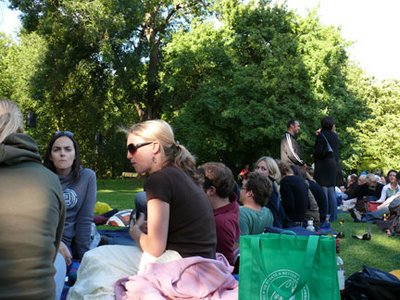
Many people took their picnic hampers, wine, etc and enjoyed the setting in the gardens.

Katherine Mansfield (she was a "short" story writer)
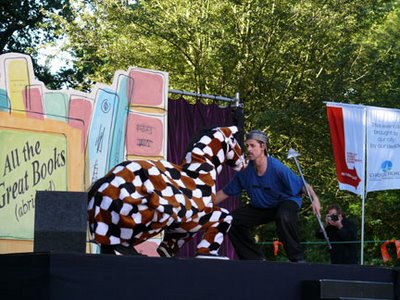
The Trojan horse
Just in case the 76 books covered weren't enough for me, my daughter introduced me to this website:
Book a Minute
(A sample: The Confessions of Augustine: "I was bad. I was very, very bad. Not any more though.")
This is part of our city council's Summertimes programme and was therefore free (sort of - the bucket was passed round at the end for donations).

Many people took their picnic hampers, wine, etc and enjoyed the setting in the gardens.
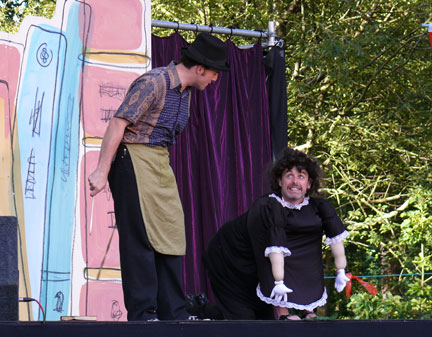
Katherine Mansfield (she was a "short" story writer)

The Trojan horse
Just in case the 76 books covered weren't enough for me, my daughter introduced me to this website:
Book a Minute
(A sample: The Confessions of Augustine: "I was bad. I was very, very bad. Not any more though.")
Thursday, February 01, 2007
Proof
For Poetry Thursday
We were invited to write a poem using the language of science. It was suggested fro instance that we start with the formula "let x equal".
My response is a little different. My first encounter with scientific method was in the later years of primary school, when we did small experiments with titles like "How do we know that air exists?". This is when I was introduced to the methodical setting out of experiments in sections. As far as I recall, they were titled "to show", "method", "results" and "conclusion". For some reason this is what first made me fall in love with science.
So, here is my rough draft of a poem based on those four sections:
Proof
To show:
that the (he)art
and love
in spring and the moon
in June
or any other time makes the world go
round or
square or any other
shape
Method:
If there is any since love
is not methodical but
if love be madness
there may yet be method in it
Results:
If love is not blind then
at least it produces
hallucinations of perfection
temporary amnesia
possibly followed by small irritations
assuming unreasonable proportions
and an inevitable cooling which is not measurable
with a thermometer
Conclusion:
which is what we have learnt
(nothing)
or alternatively which is an end
at least until the next time
when it all starts again.
We were invited to write a poem using the language of science. It was suggested fro instance that we start with the formula "let x equal".
My response is a little different. My first encounter with scientific method was in the later years of primary school, when we did small experiments with titles like "How do we know that air exists?". This is when I was introduced to the methodical setting out of experiments in sections. As far as I recall, they were titled "to show", "method", "results" and "conclusion". For some reason this is what first made me fall in love with science.
So, here is my rough draft of a poem based on those four sections:
Proof
To show:
that the (he)art
and love
in spring and the moon
in June
or any other time makes the world go
round or
square or any other
shape
Method:
If there is any since love
is not methodical but
if love be madness
there may yet be method in it
Results:
If love is not blind then
at least it produces
hallucinations of perfection
temporary amnesia
possibly followed by small irritations
assuming unreasonable proportions
and an inevitable cooling which is not measurable
with a thermometer
Conclusion:
which is what we have learnt
(nothing)
or alternatively which is an end
at least until the next time
when it all starts again.
Sunday, January 28, 2007
What I Did At the Quilt Symposium
I caught up with my best friend from high school (I stayed with her as she lives just around the corner from where it was held):
went shopping:

(a small corner of the merchants' mall at eight in the morning before it got crowded)
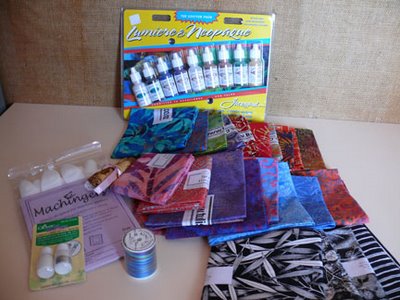
(my purchases)
made this:
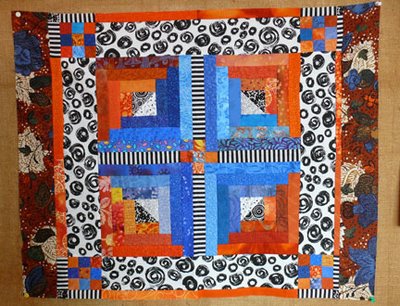
(still needing a couple more borders at this stage)
in a class with this tutor
and this:

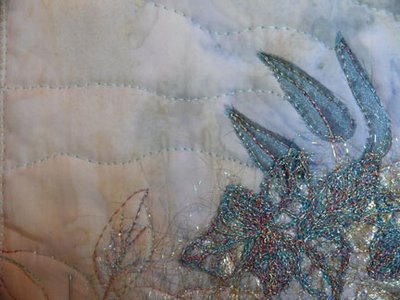
(a detail of the stitching)
in a class with this tutor, where we also painted and printed on fabric:
learnt more about my sewing machine in a class with Bernina:
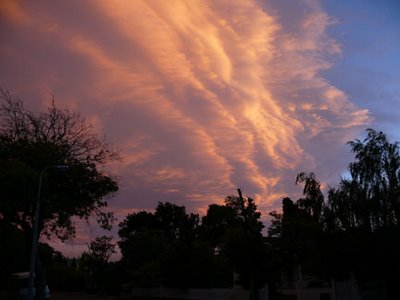
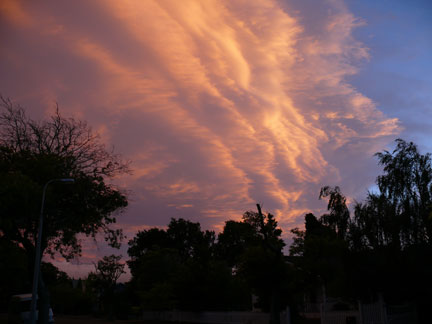
took time to look at the sunset:
went to a number of fascinating lectures:
and saw a lot of quilts (which I can't show you, unfortunately, since I don't have the permission of the owners).
I had a lot of fun and I feel thoroughly injected with the quilting virus again!
went shopping:

(a small corner of the merchants' mall at eight in the morning before it got crowded)

(my purchases)
made this:
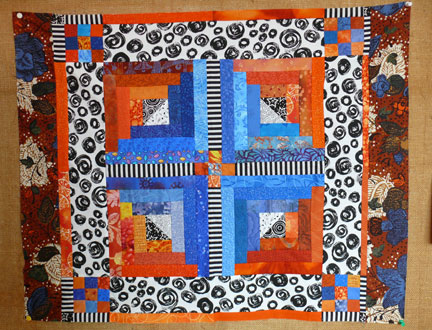
(still needing a couple more borders at this stage)
in a class with this tutor
and this:


(a detail of the stitching)
in a class with this tutor, where we also painted and printed on fabric:
learnt more about my sewing machine in a class with Bernina:
took time to look at the sunset:
went to a number of fascinating lectures:
and saw a lot of quilts (which I can't show you, unfortunately, since I don't have the permission of the owners).
I had a lot of fun and I feel thoroughly injected with the quilting virus again!
Friday, January 26, 2007
Mug Swap
A week or so before the quilt symposium I signed up to participate in a mug swap at Create a Connection. And when I returned this is what I found waiting for me:
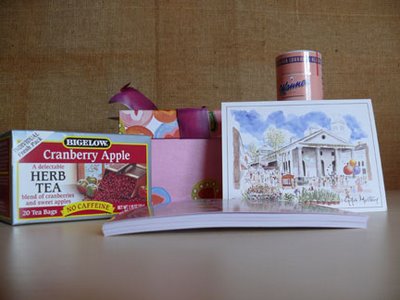
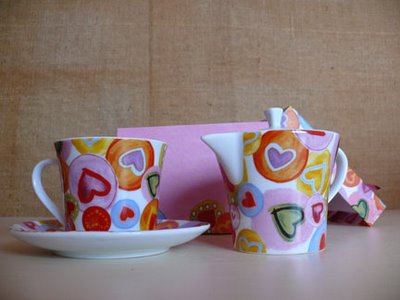
Not only a lovely teacup and saucer, but also a matching teapot, herb teas, cream filled wafers, a nice card with a message from Melanie and a bunch of her own postcards. Wow! Way more than I was expecting!
To see what other participants received go here

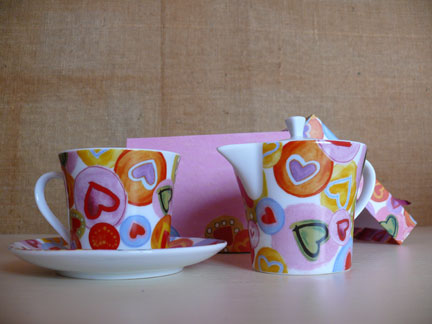
Not only a lovely teacup and saucer, but also a matching teapot, herb teas, cream filled wafers, a nice card with a message from Melanie and a bunch of her own postcards. Wow! Way more than I was expecting!
To see what other participants received go here
Thursday, January 25, 2007
Poetry Thursday: Why I Love Poetry
Yesterday I was sitting in the film room of a girls' high school. On the wall were quotes from a movie, which included one from the character Amélie which went something like this: "I like noticing details that no one else sees".
(I am still unpacking, and haven't yet found the piece of paper I wrote the quote on. I did google the names of the characters and found that the movie was Le Fabuleux Destin d'Amélie Poulain which sounds very interesting - I may try and locate it at a video store).
Back to the quote - that seems like as good a reason as any why I love poetry. The first poems that I loved, I loved for their sounds, their rhythms, their music. But at high school I discovered T.S. Eliot. We studied "The Love Song of J. Alfred Prufrock". It came as a huge shock to me. Lines like "when the evening is spread out against the sky/like a patient etherised upon a table". It was the way the poet had of looking at things that were different to the way anyone else looked at them, that sent a tingle up my spine.
So, it is not just the details that no one else sees, but the fact that poets look at the details in a way that no one else does. And I like to do this too. I may fall far short of Eliot and other poets I admire, but I love it when suddenly I see something in a new light, in a way that seems to be given to me out of nowhere.
Having been away from home for nearly a week, I have a heap of things to do (I wish I didn't have to go to work tomorrow), so this is a quick post. But I couldn't leave Poetry Thursday without posting a poem, so here is one from my files that seems to fit this week's prompt:
Gridlines
(This poem has now expired)
(I am still unpacking, and haven't yet found the piece of paper I wrote the quote on. I did google the names of the characters and found that the movie was Le Fabuleux Destin d'Amélie Poulain which sounds very interesting - I may try and locate it at a video store).
Back to the quote - that seems like as good a reason as any why I love poetry. The first poems that I loved, I loved for their sounds, their rhythms, their music. But at high school I discovered T.S. Eliot. We studied "The Love Song of J. Alfred Prufrock". It came as a huge shock to me. Lines like "when the evening is spread out against the sky/like a patient etherised upon a table". It was the way the poet had of looking at things that were different to the way anyone else looked at them, that sent a tingle up my spine.
So, it is not just the details that no one else sees, but the fact that poets look at the details in a way that no one else does. And I like to do this too. I may fall far short of Eliot and other poets I admire, but I love it when suddenly I see something in a new light, in a way that seems to be given to me out of nowhere.
Having been away from home for nearly a week, I have a heap of things to do (I wish I didn't have to go to work tomorrow), so this is a quick post. But I couldn't leave Poetry Thursday without posting a poem, so here is one from my files that seems to fit this week's prompt:
Gridlines
(This poem has now expired)
Thursday, January 18, 2007
Poetry Thursday: Off to Play
This week I have been busy gathering bits and pieces for my classes at the national quilt symposium. Tomorrow I'm off for five days of colour and cloth. I haven't followed this week's prompt at Poetry Thursday, though I have noted down some of the phrases offered and may play with them at a later date.
My father is from a longish line of youngest sons, who had to make their own way in the world (as all the best fairy stories tell us). However the eldest sons farmed the same land in Scotland from the 1600s to the mid 1900s. The various branches of the family were in touch until around the second world war or a little later. In the course of my research into the family history, I came across a book of poems called "Duty and Ease". This was published in 1926 on the death of Jessie Miller, whose poems it contains. A few by her sister Mary H Miller are also included. They were two spinster sisters who were born on the family farm near Stirling. The poems reflect the time in which they were written and many of the sentiments are old-fashioned now. Those written during World War I are of course, fiercely patriotic. Some of the poems are also quite charming.
The poem I'm posting here must have been addressed to a soldier, since it refers to "service weapons". However I chose it as my poem this week as it refers to the value of leisure. I'm not sure my week away is quite "indolence" as described in the poem, since I will be taking classes and working quite hard. But I'm sure it will be hard work of a very pleasurable kind and I hope to return next week with "renewed energy"
Ease
Go have some indolence and blissful ease,
Some precious minutes doing what you please,
Go hang your coat of duty on the wall
And lay thy service weapons in the hall.
And let thy laughter ring out strong and clear,
Without the semblance of a doubt or fear,
And make thy heart right merry for a while,
When resting thus upon the wayside stile.
'Twill smooth the folds and furrows from thy brow,
And bring back dimples to thy cheek, I trow,
'Twill make thy faded eyeballs dance and glow
And life-like wine through all thy being flow.
Go stem for once thy serious stream of thought,
And catch the humour with which life is fraught,
Stern duty plods along the toilsome road,
While humour floats above without a load.
Go wag your head, and unto duty say
I will not work to-day but I will play,
I'll meet you on the road to-morrow morn
With energy renewed and fresh hope born.
- Jessie Miller
My father is from a longish line of youngest sons, who had to make their own way in the world (as all the best fairy stories tell us). However the eldest sons farmed the same land in Scotland from the 1600s to the mid 1900s. The various branches of the family were in touch until around the second world war or a little later. In the course of my research into the family history, I came across a book of poems called "Duty and Ease". This was published in 1926 on the death of Jessie Miller, whose poems it contains. A few by her sister Mary H Miller are also included. They were two spinster sisters who were born on the family farm near Stirling. The poems reflect the time in which they were written and many of the sentiments are old-fashioned now. Those written during World War I are of course, fiercely patriotic. Some of the poems are also quite charming.
The poem I'm posting here must have been addressed to a soldier, since it refers to "service weapons". However I chose it as my poem this week as it refers to the value of leisure. I'm not sure my week away is quite "indolence" as described in the poem, since I will be taking classes and working quite hard. But I'm sure it will be hard work of a very pleasurable kind and I hope to return next week with "renewed energy"
Ease
Go have some indolence and blissful ease,
Some precious minutes doing what you please,
Go hang your coat of duty on the wall
And lay thy service weapons in the hall.
And let thy laughter ring out strong and clear,
Without the semblance of a doubt or fear,
And make thy heart right merry for a while,
When resting thus upon the wayside stile.
'Twill smooth the folds and furrows from thy brow,
And bring back dimples to thy cheek, I trow,
'Twill make thy faded eyeballs dance and glow
And life-like wine through all thy being flow.
Go stem for once thy serious stream of thought,
And catch the humour with which life is fraught,
Stern duty plods along the toilsome road,
While humour floats above without a load.
Go wag your head, and unto duty say
I will not work to-day but I will play,
I'll meet you on the road to-morrow morn
With energy renewed and fresh hope born.
- Jessie Miller
Wednesday, January 17, 2007
Five Things You May Not Know About Me
Leonie at chocolate covered musings tagged me for this meme. I have to admit that I can't recall what I have revealed on this blog before and what I haven't. There are things I know that I haven't revealed - that's because I'm not going to! And other things I know I haven't revealed, because they are really rather trivial. So it's a good thing that the word "may" is in there.
1) I used to work as a forensic scientist.
2) I have five grown children, four of whom still live at home (they must like it here!).
3) I can't whistle, but I can touch the tip of my nose with my tongue.
4) I once did a firewalk. I am definitely not a mystic and I'm not an adrenaline junkie either. But I'm open to new experiences, if other people are doing it and I think it's safe and rational. This was part of science week at my daughter's school. I got a small blister on one foot.
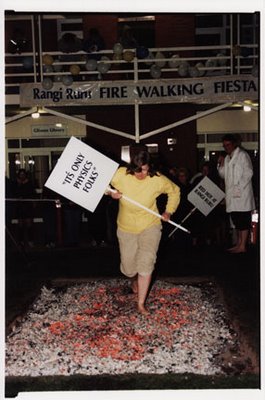
5) I once had a quilt published in Quilters Newsletter Magazine.
If anyone would like to do this, consider yourself tagged (leave a comment to that effect, and I will come and read it).
1) I used to work as a forensic scientist.
2) I have five grown children, four of whom still live at home (they must like it here!).
3) I can't whistle, but I can touch the tip of my nose with my tongue.
4) I once did a firewalk. I am definitely not a mystic and I'm not an adrenaline junkie either. But I'm open to new experiences, if other people are doing it and I think it's safe and rational. This was part of science week at my daughter's school. I got a small blister on one foot.
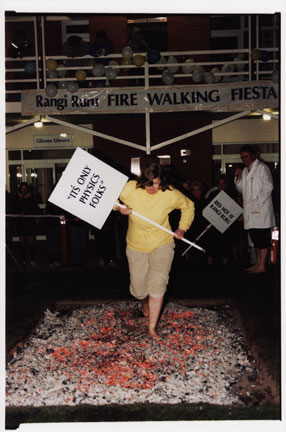
5) I once had a quilt published in Quilters Newsletter Magazine.
If anyone would like to do this, consider yourself tagged (leave a comment to that effect, and I will come and read it).
Tuesday, January 16, 2007
On Reflection...
I have been looking over the folder containing my poetry, thinking it was time to make more submissions to various journals. I found myself dissatisfied. Should I send these out again, or should I give up on them as not good enough, and wait till I have something better?
Or is there a third way? It seems to me that these poems could do with a dose of reflection. I need to print them out, carry them around. Read them out loud to myself, listen to the awkward places, let my intuition guide me to better ways of saying what I want to say. And then perhaps send them out again.
Each week I watch for the new topics to go up at one deep breath, Poetry Thursday and Sunday Scribblings. The haiku topic for one deep breath is posted usually on a Sunday evening, or perhaps a Monday. I find myself hoping that it will be Sunday evening, which is Monday here. If it goes up late afternoon New Zealand time, I can look through my collection of photos, find one that fits, write a haiku and submit my link. By this time everyone in North America is in bed asleep. By the time they are up, my link will be waiting to be posted on the site, and I in turn will wake to find it posted, and comments from visitors on my blog.
This week I watched eagerly for the topic, but didn't see it before I went to bed on Monday. And then on Tuesday I got up and it still wasn't there. Or so I thought. Later in the day I checked again, and realised I had missed it because it already had such a long list of links attached that I thought it was last week's post. And so every week I rush more and more to post my link early, so that I will be noticed and have plenty visitors. I do the same with Sunday Scribblings - I always used to post on Sunday, because that is the point, isn't it? And then I realised that more and more people were posting early, and I was getting fewer visitors, even though on Sunday in New Zealand it's still only Saturday in the US. I wanted time to think about the topic, but now if I take part I find myself submitting my link on Saturday evening so that at least it will be there before the next morning. Part of me is uneasy at this behaviour. A haiku is only three lines, but this doesn't mean it should be dashed off quickly. The best haiku are the result of long reflection. If I keep rushing everything I write, how will I write something that reflects who I am, deep down? I have time only to skim the surface.
It seems fitting that this week's topic should be "reflections".
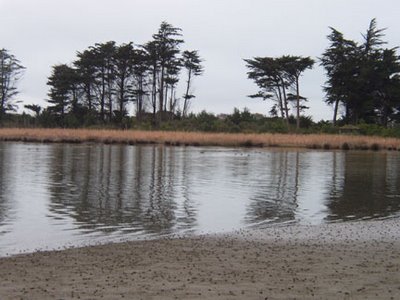
afternoon walk
lingering on the shore line
time for reflection
Or is there a third way? It seems to me that these poems could do with a dose of reflection. I need to print them out, carry them around. Read them out loud to myself, listen to the awkward places, let my intuition guide me to better ways of saying what I want to say. And then perhaps send them out again.
Each week I watch for the new topics to go up at one deep breath, Poetry Thursday and Sunday Scribblings. The haiku topic for one deep breath is posted usually on a Sunday evening, or perhaps a Monday. I find myself hoping that it will be Sunday evening, which is Monday here. If it goes up late afternoon New Zealand time, I can look through my collection of photos, find one that fits, write a haiku and submit my link. By this time everyone in North America is in bed asleep. By the time they are up, my link will be waiting to be posted on the site, and I in turn will wake to find it posted, and comments from visitors on my blog.
This week I watched eagerly for the topic, but didn't see it before I went to bed on Monday. And then on Tuesday I got up and it still wasn't there. Or so I thought. Later in the day I checked again, and realised I had missed it because it already had such a long list of links attached that I thought it was last week's post. And so every week I rush more and more to post my link early, so that I will be noticed and have plenty visitors. I do the same with Sunday Scribblings - I always used to post on Sunday, because that is the point, isn't it? And then I realised that more and more people were posting early, and I was getting fewer visitors, even though on Sunday in New Zealand it's still only Saturday in the US. I wanted time to think about the topic, but now if I take part I find myself submitting my link on Saturday evening so that at least it will be there before the next morning. Part of me is uneasy at this behaviour. A haiku is only three lines, but this doesn't mean it should be dashed off quickly. The best haiku are the result of long reflection. If I keep rushing everything I write, how will I write something that reflects who I am, deep down? I have time only to skim the surface.
It seems fitting that this week's topic should be "reflections".

lingering on the shore line
time for reflection
Sunday, January 14, 2007
Bits and Pieces
1) Just to clarify on the previous post, some people seemed to think that all the guests at my imaginary dinner party were my relatives. They are only my relatives when I stated the precise relationship, the rest are unrelated to me. As for having fascinating relatives, well, the majority of my ancestors and their descendants lived quiet lives in rural surroundings or small towns. They were farmers, agricultural labourers, miners, bakers, tailors and other such trades. It's just that I've accumulated a very large database of thousands of people, so someone interesting was sure to pop up sooner or later! No doubt everyone has interesting relatives tucked away somewhere if they look far enough.
(Mind you, I'd love to know more about my Forrester ancestors who are supposedly descended from Robert the Bruce. A Duncan Forrester was Comptroller of the Household at the Court of King James (the second, I think, of Scotland) in 1492. I'll probably never know for sure, because the records are a bit vague that far back. An heir might be a son but he might also be a distant cousin given the Scots' wild nature at the time and habit of killing each other :)
2) My daughter introduced me to Library Elf and I have signed up. Why not check to see if your library is supported? No more overdue library books, as they will send e-mail reminders of your overdue or about to be due books, and notifications of books you have on hold. What a great idea!
3) Here's another good thing: Wild Appetite. Their range of sauces and condiments looks so pretty in the jars and bottles that it is almost a shame to open and consume them. They do wonderful dessert sauces, but I'm forgoing those at the moment. Instead I have their Melanesian Mango pour over and their Capsicum and Apricot Salsa which are great with meats etc. They have stockists in New Zealand, Australia, the United States and strangely, Denmark. The website is a bit tricky at least on my browser - the products that show in the window initially are by no means the whole range, it will scroll down when you figure out how. There are also recipes.
(Mind you, I'd love to know more about my Forrester ancestors who are supposedly descended from Robert the Bruce. A Duncan Forrester was Comptroller of the Household at the Court of King James (the second, I think, of Scotland) in 1492. I'll probably never know for sure, because the records are a bit vague that far back. An heir might be a son but he might also be a distant cousin given the Scots' wild nature at the time and habit of killing each other :)
2) My daughter introduced me to Library Elf and I have signed up. Why not check to see if your library is supported? No more overdue library books, as they will send e-mail reminders of your overdue or about to be due books, and notifications of books you have on hold. What a great idea!
3) Here's another good thing: Wild Appetite. Their range of sauces and condiments looks so pretty in the jars and bottles that it is almost a shame to open and consume them. They do wonderful dessert sauces, but I'm forgoing those at the moment. Instead I have their Melanesian Mango pour over and their Capsicum and Apricot Salsa which are great with meats etc. They have stockists in New Zealand, Australia, the United States and strangely, Denmark. The website is a bit tricky at least on my browser - the products that show in the window initially are by no means the whole range, it will scroll down when you figure out how. There are also recipes.
Friday, January 12, 2007
A Dinner Party
This week Deb in her spot as guest editor at Create a Connection asked us to organise a dream dinner party. This is an entirely imaginary event with guests of our choosing from any time or place. My first reaction was to include a number of my direct ancestors and their relatives, those that I had found interesting in my researches and those who I thought would be able to solve various genealogical mysteries.
Then I read on and found that the guests had to fit certain categories - one from each. I was a little disappointed, but then I realised that I could find someone from my family connections to fit each and every category.
Deb added a "girl's night out" theme to her list. I decided to do the same and choose all women. Further, about half of my guests are related to me in some way. Even though I could fill all the categories like this, I decided not to. For instance I could have chosen poets Jessie or Mary Miller for the "writer" category, but although their poems are charming (I may just post one or two sometime), I didn't feel sufficiently inspired by two spinster women living quiet lives in rural Scotland.
So here is my list:
1. Guest one must be someone who is/was creative with words - a novelist, poet, playwright, essayist, journalist, etc.
I would invite Scottish poet Kathleen Jamie. Not only is she a fine poet, first published at a young age, but she also writes wonderful non-fiction. She has travelled in Pakistan, Tibet and the Middle East. I'm sure she would have some interesting stories to tell, and that she would interest my other Scottish guests. As a lecturer in creative writing, and mother of a young family, she may also have some useful tips for me, both on writing and on finding the time to write.
2. Guest two must be someone who is/was creative with images - a painter, photographer, sculptor, fabric artist, collage artist, etc.
I would invite Isabella Miller Morley. She was the daughter of my greatgrandmother's cousin, and together with her husband, artist Henry Morley, she lived in Stirling, Scotland. An exhibition of their work was held their at the beginning of last year. While his works were the main part of the exhibition, she was also an artist and talented metal worker. Many well known artists visited them at their home "The Gables", including Charles Rennie Mackintosh. Apart from the family connection, I would be interested in how she combined artistic pursuits with raising a family at a time when it was less easy than now (if it is ever easy).
3. Guest three must be someone who is/was a performer - an actor, singer, musician, comedian, acrobat, etc.
I had trouble with this one - performance is rather immediate, and we know less of performers' own personalities than we do for writers, artists etc. Then I decided that I would ask a broadcaster. Radio journalist Kim Hill who used to host "Nine to Noon" on national radio in New Zealand a few years back. She was just such a fantastic interviewer, I'm sure she would get the best out of the rest of the guests.
4. Guest four must be someone who is charting/charted new territory - either in the physical sense, like an explorer, adventurer, or astronaut, or someone like a groundbreaking scientist or inventor.
I would ask Victorian woman traveller Mary Kingsley, who travelled in Africa at a time when it was thought shameful for women to travel alone. (The article I have linked to gives too many fascinating details to readily sum up).
5. Guest five must be someone who is/was a leader of other people - perhaps in the area of politics, like the literal leader of a country, or perhaps a leader in the area of religion, military, business, or even a great philosopher or teacher, or an inspiring athlete.
I would invite Chrystal MacMillan. A daughter of another of my greatgrandmother's cousins. She was the first female science graduate of Edinburgh University, campaigned for the right to vote for female university graduates and founded the Women's International League for Peace and Freedom. Possibly I would find her a little earnest. But since she's a relative, she's forgiven if that is the case. Besides, the overall mix of guests would ensure lively debate.
6. Guest six must be someone from any field who you believe is/was underrated and under-appreciated by most people, but whom you admire.
I would invite my greatgrandmother Jessie Finlayson Miller. I feel she had a hard lot in life. All her female cousins made "good" marriages - they married professional men, such as teachers, ministers, wealthy merchants, an obstetrician. They were well-educated and so were their children, and achieved in numerous areas. My greatgrandmother on the other hand was fatherless at twelve and an orphan at eighteen. The eldest of the family, she had four younger brothers. Together, they continued to run the family farm. Then Jessie married her mother's cousin, a baker. Several years later he went bankrupt. She appears to have masterminded the plan to run away from Scotland, managing to save some of the family treasures in the process. Unfortunately there was another bankruptcy in New Zealand. With eight children to raise, and a husband who drank somewhat, she had a hard life, but she did a fine job. She was intelligent and resourceful, and I think could have achieved much if she had had the opportunity.
7. Guest seven is a wild card - your choice! Is there someone you'd like to invite who didn't seem to quite fit into any category, or was there a category where you'd have really liked to invite two different people?
Tia (Anna) Bates. One of the most truly fascinating of my relatives. She was the cousin of my paternal grandmother, although I don't think my grandmother knew of her existence. Her father (my greatgreatuncle) emigrated from Scotland to the United States and then to Peru. Tia as a separated woman in Peru ran a guest house for many years, which was frequented by celebrities including the princes who became Edward VIII and George VI of Great Britain, Clark Gable, and Noel Coward who wrote a seventy line verse in tribute to her. She is also apparently mentioned in the Journals of Thornton Wilder. The link is to her obituary in Time magazine.
Bonus: Uh Oh! The dinner party is just about to end, and all your guests are about to disappear, and you realize that you've forgotten to ask one important question of one of your guests. You just barely have time to squeeze in that last question, so quick! - what was the question and who did you ask?
Well, I'm sure with Kim Hill present I've just had to sit back and listen to all the fascinating stories. And hopefully I've filled in some of the missing places on my family tree, too. But in case I've forgotten, I want to ask my greatgrandmother what happened to her brother Thomas, the one whose death I can't trace.
Then I read on and found that the guests had to fit certain categories - one from each. I was a little disappointed, but then I realised that I could find someone from my family connections to fit each and every category.
Deb added a "girl's night out" theme to her list. I decided to do the same and choose all women. Further, about half of my guests are related to me in some way. Even though I could fill all the categories like this, I decided not to. For instance I could have chosen poets Jessie or Mary Miller for the "writer" category, but although their poems are charming (I may just post one or two sometime), I didn't feel sufficiently inspired by two spinster women living quiet lives in rural Scotland.
So here is my list:
1. Guest one must be someone who is/was creative with words - a novelist, poet, playwright, essayist, journalist, etc.
I would invite Scottish poet Kathleen Jamie. Not only is she a fine poet, first published at a young age, but she also writes wonderful non-fiction. She has travelled in Pakistan, Tibet and the Middle East. I'm sure she would have some interesting stories to tell, and that she would interest my other Scottish guests. As a lecturer in creative writing, and mother of a young family, she may also have some useful tips for me, both on writing and on finding the time to write.
2. Guest two must be someone who is/was creative with images - a painter, photographer, sculptor, fabric artist, collage artist, etc.
I would invite Isabella Miller Morley. She was the daughter of my greatgrandmother's cousin, and together with her husband, artist Henry Morley, she lived in Stirling, Scotland. An exhibition of their work was held their at the beginning of last year. While his works were the main part of the exhibition, she was also an artist and talented metal worker. Many well known artists visited them at their home "The Gables", including Charles Rennie Mackintosh. Apart from the family connection, I would be interested in how she combined artistic pursuits with raising a family at a time when it was less easy than now (if it is ever easy).
3. Guest three must be someone who is/was a performer - an actor, singer, musician, comedian, acrobat, etc.
I had trouble with this one - performance is rather immediate, and we know less of performers' own personalities than we do for writers, artists etc. Then I decided that I would ask a broadcaster. Radio journalist Kim Hill who used to host "Nine to Noon" on national radio in New Zealand a few years back. She was just such a fantastic interviewer, I'm sure she would get the best out of the rest of the guests.
4. Guest four must be someone who is charting/charted new territory - either in the physical sense, like an explorer, adventurer, or astronaut, or someone like a groundbreaking scientist or inventor.
I would ask Victorian woman traveller Mary Kingsley, who travelled in Africa at a time when it was thought shameful for women to travel alone. (The article I have linked to gives too many fascinating details to readily sum up).
5. Guest five must be someone who is/was a leader of other people - perhaps in the area of politics, like the literal leader of a country, or perhaps a leader in the area of religion, military, business, or even a great philosopher or teacher, or an inspiring athlete.
I would invite Chrystal MacMillan. A daughter of another of my greatgrandmother's cousins. She was the first female science graduate of Edinburgh University, campaigned for the right to vote for female university graduates and founded the Women's International League for Peace and Freedom. Possibly I would find her a little earnest. But since she's a relative, she's forgiven if that is the case. Besides, the overall mix of guests would ensure lively debate.
6. Guest six must be someone from any field who you believe is/was underrated and under-appreciated by most people, but whom you admire.
I would invite my greatgrandmother Jessie Finlayson Miller. I feel she had a hard lot in life. All her female cousins made "good" marriages - they married professional men, such as teachers, ministers, wealthy merchants, an obstetrician. They were well-educated and so were their children, and achieved in numerous areas. My greatgrandmother on the other hand was fatherless at twelve and an orphan at eighteen. The eldest of the family, she had four younger brothers. Together, they continued to run the family farm. Then Jessie married her mother's cousin, a baker. Several years later he went bankrupt. She appears to have masterminded the plan to run away from Scotland, managing to save some of the family treasures in the process. Unfortunately there was another bankruptcy in New Zealand. With eight children to raise, and a husband who drank somewhat, she had a hard life, but she did a fine job. She was intelligent and resourceful, and I think could have achieved much if she had had the opportunity.
7. Guest seven is a wild card - your choice! Is there someone you'd like to invite who didn't seem to quite fit into any category, or was there a category where you'd have really liked to invite two different people?
Tia (Anna) Bates. One of the most truly fascinating of my relatives. She was the cousin of my paternal grandmother, although I don't think my grandmother knew of her existence. Her father (my greatgreatuncle) emigrated from Scotland to the United States and then to Peru. Tia as a separated woman in Peru ran a guest house for many years, which was frequented by celebrities including the princes who became Edward VIII and George VI of Great Britain, Clark Gable, and Noel Coward who wrote a seventy line verse in tribute to her. She is also apparently mentioned in the Journals of Thornton Wilder. The link is to her obituary in Time magazine.
Bonus: Uh Oh! The dinner party is just about to end, and all your guests are about to disappear, and you realize that you've forgotten to ask one important question of one of your guests. You just barely have time to squeeze in that last question, so quick! - what was the question and who did you ask?
Well, I'm sure with Kim Hill present I've just had to sit back and listen to all the fascinating stories. And hopefully I've filled in some of the missing places on my family tree, too. But in case I've forgotten, I want to ask my greatgrandmother what happened to her brother Thomas, the one whose death I can't trace.
Thursday, January 11, 2007
Thursday Cliches
I was thinking about the topic at Poetry Thursday this week, cliches, and I realised that the very first post I made on this blog was a poem which takes a cliche and pokes a little gentle fun at it. It also explains my blog title.
I was going to link to it, but I can't seem to figure out how to find a permalink for old posts (if anyone can tell me, feel free to leave a comment!)
So here it is again:
Portrait of the Poet as a Young Girl
She tried hard to be like the others
She struggled to catch a ball
She never quite managed a cartwheel
After much practice she stood on her head
When she grew up she turned to science
She thought she would turn the world upside down
After a while she realised
that the world had stayed in its proper place all along
and she was still standing on her head.
**************************
(And yes, I am being a little lazy about Poetry Thursday today, but I'm busy digging into my cupboards for fabrics and metallic threads and fabric paints and all sorts of other pretty things to take to the quilt symposium).
More Poetry Thursday here
I was going to link to it, but I can't seem to figure out how to find a permalink for old posts (if anyone can tell me, feel free to leave a comment!)
So here it is again:
Portrait of the Poet as a Young Girl
She tried hard to be like the others
She struggled to catch a ball
She never quite managed a cartwheel
After much practice she stood on her head
When she grew up she turned to science
She thought she would turn the world upside down
After a while she realised
that the world had stayed in its proper place all along
and she was still standing on her head.
**************************
(And yes, I am being a little lazy about Poetry Thursday today, but I'm busy digging into my cupboards for fabrics and metallic threads and fabric paints and all sorts of other pretty things to take to the quilt symposium).
More Poetry Thursday here
Tuesday, January 09, 2007
Tuesday This and That
1) I noticed at work that whenever I try to type "clams" it seems to come out as "calms". Calm as a clam, maybe? I could do with some of that...
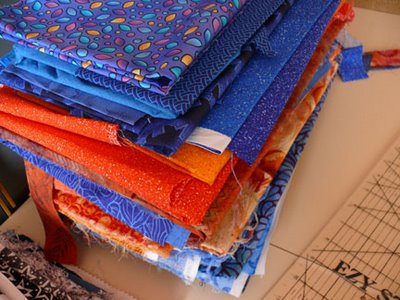
2) I am gradually getting supplies together for the quilt symposium which starts in a week and a half. One of my classes requires pre-cut strips in fortyeight different fabrics (24 of each of two colours). I am going with blue and orange. These colours make me feel happy!
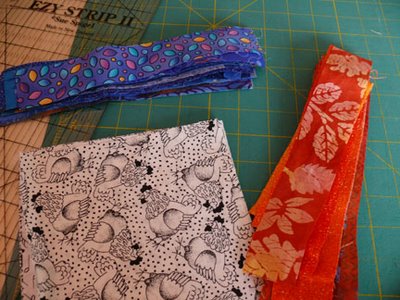
I also need pre-cut squares of various black and white printed fabrics. The chook fabric is one I just couldn't resist.
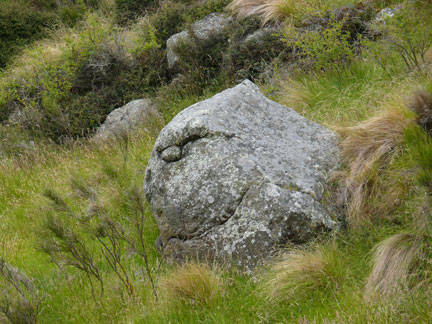
3) I've walked on this track quite a few times and never spotted this character before. I wonder what he did to suffer the penalty of being turned to stone? No wonder he looks a little grumpy.

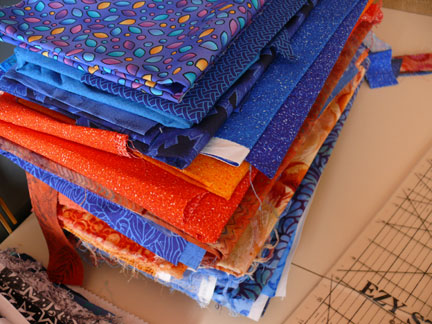
2) I am gradually getting supplies together for the quilt symposium which starts in a week and a half. One of my classes requires pre-cut strips in fortyeight different fabrics (24 of each of two colours). I am going with blue and orange. These colours make me feel happy!
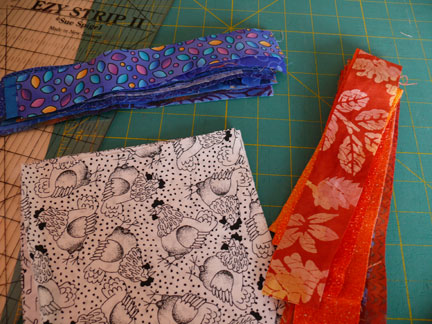
I also need pre-cut squares of various black and white printed fabrics. The chook fabric is one I just couldn't resist.
3) I've walked on this track quite a few times and never spotted this character before. I wonder what he did to suffer the penalty of being turned to stone? No wonder he looks a little grumpy.
Saturday, January 06, 2007
Kissing
"Kissing" is this week's prompt at Sunday Scribblings. This is a piece of fiction which might be a short story, except that I'm not really sure how it should end. I feel the ending lacks a little oomph. Feedback would be appreciated.
*********
Jenny didn’t think much of kissing. She liked to cuddle up on her mummy’s lap when she was tired, and she didn’t mind a hug in the morning, but mummy tried to kiss her sometimes and that was just… icky.
“Uck, it’s all wet” she would say, and wipe her cheek. Mummy didn’t try so much any more. The aunties still did, though. They weren’t Jenny’s aunties – mummy and daddy only had brothers. They were mummy’s aunties, and they were quite old. When mummy took Jenny to visit them, they always said “What a big girl you are getting” and planted a wet sloppy kiss on her cheek before she could wriggle away. Besides, they gave her lollies, so she couldn’t wriggle too far away, or she might miss out.
Lately, mummy seemed a bit different. She still let Jenny curl up in her lap before bedtime, and she still read her stories. But she didn’t seem to want to play tag and hide-and-go-seek in the garden so much. And they weren’t visiting the aunties on Sunday afternoons quite so often. Instead, mummy would go and lie down for a nap.
“We’re going to have a baby” mummy told Jenny. “But not for a few months yet, and I’ll still have plenty of time for my big girl”.
To tell the truth, Jenny wasn’t all that sure what a baby was. Her parents would have been very surprised if they had realised this, but it was true. The new subdivision where they lived was an expensive one, and full of executive families with older children. Jenny was the youngest there, and she wouldn’t start pre-school for another few months. Her best friend was David-next-door who was six months older than her. Jenny’s cousins were older than her too. The only time she had heard about babies before was when they told her,
“Oh, don’t be such a baby”. Apparently it had something to do with complaining.
Jenny did know that mummy’s tummy was getting bigger. After a while it was harder to curl up in her lap. Mummy said the baby was growing in there. She told David-next-door.
“Mummy says there is a baby growing in her tummy. How does it get in there?”
David-next-door seemed to know a lot of things.
“The daddy puts it in there” he said. “It grows from a special seed that the daddy puts there”.
“How does he do that?” Jenny wondered.
“Dunno” he shrugged.
Jenny thought about it some more. When she ate dinner, her tummy felt full. Food gets in your tummy through your mouth, she thought, so that’s how the baby gets there too. If daddy put the baby in there, it must be something to do with kissing. Mummy and the aunts kissed her on the cheek, but Daddy and Mummy kissed on the mouth sometimes. Usually when they thought she wasn’t looking. He must have been putting a special seed in mummy’s tummy.
The next day Jenny said to David-next-door “Kiss me”
“Kissing’s ucky” said David.
“Yes”, she said, “but you have to.”
“I won’t”
“If you don’t, I’ll tell your mummy who trampled her flowers”
“Well…” He gave her a quick peck on the cheek.
“No, you have to do it on my mouth, like mummy and daddy do”.
“Yuckkkk!!! No way!!!”
“I’ll tell!”
David gave in. Fortunately Jenny seemed to be satisfied with a very quick kiss. And just then she heard her father calling “Jenny!” and it was time to go home. She had left toys on the living room floor.
“Time to pick up your toys before dinner” her father said.
“No” said Jenny.
“No?” her father was astonished.
“I can’t” said Jenny. “Mummy doesn’t pick things up any more, you do it for her. I can’t pick up my toys, you have to do it for me”
“Mummy gets tired, and she can’t bend easily because of the baby” said Daddy.
“That’s why I can’t”, said Jenny.
Daddy didn’t quite understand. “Because of the baby” said Jenny. “David kissed me. I have a baby in my tummy so I don’t have to pick up toys any more”.
For more Sunday Scribblings go here
*********
Jenny didn’t think much of kissing. She liked to cuddle up on her mummy’s lap when she was tired, and she didn’t mind a hug in the morning, but mummy tried to kiss her sometimes and that was just… icky.
“Uck, it’s all wet” she would say, and wipe her cheek. Mummy didn’t try so much any more. The aunties still did, though. They weren’t Jenny’s aunties – mummy and daddy only had brothers. They were mummy’s aunties, and they were quite old. When mummy took Jenny to visit them, they always said “What a big girl you are getting” and planted a wet sloppy kiss on her cheek before she could wriggle away. Besides, they gave her lollies, so she couldn’t wriggle too far away, or she might miss out.
Lately, mummy seemed a bit different. She still let Jenny curl up in her lap before bedtime, and she still read her stories. But she didn’t seem to want to play tag and hide-and-go-seek in the garden so much. And they weren’t visiting the aunties on Sunday afternoons quite so often. Instead, mummy would go and lie down for a nap.
“We’re going to have a baby” mummy told Jenny. “But not for a few months yet, and I’ll still have plenty of time for my big girl”.
To tell the truth, Jenny wasn’t all that sure what a baby was. Her parents would have been very surprised if they had realised this, but it was true. The new subdivision where they lived was an expensive one, and full of executive families with older children. Jenny was the youngest there, and she wouldn’t start pre-school for another few months. Her best friend was David-next-door who was six months older than her. Jenny’s cousins were older than her too. The only time she had heard about babies before was when they told her,
“Oh, don’t be such a baby”. Apparently it had something to do with complaining.
Jenny did know that mummy’s tummy was getting bigger. After a while it was harder to curl up in her lap. Mummy said the baby was growing in there. She told David-next-door.
“Mummy says there is a baby growing in her tummy. How does it get in there?”
David-next-door seemed to know a lot of things.
“The daddy puts it in there” he said. “It grows from a special seed that the daddy puts there”.
“How does he do that?” Jenny wondered.
“Dunno” he shrugged.
Jenny thought about it some more. When she ate dinner, her tummy felt full. Food gets in your tummy through your mouth, she thought, so that’s how the baby gets there too. If daddy put the baby in there, it must be something to do with kissing. Mummy and the aunts kissed her on the cheek, but Daddy and Mummy kissed on the mouth sometimes. Usually when they thought she wasn’t looking. He must have been putting a special seed in mummy’s tummy.
The next day Jenny said to David-next-door “Kiss me”
“Kissing’s ucky” said David.
“Yes”, she said, “but you have to.”
“I won’t”
“If you don’t, I’ll tell your mummy who trampled her flowers”
“Well…” He gave her a quick peck on the cheek.
“No, you have to do it on my mouth, like mummy and daddy do”.
“Yuckkkk!!! No way!!!”
“I’ll tell!”
David gave in. Fortunately Jenny seemed to be satisfied with a very quick kiss. And just then she heard her father calling “Jenny!” and it was time to go home. She had left toys on the living room floor.
“Time to pick up your toys before dinner” her father said.
“No” said Jenny.
“No?” her father was astonished.
“I can’t” said Jenny. “Mummy doesn’t pick things up any more, you do it for her. I can’t pick up my toys, you have to do it for me”
“Mummy gets tired, and she can’t bend easily because of the baby” said Daddy.
“That’s why I can’t”, said Jenny.
Daddy didn’t quite understand. “Because of the baby” said Jenny. “David kissed me. I have a baby in my tummy so I don’t have to pick up toys any more”.
For more Sunday Scribblings go here
Summer At Last!
I've been reading in the paper that globally, 2007 is expected to be one of the hottest years of the last 200 or so. 2006 was pretty warm also. But locally, many places in New Zealand had their coldest December on record. On the other hand, in the last few days, December's cold and wet have been left behind, and the sun has been shining.
My daughter is staying for a few days, and my studio is also our guest room. Since she works shift work, I waited until she got up this afternoon before heading for the computer. Now that I'm here, I find the sun has warmed the upstairs room so much that all the things I planned to do seem like too much effort. If the sun has indeed arrived to stay, maybe I need to move the computer downstairs for the rest of the summer.
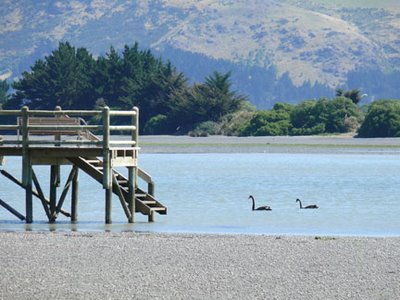
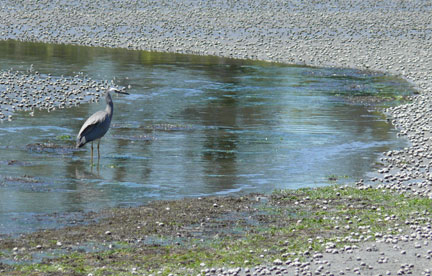
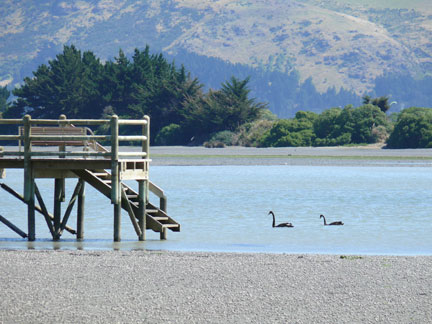
We have extended family coming for dinner, and I have a pavlova in the oven to go and check on shortly. So this is just a quick post with some photos of my walk around the estuary a couple of days ago. Mostly lately I've been walking up and down a nearby hill, which is a rather bare grassy landscape with sheep and magpies. My fitness campaign means that each time, I try and jog a little further before dropping back to a steady walking pace. It was a pleasant change to take my camera, forget about fitness, and just stroll round the estuary. It was low tide, so the birds were mostly far away across the mudflats, but I photographed these among others:
A heron wading in a small stream

Two swans glide past the end of the jetty (or are they Canada geese?)
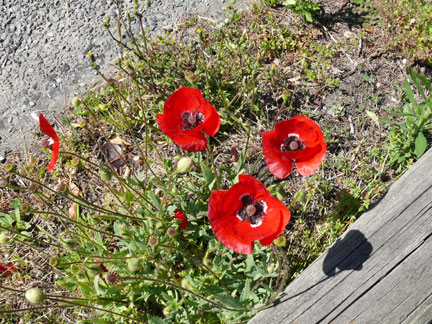
By the roadside at the end of the walk, in the dry grass, a sudden blaze of colour

My daughter is staying for a few days, and my studio is also our guest room. Since she works shift work, I waited until she got up this afternoon before heading for the computer. Now that I'm here, I find the sun has warmed the upstairs room so much that all the things I planned to do seem like too much effort. If the sun has indeed arrived to stay, maybe I need to move the computer downstairs for the rest of the summer.
We have extended family coming for dinner, and I have a pavlova in the oven to go and check on shortly. So this is just a quick post with some photos of my walk around the estuary a couple of days ago. Mostly lately I've been walking up and down a nearby hill, which is a rather bare grassy landscape with sheep and magpies. My fitness campaign means that each time, I try and jog a little further before dropping back to a steady walking pace. It was a pleasant change to take my camera, forget about fitness, and just stroll round the estuary. It was low tide, so the birds were mostly far away across the mudflats, but I photographed these among others:
A heron wading in a small stream
Two swans glide past the end of the jetty (or are they Canada geese?)
By the roadside at the end of the walk, in the dry grass, a sudden blaze of colour
Thursday, January 04, 2007
Christmas Lilies
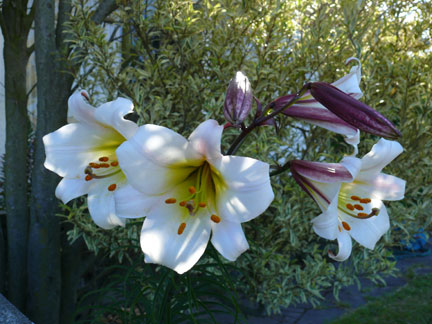
These lilies are known in New Zealand as Christmas lilies because that is when they bloom.
The prompt at Poetry Thursday this week on gumball poetry intrigued me, and I planned to write a poem inspired by it. But life intervened - just as I had to start work again after Christmas the visitors started arriving. I guess their holidays are longer than mine. So I have been hostessing, and other things, instead of writing.
Instead I pulled this poem about Christmas lilies out of my files. The summer I wrote this we were having a drought. This year we just had our coldest wettest December on record. Almost like a nothern hemisphere Christmas. So it's good to have this poem to remind me that summer still exists! (It has been sunny since yesterday when I started work again. I wonder if it will last till the weekend?)
Christmas Lilies
On the twelfth day, Christmas is almost through.
At the deserted garden centre I buy lobelia fulgans,
gazania, red-frilled lettuces
and hope they will survive the heat.
Christmas lilies sprawl across the bare patch
I plan to fill. As I lift and bunch them,
anthers laden with pollen paint
bright strokes of yellow across my shirt.
I tie green armfuls to stakes with soft bands,
trowel holes in the earth, place my purchases,
firm the soil around them
and pray, as near as I know how, for rain
and that some bright gold lingers,
as the year lurches into winter
Monday, January 01, 2007
Haiku: New Year
Later this month I will be going to the New Zealand national Quilt Symposium. It's time to go over my class needs lists. For one class in particular I have to pre-cut many strips of cloth, so that I arrive ready to start sewing.
It seemed a good way to start the New Year.
shifting patterns
cloth of many colours
- a new year begins
For more haiku on the theme of New Year go to onedeepbreath
It seemed a good way to start the New Year.
cloth of many colours
- a new year begins
For more haiku on the theme of New Year go to onedeepbreath
Subscribe to:
Posts (Atom)