
Perhaps it's just a coincidence, but both times that I've agreed to participate in Readwritepoem's Virtual Book Tour, the book for the month has been a chapbook that is essentially one long poem. Is the longer poem becoming more popular?
This month it is Molly Gaudry's Anatomy for the Artist, which you can read free online at Blossombones. Each small section/stanza begins with the phrase "we take me apart", and the poem tours the body discussing all the ways in which it is taken apart:
We take me apart--
by form and function of muscles
...by bones of the upper limb...
etc
There is a narrative hidden in the work, although it doesn't appear immediately - but the tension builds, and by the end the narrative has become clearer, with the narrator taken apart both anatomically and emotionally.
It's writing that takes me out of my comfort zone, and I didn't think I would like it at first, but it certainly grew on me by the end and I felt the force of the underlying story. And I am a sucker for scientific vocabulary - there was plenty to satisfy me there, such as cruciate ligament of knee and many others.
A few niggles, though. In particular, there are one or two places where the anatomical terms seem wrongly placed. Going back to find them, there are not many. But they certainly stuck out on first reading, making me ask "what's that doing there?" eg the symphysis pubis appears in a section beginning "we take me apart by muscles of the upper limb".
The second point is not so much a niggle as a curiosity to hear how one would read the work out loud. It makes heavy use of italics, and I always wonder how one would read a work like this and have it retain its sense. I wonder if two voices would work? There are sections that I read over about three times - once straight though, once reading the italicised bits only, and once reading the unitalicised portions only, and I felt that deepened the reading considerably.
I'm not much of a fan of reading online. I'm happy to read short poems on the screen. For something this length, I prefer to print it out so I can read it in comfort in a squishy armchair. The reader on the website did allow me to print it, but not very easily. I had to click through page by page, but couldn't jump pages and it would be the same for reading - if you get to page ten and want to check back to page 1, you can't just select page 1 but have to go back one page at a time, or use your browser history to jump back. Jumping forward would be even harder. And you can't just print the whole poem at one click - you have to print separately each time you turn to a new page.
That annoyance over, I enjoyed reading my printed out version - and the anatomical drawings on the cover and on the footer of each page are a delight.
Thursday, March 04, 2010

Friday, February 26, 2010
The Vertical Lawn

An "installation" at the front of the Canterbury Museum as part of the Christchurch Floral Festival. It's made of real grass growing in a felt backing, with water trickling down to keep it fresh and green (though it seems to be withering a little at the top).
A detail:

Posted for this week's Thematic Photographic: The Grass is Always Greener
(Something seems to have gone wrong with my Photoshop settings. These pics are way smaller than I intended, but it's late at night so I'm not going to try and fix it right now).
Update: fixed it!
Tuesday, February 23, 2010
Hokitika Beach
The West Coast has about 2000 mm of rain every year - more in the south. It's possible to go there and find glorious sunny weather, but it's best to be prepared for rain. While we were there, we experienced a pattern of rain at night and sometimes into the morning, clearing in time for warm sunny afternoons, and clouding over again by the evening.
It was sunny and hot while we were at Shantytown, but by the time we arrived at Hokitika that evening it had clouded over again, so our excursion to the beach to watch the sunset was rather doomed to failure. This is the best we could manage:

But despite the lack of sunset, the following two photos really appealed to me (even though the second one is technically rather unsharp, due to the low light and lack of a tripod):


It was sunny and hot while we were at Shantytown, but by the time we arrived at Hokitika that evening it had clouded over again, so our excursion to the beach to watch the sunset was rather doomed to failure. This is the best we could manage:

But despite the lack of sunset, the following two photos really appealed to me (even though the second one is technically rather unsharp, due to the low light and lack of a tripod):


Monday, February 22, 2010
Shantytown
Shantytown is a tourist attraction near the main West Coast town of Greymouth. It reconstructs a mining village of the 19th century, with a small section of historic railway, gold sluicing and panning demonstrations, old style shops etc
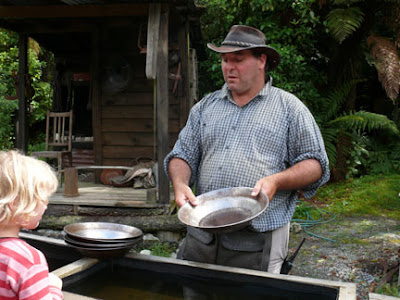
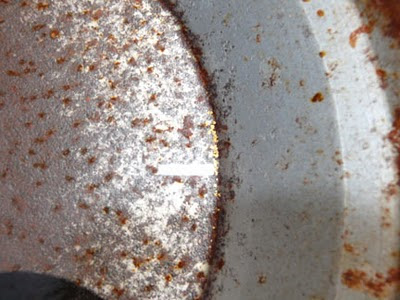
For $5 a time, visitors can try their hand at gold panning - the gravel is carefully preloaded with flakes of gold which you get to keep in a small glass vial. Look carefully and you will see the gold flakes among the rust of the pan.

A display of old style scales in one of the shops
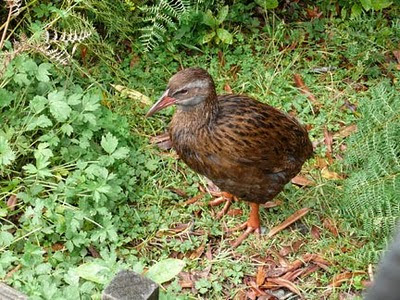
This weka was wandering around in the bush (the New Zealand term for "forest") near the end of the railway. Here in Christchurch, we live on the edge of a large plain which has been cleared for farming. Consequently, the birds we see are mainly introduced birds, as native birds mostly prefer forest. It was a delight on the West Coast to see these flightless birds wandering around everywhere. They are very cheeky and curious, and like the kiwi are flightless. I took many photos, this was the one I liked best.


For $5 a time, visitors can try their hand at gold panning - the gravel is carefully preloaded with flakes of gold which you get to keep in a small glass vial. Look carefully and you will see the gold flakes among the rust of the pan.

A display of old style scales in one of the shops

This weka was wandering around in the bush (the New Zealand term for "forest") near the end of the railway. Here in Christchurch, we live on the edge of a large plain which has been cleared for farming. Consequently, the birds we see are mainly introduced birds, as native birds mostly prefer forest. It was a delight on the West Coast to see these flightless birds wandering around everywhere. They are very cheeky and curious, and like the kiwi are flightless. I took many photos, this was the one I liked best.
Sunday, February 21, 2010
Seagull, Bruce Bay

Heading south from Fox Glacier, the road suddenly arrives at the coast at this rather wild and windswept bay. This is the main tourist route on the West Coast (it is the only through route on the West Coast). Nearly every tourist who passes by, whether in a campervan, car, or perhaps even a bus, must have stopped at this beach. Someone built a driftwood and stone sculpture, and as these things do, the trace they left behind sparked its imitators, so now the beach is crowded with driftwood and stone structures.

The seagull posed beside one of these structures as if to say "look what I made". It is as far as I can tell a young red-billed gull. We have red-billed gulls and black-billed gulls which are very similar to each other. The difference is not in the colour of their bills but in their feet. Young red-billed gulls have black bills but red feet. Young black-billed gulls have red bills but black feet. (When adult, they do in fact have the same colour bills as their name). The situation is complicated by the fact that they are now interbreeding. The brown markings on the wings are an indication of immaturity, it will lose those in adulthood. I thought they toned beautifully with the stones.
Friday, February 19, 2010
Lake, Mountain, Tree
Last week I managed to squeeze out a few days' leave from work and head off on a road trip. My daughter has a friend visiting from the UK and we thought she should see more of the South Island than just Christchurch, so the four of us (husband, self, daughter and friend) headed over the Alps to the West Coast, down the coast and back through the Haast Pass and up the middle of the island on the east side of the Alps to Christchurch.
I have been spending the past few evenings sorting and editing photos and uploading some to an online site for printing.
Here are a few for a starter:


Knowing less now, and alone
These things make for me
A gauge to measure the unknown
- Lake, mountain, tree
Sings Harry
- Denis Glover
I have been spending the past few evenings sorting and editing photos and uploading some to an online site for printing.
Here are a few for a starter:


Knowing less now, and alone
These things make for me
A gauge to measure the unknown
- Lake, mountain, tree
Sings Harry
- Denis Glover
Sunday, February 07, 2010
Road Trip
We're off on a road trip in a few days. My daughter has a visitor from the UK, and we thought it would be good to show here some of the South Island besides Christchurch. So we are heading for the West Coast in hopes of seeing some of the spectacular scenery (glaciers, rainforest etc) through the famed West Coast rain. It seems that it doesn't matter which country you are in - New Zealand, Scotland, the US - it rains on the west coast.
In the meantime it seemed fitting that Carmi's topic for Thematic Photographic this week is On the Road. Obviously I have no photos of the west coast yet, so here is one from our last road trip in the far north of the country. And yes, this is a legal road. The remains of a car buried by sand show what happens if you don't check the tides before setting out.

For those not in the know, the beach is Ninety Mile Beach, which is actually 55 miles long.
In the meantime it seemed fitting that Carmi's topic for Thematic Photographic this week is On the Road. Obviously I have no photos of the west coast yet, so here is one from our last road trip in the far north of the country. And yes, this is a legal road. The remains of a car buried by sand show what happens if you don't check the tides before setting out.

For those not in the know, the beach is Ninety Mile Beach, which is actually 55 miles long.
Tuesday, February 02, 2010
Poetry x 12: February
There's more I could say about my January reading,but I need to get on with February. This month I am reading All of it Singing: New and Selected Poems by Linda Gregg. The challenge for the month is to read a book recommended by another blogger. Again, I'm stretching it a little as it takes time to order online and the selection of poetry available at our library or locally isn't huge.
It was Dana whose blog introduced me to Linda Gregg, though not to this book in particular. I decided that it counted.
If anyone hasn't chosen a book yet, you may be interested in one of my recommendations:
Mount Clutter or Twigs and Knucklebones by Sarah Lindsay
or And Her Soul out of Nothing by Olena Kalytiak Davis
There are poems in all three books that just blew me away.
It was Dana whose blog introduced me to Linda Gregg, though not to this book in particular. I decided that it counted.
If anyone hasn't chosen a book yet, you may be interested in one of my recommendations:
Mount Clutter or Twigs and Knucklebones by Sarah Lindsay
or And Her Soul out of Nothing by Olena Kalytiak Davis
There are poems in all three books that just blew me away.
Enjoyable, But Is It Really Poetry?
The title of this post was the heading on a review of a local anthology of prose and poetry in The Press, the main Christchurch newspaper. It had me spluttering in my morning coffee.
I haven't read the anthology, but I do have an idea of what it contains, having seen the submission guidelines, and flipped through the finished book. The reviewer seems to be breaking what I understood to be a fundamental rule of reviewing, that you review a book for what it is. You don't complain of a science fiction novel that it is not a romance, or of a book of light verse that it fails to follow modern semiotic techniques (whatever they might be). This reviewer, instead of actually reviewing the poetry, jumps on his soapbox:
How strange that the poetical traditions of rhyme and thythm, which go back well over six centuries ...seem to have disappeared without trace.
He then says Of course, I am not maintaining that rhyme and regular rhythmic patterns are necessary for poetry which seems to me to be a bit of a cop-out, given that he fails to review the poems on any other basis than their lack of thyme and rhythm. Further, he suggests that it is not particularly difficult for any reasonably literate person to produce this kind of thing. That comment seems to me not only to disparage most contemporary poetry, but also prose. If poetry becomes easy to write once presented in irregular lines with no rhyme, then surely he is saying that prose is easy to write too? He gives no recognition to the fact that not all sequences of words produce the same effect and that words have to be chosen equally as carefully for their sound and meaning whether they are presented as prose, unrhymed unmetrical verse, or rhymed and metrical poetry.
As I said in my earlier post on the poets of 1951, I began to feel that at that point the tradition of rhymed verse had reached a dead end. One of the reasons that the rhymed verse of 1951 sounds so much less modern to me than the unrhymed verse is that the unrhymed version makes much more use of normal speech rhythms, or at least something that could pass for it. The poets who still wrote in rhyme and meter still seemed to use some of the old techniques of inverting normal word order to make it fit. It's the "Procrustean" technique - if it won't fit the form, chop it about and rearrange it until it does. (Procrustes, apparently, was known for chopping or stretching his guests to make them fit the bed).
Besides Denis Glover, reviewed in my previous post, I read Adrienne Rich's first published collection "A Change of World" and Mary Stanley's "A Starveling Year". The latter was a 1994 reprint - she attracted little attention in her time, and it was republished, with additional poems, at a time of renewed interest in some of New Zealand's earlier women writers. The original was published in 1953, but it went to the publisher in 1951, so I stretched the rules. It was her only published work, whereas Adrienne Rich, of course, went on to have a long and distinguished career.
Checking over the two books, I find that Rich for the most part does not use inversion of word order. Mary Stanley sometimes does. Overall, there are fewer examples than my first impression - which goes to show how strongly the technique colours our impressions of a poem - invert the word order and it immediately stands out as being what the traditionally-minded seem to think of as "poetic".
For example
I by all my imperfections stand accused
the water-walking god in greed
exploratory fingers thrusts
Other passages, while staying with normal word order, nevertheless sound very formal:
put off constricting day (Would you invite your husband to bed with those words?)
Cut off by tides we here are islanded
also by time and graver circumstance
When contemporary poets, rarely, choose rhyme and metre, it sounds different. There is often more use of enjambment. The rhymes may be slant rhymes. They manage something far more difficult than what was expected of earlier generations of poets - they make the lines sound much more like everyday informal speech, so that the rhyme and metre seem to intrude less. It's difficult to do. When it comes off, it's lovely - some of my favourite contemporary poems are rhymed. (And it's not that I don't like the old ones - I do, but I wouldn't expect a modern poet to write like Keats or Hardy or Frost, any more than I would expect a modern novelist to write like Jane Austen or Charles Dickens.) Here's a recent example of rhymed verse at the Poetry Daily website - look for the abba rhyme scheme.
And one more thing - rhymed poetry, particularly poetry that concludes with a rhyming couplet, just sounds so damned sure of itself. In today's more complex world, it's not always appropriate to end a poem with what seems like a declaration that "I know this, and that's that!" A poet who wants to end "well, perhaps..." will find it a lot easier to do so without rhyme.
I haven't read the anthology, but I do have an idea of what it contains, having seen the submission guidelines, and flipped through the finished book. The reviewer seems to be breaking what I understood to be a fundamental rule of reviewing, that you review a book for what it is. You don't complain of a science fiction novel that it is not a romance, or of a book of light verse that it fails to follow modern semiotic techniques (whatever they might be). This reviewer, instead of actually reviewing the poetry, jumps on his soapbox:
How strange that the poetical traditions of rhyme and thythm, which go back well over six centuries ...seem to have disappeared without trace.
He then says Of course, I am not maintaining that rhyme and regular rhythmic patterns are necessary for poetry which seems to me to be a bit of a cop-out, given that he fails to review the poems on any other basis than their lack of thyme and rhythm. Further, he suggests that it is not particularly difficult for any reasonably literate person to produce this kind of thing. That comment seems to me not only to disparage most contemporary poetry, but also prose. If poetry becomes easy to write once presented in irregular lines with no rhyme, then surely he is saying that prose is easy to write too? He gives no recognition to the fact that not all sequences of words produce the same effect and that words have to be chosen equally as carefully for their sound and meaning whether they are presented as prose, unrhymed unmetrical verse, or rhymed and metrical poetry.
As I said in my earlier post on the poets of 1951, I began to feel that at that point the tradition of rhymed verse had reached a dead end. One of the reasons that the rhymed verse of 1951 sounds so much less modern to me than the unrhymed verse is that the unrhymed version makes much more use of normal speech rhythms, or at least something that could pass for it. The poets who still wrote in rhyme and meter still seemed to use some of the old techniques of inverting normal word order to make it fit. It's the "Procrustean" technique - if it won't fit the form, chop it about and rearrange it until it does. (Procrustes, apparently, was known for chopping or stretching his guests to make them fit the bed).
Besides Denis Glover, reviewed in my previous post, I read Adrienne Rich's first published collection "A Change of World" and Mary Stanley's "A Starveling Year". The latter was a 1994 reprint - she attracted little attention in her time, and it was republished, with additional poems, at a time of renewed interest in some of New Zealand's earlier women writers. The original was published in 1953, but it went to the publisher in 1951, so I stretched the rules. It was her only published work, whereas Adrienne Rich, of course, went on to have a long and distinguished career.
Checking over the two books, I find that Rich for the most part does not use inversion of word order. Mary Stanley sometimes does. Overall, there are fewer examples than my first impression - which goes to show how strongly the technique colours our impressions of a poem - invert the word order and it immediately stands out as being what the traditionally-minded seem to think of as "poetic".
For example
I by all my imperfections stand accused
the water-walking god in greed
exploratory fingers thrusts
Other passages, while staying with normal word order, nevertheless sound very formal:
put off constricting day (Would you invite your husband to bed with those words?)
Cut off by tides we here are islanded
also by time and graver circumstance
When contemporary poets, rarely, choose rhyme and metre, it sounds different. There is often more use of enjambment. The rhymes may be slant rhymes. They manage something far more difficult than what was expected of earlier generations of poets - they make the lines sound much more like everyday informal speech, so that the rhyme and metre seem to intrude less. It's difficult to do. When it comes off, it's lovely - some of my favourite contemporary poems are rhymed. (And it's not that I don't like the old ones - I do, but I wouldn't expect a modern poet to write like Keats or Hardy or Frost, any more than I would expect a modern novelist to write like Jane Austen or Charles Dickens.) Here's a recent example of rhymed verse at the Poetry Daily website - look for the abba rhyme scheme.
And one more thing - rhymed poetry, particularly poetry that concludes with a rhyming couplet, just sounds so damned sure of itself. In today's more complex world, it's not always appropriate to end a poem with what seems like a declaration that "I know this, and that's that!" A poet who wants to end "well, perhaps..." will find it a lot easier to do so without rhyme.
Sunday, January 31, 2010
Poetry x 12: Sings Harry

There can't be many New Zealanders who haven't come across Denis Glover's poem "The Magpies" - very likely in primary school. That may be a pity, because it is liable to be dismissed later on as rather simple and childish, with it's repeated chorus
quardle oodle ardle wardle doodle, the magpies said
The more adult point of the ending to the story will probably be a little lost on most children with it's story of rural hardship and land lost to "mortgage corporations".
(That's a magpie in the photograph above, the same as the Australian bird of the same name, but different from the English one - larger and more agressive).
And there are other Glover poems which I enjoyed in my younger years, which also seem quite simple -
Drift, drift upon the beach
Dead man's bay and dead man's reach
And another entitled "For a Child"
which begins
Cave Rock is made of toffee
and the sea of lemonade
But ends in rather more barbed fashion
And wistfully the children sit
While Army trombones teach
That only Christ, not Cortes,
Can land upon the beach
At Sumner when the seas roll in.
At Sumner on a Sunday.
(The Army in question, of course, being the Salvation Army - whose bands rarely at the beach these days).
Both "For a Child" and "Drift" appear in Glover's collection "Sings Harry" published in 1951. But it was the title sequence which particularly interested me. I'd never looked really closely at the "Sings Harry" poems before. Again, they are apparently simple poems. On the evidence of the text, Harry is a rural character, probably unmarried, now elderly and living a simple life:
Once I followed horses
And once followed whores,
And marched once with a banner
For some great cause,
sings Harry.
But that was thistledown planted on the wind.
The device of the irregularly repeated refrain sings Harry in these verses is interesting. The poems read perfectly well without it, many then becoming sequences of regular four line stanzas. But the phrase "sings Harry" distances the poet from the poems a little. Without it, they might be taken as autobiographical. Clearly they are not. Glover was born in 1912, whereas Harry remembers Uncle JIm going off to the wars and being killed in the Transvaal -presumably around 1904. He is an older man than Glover. Still, I can't help wondering how much of his own feelings and attitudes Glover puts into the character.
Harry is a mountain man, but in other poems in the collection, and even in the "Sings Harry" poems, Glover's love of the sea shows through
From the cliff-top a boy
Felt that great motion,
And pupil to the horizon's eye
Grew wide with vision
I enjoyed this collection. Perhaps Glover was half-referring to himself when he wrote the first in the book:
These songs will not stand-
The wind and the sand will smother.
Not I but another
Will make songs worth the bother:
The rimu* or kauri* he
I'm but the cabbage tree*.
Sings Harry to an old guitar
The Sings Harry songs have been set to music, and I believe they will last longer than the author might have expected.
*The Maori have a saying when someone of stature dies: A mighty totara has fallen. Like the totara, rimu and kauri are majestic giants of the forest, particularly the kauri. The cabbage tree is a palm tree native to New Zealand, quick growing and common (we have one in our garden).
Thursday, January 28, 2010

Poetry x 12
The challenge that Dana set over at My Gorgeous Somewhere was to read a poetry book for each month of 2010. January's was to be a book published in the year that we were born.
Of the responses I have seen to this prompt so far, everyone is younger than me. Some of them are younger than most of my children. So it's not surprising that the poetry I have been reading, published in (I admit it!) 1951, seems less modern than that most of the other participants are reading. Actually, I was surprised at how un-modern it feels. After all, in high school we read T S Eliot (I was a big fan), and most of that was a good deal older - for instance, The Love Song of J Alfred Prufrock was published in 1915. It seems then, that the traditionalists hung on quite a bit longer.
I read a New Zealand classic, Denis Glover's Sings Harry, followed by Adrienne Rich's first book A Change of World (not in our local library, but included in her Collected Early Poems which is. Then for good measure, I started delving into another little-known New Zealand poet, Mary Stanley, whose book The Starveling Year was not published until 1953 - however as some of the poems in it were written in 1951, I thought it was close enough.
If I get round to it, I will comment on these in more detail in the next few days. All of these poets in 1951 were writing in fairly conventional forms - generally rhymed, and if not, at least in fairly equal line lengths with traditional metre. And I began to think that rhyming poetry had at that time pretty much come to the end of the line.
These days, I love to find a well-crafted modern rhymed poem. I see no reason to think that rhymed poetry is dead. But my overwhelming sense from reading rhymed poetry 1951 style is that freer verse forms didn't come a moment too soon. I think that the more conversational forms of free verse have actually revitalised rhyming poetry. The rhymed poems that I love now sound quite different to these mid-century versions - much less stiff and formal. There are poets now who seem to combine the best of both worlds - the heightened sense of structure and rhythm that well-placed rhyme gives, and the sense of flow that arises from the less strait-jacketed free verse forms. Or - since I've hardly made an exhaustive study - maybe I'm just talking through my hat.
Of the responses I have seen to this prompt so far, everyone is younger than me. Some of them are younger than most of my children. So it's not surprising that the poetry I have been reading, published in (I admit it!) 1951, seems less modern than that most of the other participants are reading. Actually, I was surprised at how un-modern it feels. After all, in high school we read T S Eliot (I was a big fan), and most of that was a good deal older - for instance, The Love Song of J Alfred Prufrock was published in 1915. It seems then, that the traditionalists hung on quite a bit longer.
I read a New Zealand classic, Denis Glover's Sings Harry, followed by Adrienne Rich's first book A Change of World (not in our local library, but included in her Collected Early Poems which is. Then for good measure, I started delving into another little-known New Zealand poet, Mary Stanley, whose book The Starveling Year was not published until 1953 - however as some of the poems in it were written in 1951, I thought it was close enough.
If I get round to it, I will comment on these in more detail in the next few days. All of these poets in 1951 were writing in fairly conventional forms - generally rhymed, and if not, at least in fairly equal line lengths with traditional metre. And I began to think that rhyming poetry had at that time pretty much come to the end of the line.
These days, I love to find a well-crafted modern rhymed poem. I see no reason to think that rhymed poetry is dead. But my overwhelming sense from reading rhymed poetry 1951 style is that freer verse forms didn't come a moment too soon. I think that the more conversational forms of free verse have actually revitalised rhyming poetry. The rhymed poems that I love now sound quite different to these mid-century versions - much less stiff and formal. There are poets now who seem to combine the best of both worlds - the heightened sense of structure and rhythm that well-placed rhyme gives, and the sense of flow that arises from the less strait-jacketed free verse forms. Or - since I've hardly made an exhaustive study - maybe I'm just talking through my hat.
Sunday, January 24, 2010
Where's Summer?
This magnificent crop of mushrooms has been growing in our backyard most of the summer. It must be something to do with all the damp grey weather we have been having.

Yesterday after a night of heavy rain, things cleared for a while, so I headed into the hills, starting in the dry valley then up into the wind and mist. Returned wind-tossed but well-stretched.
I've been doing quite well with my "sort of goal" (no New Year's resolutions around here) to get more exercise. Other projects such as family history and poetry have been languishing. Fortuitously, I received Jennifer Louden's newsletter this week in which she talks about how lesiure time pursuits. She says (referring to Winifred Gallagher's book Rapt) that Sunday noon is the unhappiest hour in America. There are useful tips on creating the conditions needed to achieve flow in leisure time activities.
I'd like to link to the article but it's not on line. If anyone is interested, I can forward the e-mail to you.
A couple of quotes:
You have to resist the seductive pull of shadow comforts and time monsters (the things you do that don't really nurture or engage you) to get into flow.
..You can lose yourself to shadow comforts and time monsters in the gaps between planned activities.
(That would be computer games, then?)
I've been pondering the idea that since I work - using my brain in a fairly concentrated way - for thirtyeight hours a week, and have other responsibilities as well, I shouldn't create extra obligations for myself by feeling I must write poetry, record the family history and so on. This newsletter helps me to look at those "extras" in a different way and brings me back to the idea that it is more relaxing and renewing to take time for writing than not.

Yesterday after a night of heavy rain, things cleared for a while, so I headed into the hills, starting in the dry valley then up into the wind and mist. Returned wind-tossed but well-stretched.
I've been doing quite well with my "sort of goal" (no New Year's resolutions around here) to get more exercise. Other projects such as family history and poetry have been languishing. Fortuitously, I received Jennifer Louden's newsletter this week in which she talks about how lesiure time pursuits. She says (referring to Winifred Gallagher's book Rapt) that Sunday noon is the unhappiest hour in America. There are useful tips on creating the conditions needed to achieve flow in leisure time activities.
I'd like to link to the article but it's not on line. If anyone is interested, I can forward the e-mail to you.
A couple of quotes:
You have to resist the seductive pull of shadow comforts and time monsters (the things you do that don't really nurture or engage you) to get into flow.
..You can lose yourself to shadow comforts and time monsters in the gaps between planned activities.
(That would be computer games, then?)
I've been pondering the idea that since I work - using my brain in a fairly concentrated way - for thirtyeight hours a week, and have other responsibilities as well, I shouldn't create extra obligations for myself by feeling I must write poetry, record the family history and so on. This newsletter helps me to look at those "extras" in a different way and brings me back to the idea that it is more relaxing and renewing to take time for writing than not.
Monday, January 11, 2010
Mt Cavendish
I once wrote in a poem "After Christmas, all the days fall off the calendar". It's been pretty much like that around here. I've been on holiday from one job, the other is only a day or two a week, and I've had plenty of time to blog or do just about anything else, but no real sense of urgency about it. Back to work full time next Wednesday, and it feels like time to get back into some sort of routine.
One of my Christmas presents was an annual pass for the Christchurch tram and gondola. These two businesses make their money by charging high prices to tourists, but for locals the annual pass is an amazingly cheap deal. I asked for one because I fugured that if I use the gondola, I can walk in the hills without having to walk up the hill - and I can easily access a greater variety of tracks than the ones I usually walk in. (I could drive around the Summit Road, too, but that's a bit circuitous - the gondola is more direct).
I'd been waiting for a day that was not too hot, and not too windy (the gondola sometimes closes down if the wind is too strong). Finally I went up on a still but overcast day which seemed just right. I was expecting terrain like this:

(That't the gondola terminal perched on top of the hill).
In fact much of the route in the direction I went was more like this:


- a path under the steep bluffs, with plenty of shade from the native bush. This is not quite typical, because it's wide and level here. Much of the path tracked up and down the steep hillside, so it was a bit tougher than my usual walking track.
View of Lyttelton - the harbour on the opposite side of the hill from where I live - from the track:

Another favourite shot:

And because Carmi's theme for Thematic Photographic this week is What I Did on Vacation, this re-entry into the blogosphere will also serve as my contribution for this week.
One of my Christmas presents was an annual pass for the Christchurch tram and gondola. These two businesses make their money by charging high prices to tourists, but for locals the annual pass is an amazingly cheap deal. I asked for one because I fugured that if I use the gondola, I can walk in the hills without having to walk up the hill - and I can easily access a greater variety of tracks than the ones I usually walk in. (I could drive around the Summit Road, too, but that's a bit circuitous - the gondola is more direct).
I'd been waiting for a day that was not too hot, and not too windy (the gondola sometimes closes down if the wind is too strong). Finally I went up on a still but overcast day which seemed just right. I was expecting terrain like this:

(That't the gondola terminal perched on top of the hill).
In fact much of the route in the direction I went was more like this:


- a path under the steep bluffs, with plenty of shade from the native bush. This is not quite typical, because it's wide and level here. Much of the path tracked up and down the steep hillside, so it was a bit tougher than my usual walking track.
View of Lyttelton - the harbour on the opposite side of the hill from where I live - from the track:

Another favourite shot:

And because Carmi's theme for Thematic Photographic this week is What I Did on Vacation, this re-entry into the blogosphere will also serve as my contribution for this week.
Tuesday, December 22, 2009
Things Get Crazy Just Before Christmas
I've been missing my paper scissors for ages, and finally bought a new pair. Then today I started rummaging through our box of wrapping paper (we reuse the good bits), and there was the old pair, along with two big rolls of sellotape.
Then this evening I returned home from work and checked to see if my husband had brought in our rubbish bins. We get three - a large one with a yellow lid for recycling, a middle-sized one with a red lid for rubbish, and a small one with a green lid for compostable organic waste. (Just like the Three Bears!). The green one goes out each week, and the other two alternate. We live at the end of a cul-de-sac, and off the end of the end is a private lane with eight houses up it. The waste trucks don't go up there, so all the bins from about ten houses end up on the pavement right outside our house, and they tend to get muddled up.
So - I saw that P had brought in our yellow bin, but I couldn't see the green bin. There were one of each left in the street, but they had a different house number on them. So, thinking they might have taken ours by mistake, I took theirs up to check. No, they didn't have ours, they hadn't brought theirs in yet. Then I went to every other house, and couldn't find anyone who had taken an extra by mistake.
So - I told P that our bin was missing, and he said "I brought them both in". But it isn't there, I replied. And then he showed me. He had put the small bin inside the large bin, like a Russian nesting doll, and they were indeed both there by our back door. Now I feel very foolish for bothering all the neighbours!
On another tack, I love Carols by Candlelight, but this made me go "huh?" - Carols by Glowstick. I'm slowly getting used to the idea. Granted, they look very pretty, and don't blow out or go out if it rains, and don't pose a fire risk to small children - but it just doesn't sound quite right.
Currently listening to a free downloadable mix tape from World Sweet World, a New Zealand indie craft/sustainability magazine. Check it out, there is nothing else quite like it.
Then this evening I returned home from work and checked to see if my husband had brought in our rubbish bins. We get three - a large one with a yellow lid for recycling, a middle-sized one with a red lid for rubbish, and a small one with a green lid for compostable organic waste. (Just like the Three Bears!). The green one goes out each week, and the other two alternate. We live at the end of a cul-de-sac, and off the end of the end is a private lane with eight houses up it. The waste trucks don't go up there, so all the bins from about ten houses end up on the pavement right outside our house, and they tend to get muddled up.
So - I saw that P had brought in our yellow bin, but I couldn't see the green bin. There were one of each left in the street, but they had a different house number on them. So, thinking they might have taken ours by mistake, I took theirs up to check. No, they didn't have ours, they hadn't brought theirs in yet. Then I went to every other house, and couldn't find anyone who had taken an extra by mistake.
So - I told P that our bin was missing, and he said "I brought them both in". But it isn't there, I replied. And then he showed me. He had put the small bin inside the large bin, like a Russian nesting doll, and they were indeed both there by our back door. Now I feel very foolish for bothering all the neighbours!
On another tack, I love Carols by Candlelight, but this made me go "huh?" - Carols by Glowstick. I'm slowly getting used to the idea. Granted, they look very pretty, and don't blow out or go out if it rains, and don't pose a fire risk to small children - but it just doesn't sound quite right.
Currently listening to a free downloadable mix tape from World Sweet World, a New Zealand indie craft/sustainability magazine. Check it out, there is nothing else quite like it.
Monday, December 21, 2009
Facebook Knows All About Me
I have never, never in my life been anywhere near Facebook. I wasn't especially surprised to get two invitations recently to befriend certain people on Facebook. What did suprise me was the rest of the message which listed various other people on Facebook who I supposedly knew.
This means that entirely without action on my part, Facebook has a pretty good profile of the range of people I have contact with in various ways - a bunch of poets, some distant relatives I've contacted on genealogy matters, people I've worked with on various committees, and so on.
How does this happen? I had to ask my offspring to explain it to me. Apparently when you join Facebook, you can tick a box and Facebook will rifle through your e-mail address list, store the addresses, and check to see if any of them are also on Facebook. Which may seem like a good idea at the time, but it means that you are giving out information that your contacts may well have considered private, to be stored by Facebook forever plus a hundred years or so.
It all makes me rather uneasy.
This means that entirely without action on my part, Facebook has a pretty good profile of the range of people I have contact with in various ways - a bunch of poets, some distant relatives I've contacted on genealogy matters, people I've worked with on various committees, and so on.
How does this happen? I had to ask my offspring to explain it to me. Apparently when you join Facebook, you can tick a box and Facebook will rifle through your e-mail address list, store the addresses, and check to see if any of them are also on Facebook. Which may seem like a good idea at the time, but it means that you are giving out information that your contacts may well have considered private, to be stored by Facebook forever plus a hundred years or so.
It all makes me rather uneasy.
Saturday, December 19, 2009
Musings from the Garden
If the future of the planet depends on us all learning to grow our own vegetables, we're doomed. Today I picked the best of the half dozen cabbages I've been trying to cultivate. I planted them back in April - autumn here - so they've been growing for eight months. The one I picked had the biggest heart, big enough to fill the palm of my hand, and it was solid feeling, so I decided it really wasn't going to grow much bigger. It was just about enough for three of us.
Meanwhile, at the greengrocer I could have bought a cabbage for around $1.50, and it would have been the green vegetable portion of four meals.
So - considering that I paid $3.25 for a punnet of six seedlings, and that of the other five, two have no heart at all, and three have hearts so tiny that I'd be lucky to get even one more meal out of them, I'd say my efforts have not been very successful. It's a good thing that we're not charged for water. And that I didn't spend any money on compost, fertiliser etc - or tools for that matter, since we have garden tools anyway.
Then there are the lettuces. I thought it would make more sense to buy seeds than seedlings, since it's much cheaper. Or would be if I hadn't bought seed raising mix to start them off in. Of course I ended up with far more than I needed. Eventually I planted out about a dozen, and at first I checked on them every night, and made sure they had enough water. But P has the automatic sprinkler system going, and we've had rain in the last week, so I hadn't checked for a few days. Then when I did go to see how they were getting on, they had vanished. Completely. Not even a single withered stalk to be seen.
On this occasion, I suspect slugs. In the past, I've had flower beds destroyed by blackbirds digging for grubs, and I've lost a whole crop of pansies to a marauding human. That was in a previous house, which had a grass strip and a narrow flower bed between the front stone fence and the pavement. The pansies were disappearing one by one, and I couldn't figure it out, until the neighbour told me she had seen a woman stop by, dig out a plant and pop it into her handbag!
So - back to the vegetables. To be honest, I suspect it is actually more sustainable (i.e. lower carbon footprint) not to grow your own. If a market gardener can get cabbages to the market at $1.50 each and still make a profit, he has to be doing it pretty efficiently. A large crop all in one place will probably need less water than a few in a garden bed, where the sprinkler system waters some of the path and lawn as well. Then, there are no plastic punnets to dispose of (or little foil packets if you're buying seeds). Sure, the cabbages travel to market by truck, using fuel, but there are a lot of cabbages in that truck per gallon of petrol. It really doesn't make too much difference whether I drive to the garden centre or the supermarket - except that the supermarket is closer. In fact I often walk to the supermarket.
As for farmer's markets, each grower there grows in smaller quantities, and many of the shoppers at a farmer's market seem to have travelled further to get there, so I suspect the fuel per cabbage is considerably higher than it is for those at the local supermarket.
If you want pesticide free organic vegetables, it may make sense to grow your own or buy at the Farmer's Market. If your carbon footprint is all you're concerned about, then it wouldn't surprise me at all to learn that the local supermarket is the best choice.
(I may just try again with the lettuces though. I don't want the slugs to beat me!)
Meanwhile, at the greengrocer I could have bought a cabbage for around $1.50, and it would have been the green vegetable portion of four meals.
So - considering that I paid $3.25 for a punnet of six seedlings, and that of the other five, two have no heart at all, and three have hearts so tiny that I'd be lucky to get even one more meal out of them, I'd say my efforts have not been very successful. It's a good thing that we're not charged for water. And that I didn't spend any money on compost, fertiliser etc - or tools for that matter, since we have garden tools anyway.
Then there are the lettuces. I thought it would make more sense to buy seeds than seedlings, since it's much cheaper. Or would be if I hadn't bought seed raising mix to start them off in. Of course I ended up with far more than I needed. Eventually I planted out about a dozen, and at first I checked on them every night, and made sure they had enough water. But P has the automatic sprinkler system going, and we've had rain in the last week, so I hadn't checked for a few days. Then when I did go to see how they were getting on, they had vanished. Completely. Not even a single withered stalk to be seen.
On this occasion, I suspect slugs. In the past, I've had flower beds destroyed by blackbirds digging for grubs, and I've lost a whole crop of pansies to a marauding human. That was in a previous house, which had a grass strip and a narrow flower bed between the front stone fence and the pavement. The pansies were disappearing one by one, and I couldn't figure it out, until the neighbour told me she had seen a woman stop by, dig out a plant and pop it into her handbag!
So - back to the vegetables. To be honest, I suspect it is actually more sustainable (i.e. lower carbon footprint) not to grow your own. If a market gardener can get cabbages to the market at $1.50 each and still make a profit, he has to be doing it pretty efficiently. A large crop all in one place will probably need less water than a few in a garden bed, where the sprinkler system waters some of the path and lawn as well. Then, there are no plastic punnets to dispose of (or little foil packets if you're buying seeds). Sure, the cabbages travel to market by truck, using fuel, but there are a lot of cabbages in that truck per gallon of petrol. It really doesn't make too much difference whether I drive to the garden centre or the supermarket - except that the supermarket is closer. In fact I often walk to the supermarket.
As for farmer's markets, each grower there grows in smaller quantities, and many of the shoppers at a farmer's market seem to have travelled further to get there, so I suspect the fuel per cabbage is considerably higher than it is for those at the local supermarket.
If you want pesticide free organic vegetables, it may make sense to grow your own or buy at the Farmer's Market. If your carbon footprint is all you're concerned about, then it wouldn't surprise me at all to learn that the local supermarket is the best choice.
(I may just try again with the lettuces though. I don't want the slugs to beat me!)
Thematic Photographic: Abstract

I don't think any photo is really "abstract" - although I gather in "artspeak" abstract is not quite the same thing as "non-representational". Abstract, as I understand it, represents a real image in an "abstracted" way so that much of the detail is stripped out, and only certain essentials remain - although the artist's view of what the "essentials" are may not be the same as the viewer's.
With photography, unless you do a lot of image manipulation, it is tricky to "abstract" a subject. Selecting a detail by using close-up, or blurring the image, are two possibilities that come to mind as ways of making an image without it being obvious what it is an image of.
The above image is probably a bit easier to identify, although I find it more intriguing in thumbnail size, where the overall pattern becomes more striking than the individual items (overlapping magazines) that make up the image. Not quite abstract perhaps, but it is what I thought of when I read Carmi's theme for this week - abstract. Do visit him for some alternative views on the subject.
Sunday, December 06, 2009
Thematic Photographic: Different
I've been doing a lot of gardening lately, so it's natural that it should be on my mind. Christchurch prides itself on being "the Garden City". Not every garden is the same - there are formal English-style gardens, gardens full of flowers, green gardens with native New Zealand plants, Japanese style gardens, low maintenance gardens with areas of pebble or bark mulch, and so on. But there are certain features that are consistently the same - for instance,it's pretty much a given that the front garden is ornamental, and edible gardens are confined to the back yard. Which is fine if your back yard is on the north side of the house - the sunny side in the southern hemisphere. But if your street frontage is on the north side, as ours is, growing vegetables in the back yard is more of a problem.
We don't have a large backyard. There is a very abundant grapevine along one fence, and a narrow strip alongside the garage where my husband grows tomatoes every year - other than that, the backyard is mostly taken up by a weedy patch of lawn, and a clothes line which gets no sun in winter. So when I decided to try growing more vegetables, I had to get inventive. I've planted red frilly lettuces in a flower bed in the front - I plan to intersperse these with blue lobelia - and I've planted capsicums in pots. I also found room in the back garden to try some other varieties of salad greens - mizuna and sorrel - in an old stainless steel laundry tub, and I have planted a few snow pea seeds in another small plot.
I have a large sunny flower bed in front which is full of a particularly invasive plant that was sold to me as a "good ground cover". I've decided that this is the year to clear the bed completely and to eradicate it (which will probably involve weed killer somewhere along the way, rather reluctantly). Next year, I may plant pumpkins or other veges among the flowers in this bed.
All this reminds me of this exuberant garden I photographed a few years ago. As a front garden, it is not at all typical of a Christchurch garden, with everything in together and not much regard for tidiness or order. But it made me smile (it must have looked even better when the scarecrow had all his face).


For more photographs on the theme "different" visit Carmi here.
We don't have a large backyard. There is a very abundant grapevine along one fence, and a narrow strip alongside the garage where my husband grows tomatoes every year - other than that, the backyard is mostly taken up by a weedy patch of lawn, and a clothes line which gets no sun in winter. So when I decided to try growing more vegetables, I had to get inventive. I've planted red frilly lettuces in a flower bed in the front - I plan to intersperse these with blue lobelia - and I've planted capsicums in pots. I also found room in the back garden to try some other varieties of salad greens - mizuna and sorrel - in an old stainless steel laundry tub, and I have planted a few snow pea seeds in another small plot.
I have a large sunny flower bed in front which is full of a particularly invasive plant that was sold to me as a "good ground cover". I've decided that this is the year to clear the bed completely and to eradicate it (which will probably involve weed killer somewhere along the way, rather reluctantly). Next year, I may plant pumpkins or other veges among the flowers in this bed.
All this reminds me of this exuberant garden I photographed a few years ago. As a front garden, it is not at all typical of a Christchurch garden, with everything in together and not much regard for tidiness or order. But it made me smile (it must have looked even better when the scarecrow had all his face).


For more photographs on the theme "different" visit Carmi here.
Wednesday, December 02, 2009
Bad Solutions to Complex Problems
One more building photo as an excuse to talk about something that's been on my mind lately. I recently approached a post office that I visit often from a different direction than usual, and came across this striking building:

even more striking on the side that faces the river. The reflections of the poplar trees that line the river put me in mind of the Hanging Gardens of Babylon. The building looks green, but is it really?

- Just like the Emissions Trading Scheme that our government has been discussing recently. Actually, I believe the legislation was first passed by the previous government, and our current government is busy tinkering with it, and trying to get its amendments passed before the Copenhagen Climate Conference.
Some time back, it seems that the government decided that the choice was between an ETS and a carbon tax, and they rejected the latter. Are those the only two ways to reduce emissions? Both are ways of punishing the high emitters - a trading scheme is perhaps slightly better in that it provides rewards for those who reduce emissions, as they can sell their carbon credits. But there are already inherent rewards for reducing emissions. For instance, I would be very happy to be able to halve the fuel bill for my car, or the power bill for my home. Paying less is a reward for being more efficient. To buy a more fuel-efficient car, however, would cost me a good deal more short term than I would save (maybe I would save in the long term). And to reduce my power bills - after we have tried all the easier and more obvious measures - might cost tens of thousands of dollars in modifications to my house - installation of double glazing, solar heating etc, rearrangement of rooms to catch the sun, more insulation and so on.
Financial penalties will bring about changes in behaviour, sometimes. For instance, when our supermarket started charging for plastic bags, it's amazing how many people found it easier to remember to take their reusable bags along on each shopping trip. But they had an easy choice - buy a bag or take one of their own. On the other hand, the ETS, we are told, will add three and a half cents a litre to fuel prices at the pump. But most of us drive because we need to drive to get where we are going. (I walk to work on the days that I work close to home, and it's not raining - and on the other days, I calculate that it will take me four times as long to get to work by bus, and cost me as much in bus fares as in petrol). Here in New Zealand, our fuel prices rise and fall by much more than three and a half cents as our exchange rate fluctuates, and it doesn't affect behaviour very much. Higher fuel prices will also mean more expensive food, but we still have to eat. So we will have less left over to save, which means less to invest in new companies, which may develop new energy efficient technologies.
OK, I'm being a little simplistic here. Still, I don't believe reducing emissions means a choice between two "punishments". And we have to remember that reducing emissions is the goal, not just punishing polluters. One thing that our government has done that I believe will make a difference is to bring in a subsidy for home insulation. There are many more things that could be done. What about ensuring all new government buildings, schools, etc are designed for energy efficiency? What about buying only fuel efficient cars to drive our politicians around in? What about investing more in scientific research into energy efficient technologies? This might not only reduce our country's emissions, but prove an excellent export earner. Our current record of support for scientific research is so dismal that few young people are going into science, and most of those who do have to travel overseas to find work. I'm sure a little brainstorming would come up with many more ideas, at least some of which would be workable.
It's not even a matter of whether man-made global warming is a reality or not. If it isn't (and I somehow doubt that is the case), we will still benefit from warmer houses, from lower government costs in the long run due to more efficient buildings, from the increased export earnings from technology, and so on.
Let's discuss the real problem and find real solutions.
(and visit Carmi's Thematic Photographic for more photos of buildings. Carmi is an excellent photographer and also usually has something thoughtful to say, to go along with his photos.)

even more striking on the side that faces the river. The reflections of the poplar trees that line the river put me in mind of the Hanging Gardens of Babylon. The building looks green, but is it really?

- Just like the Emissions Trading Scheme that our government has been discussing recently. Actually, I believe the legislation was first passed by the previous government, and our current government is busy tinkering with it, and trying to get its amendments passed before the Copenhagen Climate Conference.
Some time back, it seems that the government decided that the choice was between an ETS and a carbon tax, and they rejected the latter. Are those the only two ways to reduce emissions? Both are ways of punishing the high emitters - a trading scheme is perhaps slightly better in that it provides rewards for those who reduce emissions, as they can sell their carbon credits. But there are already inherent rewards for reducing emissions. For instance, I would be very happy to be able to halve the fuel bill for my car, or the power bill for my home. Paying less is a reward for being more efficient. To buy a more fuel-efficient car, however, would cost me a good deal more short term than I would save (maybe I would save in the long term). And to reduce my power bills - after we have tried all the easier and more obvious measures - might cost tens of thousands of dollars in modifications to my house - installation of double glazing, solar heating etc, rearrangement of rooms to catch the sun, more insulation and so on.
Financial penalties will bring about changes in behaviour, sometimes. For instance, when our supermarket started charging for plastic bags, it's amazing how many people found it easier to remember to take their reusable bags along on each shopping trip. But they had an easy choice - buy a bag or take one of their own. On the other hand, the ETS, we are told, will add three and a half cents a litre to fuel prices at the pump. But most of us drive because we need to drive to get where we are going. (I walk to work on the days that I work close to home, and it's not raining - and on the other days, I calculate that it will take me four times as long to get to work by bus, and cost me as much in bus fares as in petrol). Here in New Zealand, our fuel prices rise and fall by much more than three and a half cents as our exchange rate fluctuates, and it doesn't affect behaviour very much. Higher fuel prices will also mean more expensive food, but we still have to eat. So we will have less left over to save, which means less to invest in new companies, which may develop new energy efficient technologies.
OK, I'm being a little simplistic here. Still, I don't believe reducing emissions means a choice between two "punishments". And we have to remember that reducing emissions is the goal, not just punishing polluters. One thing that our government has done that I believe will make a difference is to bring in a subsidy for home insulation. There are many more things that could be done. What about ensuring all new government buildings, schools, etc are designed for energy efficiency? What about buying only fuel efficient cars to drive our politicians around in? What about investing more in scientific research into energy efficient technologies? This might not only reduce our country's emissions, but prove an excellent export earner. Our current record of support for scientific research is so dismal that few young people are going into science, and most of those who do have to travel overseas to find work. I'm sure a little brainstorming would come up with many more ideas, at least some of which would be workable.
It's not even a matter of whether man-made global warming is a reality or not. If it isn't (and I somehow doubt that is the case), we will still benefit from warmer houses, from lower government costs in the long run due to more efficient buildings, from the increased export earnings from technology, and so on.
Let's discuss the real problem and find real solutions.
(and visit Carmi's Thematic Photographic for more photos of buildings. Carmi is an excellent photographer and also usually has something thoughtful to say, to go along with his photos.)
Subscribe to:
Posts (Atom)