
Sunday, August 15, 2021
Vanuatu: Sista Stanap Strong, edited by Mikaela Nyman and Rebecca Tobo Olul-Hossen

Friday, March 19, 2021
Argentina: The Adventures of China Iron, by Gabriela Cabezon Camara

Friday, March 05, 2021
Samoa: Freelove, by Sia Figiel

Sunday, January 31, 2021
Jamaica: How to Love a Jamaican, by Alexia Arthurs

Tuesday, January 05, 2021
Kenya: The Perfect Nine, by Ngūgi wa Thiong'o

Sunday, December 27, 2020
Liechtenstein: Seven Years in Tibet, by Heinrich Harrer
This is not the book I wanted to read for Liechtenstein. Written by a man who was born and died in Austria, and recounting, as referred to in the title, his time in Tibet, it would seem to have little connection to Liechtenstein. But so far I have failed to find anything else, and I did find a copy of this book cheaply on a second hand table. As Ann Morgan, also unable to find anything else, read it for Liechtenstein, and claimed that the author spent some years there and was living there when he wrote the book, I decided to do the same.
Harrer was in India, planning a mountaineering expedition in the Himalayas, when war broke out and he was interned by the British at Dehra Dun. Chafing at his confinement, he managed to escape on his third attempt, and with another mountaineer, Peter Aufschnaiter, made his way to Tibet, then largely closed off to the western world. Remarkably, he made his way to Lhasa where he became a tutor to the young Dalai Lama. The picture given of the intellectual curiosity of the young boy is remarkable. But the Chinese were pressing at the borders, and eventually Harrer, followed by the Dalai Lama himself, had to escape Tibet, where it is clear he would have preferred to stay longer.
I was fascinated by the picture given of Tibet. Until I reread Ann's review, I didn't notice that the book somewhat patronized the Tibetan people. But I did note that the author often referred to aspects of Tibet in the present, even though he was writing after the Chinese invasion when things would surely have changed. And apparently he did manage to get back to Tibet in the 1980's, and wrote another book in which he was both saddened and heartened by the changes he saw, and by the resilience of the Tibetan people.
A worthwhile read (whatever one might think of Harrer's supposed Nazi background), but I am still hoping to find a book that will enlighten me as much about Liechtensten.
Sunday, December 13, 2020
Kazakhstan: Contemporary Kazakh Literature: Prose
As I move further through this project, I find that the remaining countries become more and more difficult to source books from. So I was pleased when I saw this collection on our library's list of new acquistions a few months ago.
"Contemporary Kazakh Literature: Prose" was commissioned by the Ministry of Culture and Sport of the Republic of Kazakhstan and published by the National Bureau of Translations in association with Cambridge University Press in 2019. That of course was the English translation, but it was published in total in 6 UN languages and 60,000 copies distributed to universities, libraries and research centres across 93 countries.
Clearly this was a project which comes with an agenda - all the stories in the more than 600 pages reflect various aspects of Kazakh culture, mainly focusing on the conflict between the traditional nomadic and rural way of life with collectivisation under Soviet rule, and modern city life. Indeed, the preface stresses that this was the purpose behind the project, initiated by the first president of the republic of Kazakhstan. At first I found the stories blending into each other, with the settings similar enough that the same footnotes, explaining various items of vocabulary, repeated for each story - the "auyl" - traditional village unit - "zigit" - a young man of a certain age group, with leadership qualities more fully explained in the text, and so on.
The similarity was probably enhanced by the arrangement in chronological order of the author's birthdate. There were very many by authors born in the 1940s. So I skipped towards the end and read some that were written by considerably younger authors. I also noted that almost all the authors, from a large number, were men, with only two female writers represented.
Nevertheless in the more than 600 pages, there was enough variation to give a much better understanding of a country I had previously known little about. If more governments initiated such a project, the job of finding reading matter from the remaining countries on the list would be much easier.
Monday, October 19, 2020
Tajikistan: Hurramabad, by Andrei Volos

Monday, September 21, 2020
Finland: The Iron Age, Arja Kajermo

Saturday, September 12, 2020
Venezuela: It Would Be Night in Caracas, by Karina Sainz Borgo

Sunday, August 02, 2020
Georgia: The Eighth Life (for Brilka) by Nino Haratischvili

This huge family saga of over 900 pages appeared in our library when I was wondering what to read for Georgia. I was afraid that it would take me weeks and weeks to get through, however, fortuitously a bad cold kept me from work for several days, so I was able to read it in a concentrated three days.
At the start of the twentieth century a chocolate maker in a town in Georgia prospers due to a delicious recipe, which he uses in tiny amounts in his cakes and confectionary. However he warns his daughter Stasia, to whom he entrust the recipe, that the recipe is cursed, and tragedy will follow for anyone who drinks the chocolate it in its pure form.
Is it really cursed? It is never quite clear, but certainly a very tumultuous century follows for the descendants of Stasia and her husband, Simon Jashi, a lieutenant in the revolutionary army posted to St Petersburg.
Back in Georgia, Stasia raises a son and daughter. Her son Kostya becomes a fervent Communist and navy officer. Her daughter Kitty, meanwhile, falls in love with a man branded a traitor, and flees to the west where she becomes a famous singer. Kostya's daughter Elene has a number of turbulent relationships with men deemed unsuitable by her father. The book is narrated by her younger daughter, Niza, telling the family stories to her niece Brilka in the hopes that Brilka can create a new, less tragic, start to her own story.
Interwoven with the plot is a summary of the course of Eastern European history of the twentieth century - the Russian Revolution, the Georgian Communist party, the velvet revolution in Czechoslovakia, the protests in Wenceslas Square in Prague, and the break up of the Soviet Empire. It depicts the Georgian Communist party as exceeding the Russian Communists in brutality and corruption. Real historic figures such as Stalin (himself a Georgian) intersect with the fictional characters of the novel.
The book does need a good amount of free time to give it the attention it deserves. I suspect I would not have been so gripped by it if I had had to read it in the smaller sections that I usually have time for, spread out over a couple of months. But although the events depicted are brutal at times, I found myself both educated and entertained, and ultimately hopeful that the new start the narrator is hoping for, for the rebellious niece Brilka, would in fact eventuate.
Nino Haratischvili was born in Georgia in 1983, and now lives in Berlin, where she writes in both Georgian and German. The Eighth Life was a best-seller in Germany and won a number of literary prizes. It was translated into English by Charlotte Collins and Ruth Martin with the assistance of an English PEN award, and was published by Scribe Publications in 2019.
Saturday, July 18, 2020
Armenia: Three Apples Fell From the sky, by Narine Abgaryan

The title comes from an Armenian saying "Three apples fell from heaven, one for the storyteller, one for the listener, and one for the eavesdropper". The story is set in the remote mountain village of Maran. Hard times have fallen on the village whose inhabitants are now all elderly. They have survived an earthquake which caused half of the village to tumble into an abyss, war, drought, and famine. And yet, there is something strange and rejuvenating in the air. An elderly widow, Anatolia, about to give up on life, instead is persuaded to marry the widowed blacksmith Vasily. And an unexpected romance blossoms, and with it something else..
Despite covering most of the twentieth century in Armenian history, the events in the outside world are only vaguely sketched. There are references to "the war" (which takes eight years, so I am not quite sure which war is referred to), "the world war" and "the massacre". There is also a family which fled south to avoid "the Bolsheviks". But mostly, life in the village continues in the old, traditional ways, with little reference to the outside world. The villagers eat in a traditional and self-sufficient manner. One of the residents had been sent yeast by her son who now lives in the outside world. She tries it but everyone agrees that the bread produced from this yeast is tasteless. A rather comical incident arises from her attempt to dispose of the yeast.
Despite all the hardship depicted, this is a gentle and ultimately joyful book, which was easy and enjoyable to read. "Three Apples Fell From the Sky" was translated from Russian by Lisa C Hayden with the help of an English Pen Award, and published by Oneworld Publications in 2020.
Saturday, July 11, 2020
Guyana: Children of Paradise, by Fred D'Aguiar
I usually think of South America as Hispanic (with the exception of Brazil, colonized by Portugal and therefore closely related). Of course, that is not true, especially of the three small countries to the north of Brazil, formerly known as British Guiana, Dutch Guiana and French Guiana.
Since Guiana is a former British colony, many of its inhabitants emigrated to the UK, and I found it quite difficult to find a Guyanese writer actually living in Guyana, although there are a number in Britain. Fred D'Aguiar was born in London to Guyanese parents, but spent much of his childhood growing up in Guyana. For his novel, Children of Paradise, he has taken as his inspiration the true story of the Jonestown massacre. Jonestown was a religious community established in a remote area of the Guyanese jungle by American pastor Jim Jones. In 1978 most of the community, around 900 members including 300 children, died after drinking a cyanide laced potion, at the directive of the leader, rather than face investigation by authorities.
This book is a novel and the author does not claim it sticks to the facts, but it does seem to follow them quite closely. It chillingly sets out the ways in which a charismatic leader can exert a hold over a large group of people, both by mental and physical methods. One thing that did rather puzzle me was the presence in the community of a pet gorilla. It was implied that the gorilla was taken into captivity when his mother was shot, presumably in the forest where the community was located. Gorillas however, are native to Africa and not to South America. Was the gorilla transported across the ocean? There seemed to be no good reason why that might have happened. Nevertheless, the gorilla is central to the story so it was necessary for me to suspend my disbelief on that point.
Fred D'Aguiar is also a poet and that showed through particularly in the final chapter which interweaves two alternate endings to the story, one hopeful and one less so. I wanted to believe that the resourceful 10 year old Trina, along with her mother Joyce, and a large band of the commune's children, did manage to escape. In the real life version, sadly, that did not happen.
Children of Paradise was published in the UK by Granta Books in 2014 and in the USA by Harper Collins in 2016.
Since Guiana is a former British colony, many of its inhabitants emigrated to the UK, and I found it quite difficult to find a Guyanese writer actually living in Guyana, although there are a number in Britain. Fred D'Aguiar was born in London to Guyanese parents, but spent much of his childhood growing up in Guyana. For his novel, Children of Paradise, he has taken as his inspiration the true story of the Jonestown massacre. Jonestown was a religious community established in a remote area of the Guyanese jungle by American pastor Jim Jones. In 1978 most of the community, around 900 members including 300 children, died after drinking a cyanide laced potion, at the directive of the leader, rather than face investigation by authorities.
This book is a novel and the author does not claim it sticks to the facts, but it does seem to follow them quite closely. It chillingly sets out the ways in which a charismatic leader can exert a hold over a large group of people, both by mental and physical methods. One thing that did rather puzzle me was the presence in the community of a pet gorilla. It was implied that the gorilla was taken into captivity when his mother was shot, presumably in the forest where the community was located. Gorillas however, are native to Africa and not to South America. Was the gorilla transported across the ocean? There seemed to be no good reason why that might have happened. Nevertheless, the gorilla is central to the story so it was necessary for me to suspend my disbelief on that point.
Fred D'Aguiar is also a poet and that showed through particularly in the final chapter which interweaves two alternate endings to the story, one hopeful and one less so. I wanted to believe that the resourceful 10 year old Trina, along with her mother Joyce, and a large band of the commune's children, did manage to escape. In the real life version, sadly, that did not happen.
Children of Paradise was published in the UK by Granta Books in 2014 and in the USA by Harper Collins in 2016.
Monday, July 06, 2020
Vietnam: The Mountains Sing, by Nguyen Phan Que Mai

Even though there were protests in New Zealand about the Vietnam war, wanting the Americans and allies to withdraw, the Communist north was still portrayed as the enemy at the time. I was pleased to discover a much more nuanced picture of events in this novel. The Tran family at the centre of the saga are hard-working farmers living a relatively comfortable life until a series of misfortunes befall them. The patriarch of the family is killed by the Japanese during the occupation. After the war, the Communist instigated Land Reform results in them being denounced as landlords exploiting the poor, and they lose their land. Grandmother Tran Dieu Lan moves to the city, where several of her sons of the family enlist to fight in the war against the south and against the American "imperialists", with devastating results. The story is told through the eyes of Dieu Lan, and through those of her granddaughter Huong, whose mother also served in the war as a medical doctor, and returned traumatised.
Despite the hardships, the story takes a more positive turn towards the end, as young Huong studies hard at high school, and falls in love. She is a keen reader and writes "I had resented America, too. But by reading their books, I saw the other side of them - their humanity. Somehow I was sure that if people were willing to read each other, and see the light of other cultures, there would be no war on earth." This book surely shows the humanity of the North Vietnamese, through a variety of well-rounded characters. There were a couple of plot points which I felt were somewhat contrived in order to tie up all the loose ends, but on the whole I enjoyed the book very much.
Nguyen Phan Que Mai was born in North Vietnam in 1973 during the Vietnam war. She worked as a street vendor and rice farmer before winning a scholarship to study in
Australia. She returned to Vietnam where she worked in sustainable development with various agencies including the United Nations. She is the author of eight books of poetry, fiction and non fiction in Vietnamese. She currently lives in Indonesia. The Mountains Sing is her first book in English and was published in 2020 by Algonquin Books of Capitol Hill, a division of Workman Publishing.
Thursday, June 25, 2020
United Kingdom: The Insomnia Museum, by Laurie Canciani

She is taken in by a former friend of her father, Lucky. He is described in some reviews as a "born again Christian" although I didn't feel that was clear in the book. He does, however, believe in God. And he compulsively helps people, believing that there is one person out there somewhere who he has to save.
Lucky lives on a rather grim housing estate full of high rise apartments. His son Tick supposedly has ADHD and wags school to deal drugs. I found the whole scenario of the book rather bleak. The language however is beautiful, and the voice of Anna is unusual and intriguing.
But for all her powers of description, the author needed the services of a good editor as some scenes are muddled and lacking in continuity. For instance, she makes a big deal out of Lucky's flat having bare wood floors. Then, in a scene with Anna and Tick in the living room, it shifts to the kitchen without them actually going there. Next thing, they are back in the living room. A blob of mayonnaise falls on Anna's shoe and she wipes it off on the (supposedly non-existent) carpet.
Other aspects of the story stretched my credibility slightly, although it didn't quite break, because after all, it was set in a community of the underclass, which I am not at all familiar with, so I was prepared, in the end, to believe it was possible. And for all its bleakness, it even felt somewhat redemptive, at the end.
Laurie Canciani suffered from agoraphobia as a teen (like Anna) and was kicked out of school at 16. Later she returned to formal education and earned a Masters in Creative Writing at Bath Spa University. The Insomnia Museum is her first book and was published in the UK by Head of Zeus in 2018.
Wednesday, June 24, 2020
Singapore: How We Disappeared, by Jing-Jing Lee
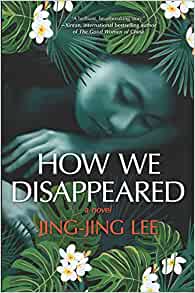
The story is set in Singapore both during the World War II occupation of the island by the Japanese, and in relatively modern times - it seems somewhere around the turn of the century, which is perhaps during the childhood of the author. 12 year old Kevin's grandmother is dying. As she does so, confused and believing Kevin to be his father, she mumbles a confession. In the meantime, the elderly Wang Di is grieving the death of her husband, and adjusting to life in a modern high rise apartment since her old home is to be bulldozed for a new development.
Kevin sets about unravelling a family mystery. The story crosses back and forth between his story and Wang Di's in the present, and Wang Di's story in the past. I found it a compelling story, if a little grim in the description of the lives of the "comfort women" who were taken by the Japanese to serve the physical needs of their soldiers during the war.
Ultimately though, it is a redemptive story. One minor niggle I had was that the book supposedly explains why Kevin has no uncles, aunts, cousins and so on - but that is on this father's side, and there is little explanation of his mother's background. True, it would unnecessarily complicate the story to digress to much, but a little casual explanation of his mother's background would have filled out her character.
Jing-Jing Lee was born and raised in Singapore and gained a Master's Degree in Creative Writing from Oxford University. She currently lives in Amsterdam. How We Disappeared was published in the UK by Oneworld Publications in 2019. The edition I read was published in the USA by Hanover Square Press, also in 2019.
Saturday, May 23, 2020
Angola: The Society of Reluctant Dreamers, by Jose Eduardo Agualusa

Recently I spotted his latest book at the library and as I had enjoyed the previous one, decided to read that as well. I really liked this book and it's rather unusual narrative. Daniel Benchimol, a reporter, finds a waterproof camera floating in the sea. It turns out to contain images of a woman who has been appearing in his dreams. He discovers that the woman is Moira, a Mozambican artist famous for a series of photographs depicting her own dreams.
Daniel contacts Moira and they meet. Meanwhile his daughter has been arrested as one of a group of young protesters against the current political regime.
The idea of dreams, both in the sense of what happens when we sleep, and in the sense of visions and hopes for the future, binds this book together. It is about the power of art, and of working together. It is both a beautiful and lyrical fantasy, and a powerful political document.
I found myself wondering about the history of the country and the current political situation - if, as it seemed from this book, it is still under a dictatorship, then how could the book get published when the author still lives in the country? So, I suspect that the government depicted in the book is fictionalized, but I will need to do more research before being sure of that.
Jose Eduardo Agualusa was born in Huambo, Angola. His previous book "A General Theory of Oblivion" won the International Dublin Literary Award and was shortlisted for the Man Booker International Prize. "The Society of Reluctant Dreamers" was translated from Portuguese by Daniel Hahn and published by Harvill Secker in 2019.
Monday, May 18, 2020
Gabon: Awu's Story, by Justine Mintsa

Another library book I had borrowed just before lockdown was much slimmer - Justine Mintsa's "Awu's Story". It's not much over 100 pages, and the translator's introduction alone, where she comments on the cultural background and significance of the book, takes up nearly thirty pages. So it would be unreasonable, I suppose, to expect great depth in that space, and indeed, I felt the character's were rather one dimensional.
Still, there is much of interest here. Awu is the second wife of a village schoolteacher, Obame Afane. She is taken as his second wife because his much loved first wife, Bella, is childless. (That is, in a polygamous marriage). She longs to be loved in the same way as he loves Bella. But this is not to be for many years.
Eventually Obame Afane retires, and travels to the city to try and obtain his pension. Bureaucracy makes this a long drawn out and difficult process. And after his death, in tragic circumstances, Awu is subjected to humiliating traditional rituals to which widows in Fang society are customarily subjected.
As a novel, I would have appreciated more complexity, and found myself not particularly emotionally involved with the characters. But as a cultural document, I found the book interesting. There seems to be little literature from Gabon, a French speaking country (along with traditional languages), published in English, so I was glad to be able to find something.
Awu's Story was translated by Cheryl Toman and published by the University of Nebraska Press in 2018.
Thursday, April 16, 2020
Armenia: The Gray House, by Mariam Petrosyan

I've been working my way through it since Christmas, reading other, shorter, works at the same time. But its uniqueness kept me going. While I describe it as a fantasy novel, it's not typical of any genre. On the surface, the world it describes seems almost normal at first. It is set in a residential school for children with various physical disabilities - although in The House they are not seen as disabilities, merely individual characteristics. And the House itself seems to be alive. As the novel progresses, certain happenings become stranger and stranger. The culmination of the book is the final year and graduation of the group of pupils on which the book is focused.
There were one or two points that seemed to be a bit odd - not odd in the sense that this is a fantasy, but odd in a way that didn't quite fit. There seemed to be only two intakes of new pupils over a twelve year period so that there were juniors, all roughly the same age, and seniors, also all roughly the same age as each other. The seniors had only observed graduation, and The Longest Night that preceded it, once in their time in the House,before it was there turn. One would expect - even in the context of the world of The House - new pupils each year, with a full range of ages at any one time.
Minor points such as this, however, could be overlooked in the overall powerful story telling.
This is Mariam Petrosyan's first novel and also likely to be her last - she worked on the book for eighteen years, and says that readers should not expect another book from her, since The Gray House is not merely a book but a world she knew and could visit, and she doesn't know another one. She was born in Yerevan, Armenia in 1969, where she currently lives, after a time in Moscow. The book was published in Russia in 2009, and translated into English by Yuri Machkasov. It was published by AmazonCrossing, Seattle in 2017.
Friday, March 27, 2020
Liberia: She Would be King, Wayetu Moore
A while back I chose Ellen Johnson Sirleaf's memoir as my choice for Liberia. I'd rather read novels, though, so when Wayetu Moore's debut novel popped up in the library, I decided to add it to my reading list.
Wayetu Moore was born in Monrovia, Liberia in 1985. When she was four years old, civil war broke out. At the time, her mother was studying in America. Her father fled with her and her sisters and hid in a village for six months before her mother was able to send someone to get them across the border. She now lives in America where she teaches at the City University of New York.
She Would be King is a retelling of Liberia's origins which incorporates magical and supernatural elements. It has been described as magical realism, however the author has explained that she is not attempting to fit it into this genre, but is using elements that are traditional to African story telling. It centres round three people who have supernatural powers. Gbessa is born into the Vai tribe, and is considered cursed and a witch because she was born on the day that an old woman died after beating her cat (cats were revered in the Vai culture). Gbessa has startling red hair, and an inability to die, although she feels pain.
Norman Aragon was born in Jamaica to an English father and a Maroon mother. He has the ability to become invisible. He escapes from his English father, and travels to Liberia, where he has heard there is a new colony for former slaves.
June Day is born on a southern plantation to a mother who is a ghost, a dead slave woman who does not know that she is dead. June has supernatural strength, a power which includes the ability to repel bullets and other wounds. He boards a ship for New York, but mistakenly ends up in Liberia.
Norman and June team up to rescue villagers from the predations of the slavers who still terrorize Africa, although slavery has been outlawed in the United States. They meet up with Gbessa, but she is carried off and then abandoned for dead by French slavers. She is rescued and taken into the household of an American settler in Monrovia, where she rises in society, marries and becomes a farmer's wife. Eventually, however, she meets up with Norman and June once more, as the colony is threatened by the outsiders who are still marauding and taking captives, seeing no difference between the villagers of the hinterland and the freed slaves who have settled on the coast.
This is a many layered novel with a powerful and interesting story line. I did feel the telling was a little stilted in places although I could not quite put my finger on why. And in places, the meeting and re-meeting of the three protagonists felt a little contrived. But overall, it is an original and powerful story, and an interesting take on the origins of Liberia.
The edition I read was published in the US by Graywolf Press in 2018. The book was also published in the UK by Pushkin Press in May 2019.
Wayetu Moore was born in Monrovia, Liberia in 1985. When she was four years old, civil war broke out. At the time, her mother was studying in America. Her father fled with her and her sisters and hid in a village for six months before her mother was able to send someone to get them across the border. She now lives in America where she teaches at the City University of New York.
She Would be King is a retelling of Liberia's origins which incorporates magical and supernatural elements. It has been described as magical realism, however the author has explained that she is not attempting to fit it into this genre, but is using elements that are traditional to African story telling. It centres round three people who have supernatural powers. Gbessa is born into the Vai tribe, and is considered cursed and a witch because she was born on the day that an old woman died after beating her cat (cats were revered in the Vai culture). Gbessa has startling red hair, and an inability to die, although she feels pain.
Norman Aragon was born in Jamaica to an English father and a Maroon mother. He has the ability to become invisible. He escapes from his English father, and travels to Liberia, where he has heard there is a new colony for former slaves.
June Day is born on a southern plantation to a mother who is a ghost, a dead slave woman who does not know that she is dead. June has supernatural strength, a power which includes the ability to repel bullets and other wounds. He boards a ship for New York, but mistakenly ends up in Liberia.
Norman and June team up to rescue villagers from the predations of the slavers who still terrorize Africa, although slavery has been outlawed in the United States. They meet up with Gbessa, but she is carried off and then abandoned for dead by French slavers. She is rescued and taken into the household of an American settler in Monrovia, where she rises in society, marries and becomes a farmer's wife. Eventually, however, she meets up with Norman and June once more, as the colony is threatened by the outsiders who are still marauding and taking captives, seeing no difference between the villagers of the hinterland and the freed slaves who have settled on the coast.
This is a many layered novel with a powerful and interesting story line. I did feel the telling was a little stilted in places although I could not quite put my finger on why. And in places, the meeting and re-meeting of the three protagonists felt a little contrived. But overall, it is an original and powerful story, and an interesting take on the origins of Liberia.
The edition I read was published in the US by Graywolf Press in 2018. The book was also published in the UK by Pushkin Press in May 2019.
Subscribe to:
Posts (Atom)