The sheets on my bed are almost worn out. It won't be long before our heels go right through. So a couple of weeks ago I treated myself to new ones. And then I went to put them on the bed, and found the fitted bottom sheet didn't fit.
Now, I have to say that I loathe and despise fitted sheets. Whoever invented them better not make it known to me, if he/she ever happens to meet me. Why? Well, for a number of reasons:
1) It makes twice as much washing. My mother always changed the sheets by washing the bottom sheet, moving the top sheet to the bottom - it's cleaner - and putting a clean top sheet on the bed. Everyone I know my age says their mothers did it that way! Well yes, I have to admit that maybe we have moved on in standards of cleanliness. The Elizabethans washed themselves about once a year, and I don't complain about the added work of having a daily shower. Still, I look at the piles of sheets in the laundry and remember the days of half as many to wash each week.
2) They are totally impossible to fold, once you get them out of the packet. So, they always come out of the linen cupboard a crumpled mess.
3) We have a water bed. (Shades of the seventies, I know, but I like it. It's warm and comfy. Actually we bought it in the eighties). Anyway, I always felt that the squishiness of the corners in a waterbed meant that a fitted sheet wouldn't stay on very well. So I never bought one for our bed before - only for the single beds. But P. said that he thought they would stay on OK. So I gave in.
4) Here's the clincher. Of course a fitted sheet has to fit. That's when I found out that not all king size beds are created equal. The sheets I bought were about six inches too narrow and about nine inches too short. Even though they were labelled "king size". Fortunately the shop was willing to take them back. (It did take P. and I about half an hour to get the unused sheet folded up and back in the packet though). Then I went looking for something else. I found three different widths of king size fitted sheet. 168 cm (5 ft 6 inches), labelled "king size", 180 cm (6 ft) labelled "king size" or "super king" depending on which shop, and 203 cm (about 6 ft 9 inches) labelled "California king". But they were all exactly the same length, which I had already established was about 9 inches too short. Back to the original plan of buying plain flat sheets. No luck there either - these days all the flat sheets are intended to go on top, so they have fancy top edges not designed for tucking in, and they are a little too short for a really generous tuck in, as well. So I came home sheetless, and rang a fabric shop - do they sell plain sheeting by the metre? Yes they do, it comes in any colour you want as long as it's white. And it comes in two widths, neither of which are anywhere near wide enough for a king size bed. I wonder how soon our feet are going to go through that thin spot? Aaargh! Any suggestions?
Tuesday, October 17, 2006

Haiku: Simple Pleasures
steaming hot chocolate with
fluffy marshmallows
Sadly I have no photo to go with the above haiku as I am forgoing such pleasures for a while in a bid to lose weight.
in a clear blue sky
first butterfly of spring
The butterfly was too quick to catch on camera, but here is a summer view in my yard:

For more simple pleasures, visit onedeepbreath
Sunday, October 15, 2006
Sunday Scribblings: Stopping Time
If I could stop time, just once, I would choose to do it next year on our planned trip to Scotland. That way, we could fit in everything I want to see and do, and still get back within the four weeks that is the most leave I am able to take from work. But of course it wouldn't work, really, as you can see in this piece of fiction (disclaimer: unedited, first draft)...
*************************************
I am talking to my eccentric neighbour, who has made one of his rare excursions out of his back shed to collect his mail from the letterbox. Most days, I hear banging and whining of power tools in the shed. Delivery men bring mysterious shaped packages quite often. Once I saw the shed shimmer strangely and start to fade, then I blinked and it appeared again. I thought I was imagining things.
Today I am asking him if he can clear our letterbox of junk mail while we are away. "If only I could stop time," I say, "I'd be able to see everything I want. Four weeks just isn't enough."
A strange look appears on his face. "Maybe I can help you there. Can you keep a secret?". He invites me to his shed where he produces two strange-looking belts.
"I need someone to test these for me", he says. "You can stop time with these, but I warn you, they take a lot of power. I've only been able to store enough charge in each to do it once. When you have turned them on, you have to keep them turned on, they won't work a second time. And please keep careful records of what happened, so you can report back to me."
Naturally I am doubtful, but it won't hurt to try, will it? If nothing happens, there's no harm done. After all, I've just asked a favour of him, so we will try out his weird invention, collect our mail when we get back and tell him it didn't work.
We reach Edinburgh and check into our bed and breakfast. "Shall we try them?" Paul# asks. "No, wait till we get to the castle", I suggest. So we leave our rental car parked in the garage, and catch a bus to the castle (parking is difficult in Edinburgh, we have been told). We look at each other. "Now?" "OK". We each push the right hand button, and everything freezes. The flag fluttering in the wind is as still as if it were a photograph. I notice a small girl with an ice cream. It is falling from her cone and sits in midair between the cone and the pavement. There is a line of tourists at the ticket booth. We start to push past them. "We should pay" I say. "No, we bought Heritage passes, remember?"
Inside the castle I wonder where to go next. "Audio guides" - I point out. We try one, but of course it doesn't play. Time is frozen. Instead we take a brochure, and explore the castle. Where next? "The Museum of Scotland" says Paul. All the buses are frozen, so we walk. When we get there, there is a problem. Automatic doors. They won't open. We look around the side and back of the building. There are staff entrances, but they have electronic key pads to open them, and we don't have the combination. Then I spot an open door, with a middle-aged man halfway through it. "Excuse me" we say, squeezing past him. He rocks and almost falls over. "Sorry", says Paul, and sets him back on his feet. The museum too has audio guides. No use to us. I can't find any brochures, we will have to manage the best we can. At least there is a plan of the layout. We start on the first floor: "Prehistoric Scotland". Another automatic door, but there are people walking through and we can enter. There are traditional displays, of course, but this museum is a modern one, and there are videos, all frozen in time. We see what we can and make our way to the next section. The door to this section is closed, and we can't get through at all. We have to move on.
After we have seen what we can in the museum, I realise my feet are aching and I'm starving. We walk out into the street and look for a restaurant. At the first, there is a tempting menu on the display board. But the food is all cooked to order, and there is no-one to order from. They are all statues. Eventually we find a cafe with a selection of sandwiches and muffins. We eat, and leave money at the counter. We continue our sight seeing. But we are getting tired and it's a long walk back to the bed and breakfast.
"We can sleep anywhere we like", says Paul. "The best hotels...nobody will ever know, we can walk in and out in an instant." There is a likely looking hotel just down the street. People are queued at the desk with suitcases, they appear to be checking out.
"Excuse me," says Paul, as he takes a key from the hand of the man at the front of the queue. "Room 626" he says to me. When we find the room, the sheets are rumpled, of course, but we straighten the bed and lie down exhausted. We wake some time later - no time later, really, from a sound sleep. I am hot and sweaty, and head for the shower. I turn on the taps, but nothing happens. The water is frozen in time, too.
"I can put up with your sweat, if you can put up with mine", Paul says.
"The hotel pool", I suggest.
"Good idea."
We swim naked, towel ourselves off and replace our somewhat crumpled clothes.
"We'll need more clothes", I say. We head off and find a chain store, where we buy cheap underwear and T-shirts, leaving the money on the counter with the price tags from the clothes. We buy books from a nearby bookstore, and look at souvenirs. But the tills won't open. We can't get change, and I am running low on all but large-denomination notes. And I can't bring myself to steal. We have to economize.
Still, we manage to see a good deal of Edinburgh. What a shame that our digital cameras won't work. It may take only an instant to process a photo, but it is still time. And time has stopped. As for the research I planned to do, everything at the National Archives has been computerised. and the computers won't work, either. After three more sleeps (I would say three days, but time has stopped), we have seen all that we can see. We make the long trudge back to our bed and breakfast.
"Where next?" Paul asks.
"Dundee," I say. We pack the suitcases into our rental car, sit down and do up our seatbelts. Paul turns the key in the ignition. Nothing. We look at each other.
"The petrol won't burn, frozen in time" he says.
"Bicycles?" I suggest.
"Roller skates?" counters Paul.
We sigh. It's a long, long way to Dundee on foot. Simultaneously, our hands reach for the "off" button on our belts.
*******************************
# Not his real name. This is fiction, remember?
We were also asked this week, what superpower (other than freezing time) we would choose, if we could have one. I'd like to be able to fly round the world in an instant, like Superman. Then it wouldn't matter that I can only get away for four weeks. I could flit off to Scotland (or Paris, or the Great Wall of China, or Egypt, Spain , Morocco, Peru) for a day here or there, any time I want.
More Sunday Scribblings here.
I am talking to my eccentric neighbour, who has made one of his rare excursions out of his back shed to collect his mail from the letterbox. Most days, I hear banging and whining of power tools in the shed. Delivery men bring mysterious shaped packages quite often. Once I saw the shed shimmer strangely and start to fade, then I blinked and it appeared again. I thought I was imagining things.
Today I am asking him if he can clear our letterbox of junk mail while we are away. "If only I could stop time," I say, "I'd be able to see everything I want. Four weeks just isn't enough."
A strange look appears on his face. "Maybe I can help you there. Can you keep a secret?". He invites me to his shed where he produces two strange-looking belts.
"I need someone to test these for me", he says. "You can stop time with these, but I warn you, they take a lot of power. I've only been able to store enough charge in each to do it once. When you have turned them on, you have to keep them turned on, they won't work a second time. And please keep careful records of what happened, so you can report back to me."
Naturally I am doubtful, but it won't hurt to try, will it? If nothing happens, there's no harm done. After all, I've just asked a favour of him, so we will try out his weird invention, collect our mail when we get back and tell him it didn't work.
We reach Edinburgh and check into our bed and breakfast. "Shall we try them?" Paul# asks. "No, wait till we get to the castle", I suggest. So we leave our rental car parked in the garage, and catch a bus to the castle (parking is difficult in Edinburgh, we have been told). We look at each other. "Now?" "OK". We each push the right hand button, and everything freezes. The flag fluttering in the wind is as still as if it were a photograph. I notice a small girl with an ice cream. It is falling from her cone and sits in midair between the cone and the pavement. There is a line of tourists at the ticket booth. We start to push past them. "We should pay" I say. "No, we bought Heritage passes, remember?"
Inside the castle I wonder where to go next. "Audio guides" - I point out. We try one, but of course it doesn't play. Time is frozen. Instead we take a brochure, and explore the castle. Where next? "The Museum of Scotland" says Paul. All the buses are frozen, so we walk. When we get there, there is a problem. Automatic doors. They won't open. We look around the side and back of the building. There are staff entrances, but they have electronic key pads to open them, and we don't have the combination. Then I spot an open door, with a middle-aged man halfway through it. "Excuse me" we say, squeezing past him. He rocks and almost falls over. "Sorry", says Paul, and sets him back on his feet. The museum too has audio guides. No use to us. I can't find any brochures, we will have to manage the best we can. At least there is a plan of the layout. We start on the first floor: "Prehistoric Scotland". Another automatic door, but there are people walking through and we can enter. There are traditional displays, of course, but this museum is a modern one, and there are videos, all frozen in time. We see what we can and make our way to the next section. The door to this section is closed, and we can't get through at all. We have to move on.
After we have seen what we can in the museum, I realise my feet are aching and I'm starving. We walk out into the street and look for a restaurant. At the first, there is a tempting menu on the display board. But the food is all cooked to order, and there is no-one to order from. They are all statues. Eventually we find a cafe with a selection of sandwiches and muffins. We eat, and leave money at the counter. We continue our sight seeing. But we are getting tired and it's a long walk back to the bed and breakfast.
"We can sleep anywhere we like", says Paul. "The best hotels...nobody will ever know, we can walk in and out in an instant." There is a likely looking hotel just down the street. People are queued at the desk with suitcases, they appear to be checking out.
"Excuse me," says Paul, as he takes a key from the hand of the man at the front of the queue. "Room 626" he says to me. When we find the room, the sheets are rumpled, of course, but we straighten the bed and lie down exhausted. We wake some time later - no time later, really, from a sound sleep. I am hot and sweaty, and head for the shower. I turn on the taps, but nothing happens. The water is frozen in time, too.
"I can put up with your sweat, if you can put up with mine", Paul says.
"The hotel pool", I suggest.
"Good idea."
We swim naked, towel ourselves off and replace our somewhat crumpled clothes.
"We'll need more clothes", I say. We head off and find a chain store, where we buy cheap underwear and T-shirts, leaving the money on the counter with the price tags from the clothes. We buy books from a nearby bookstore, and look at souvenirs. But the tills won't open. We can't get change, and I am running low on all but large-denomination notes. And I can't bring myself to steal. We have to economize.
Still, we manage to see a good deal of Edinburgh. What a shame that our digital cameras won't work. It may take only an instant to process a photo, but it is still time. And time has stopped. As for the research I planned to do, everything at the National Archives has been computerised. and the computers won't work, either. After three more sleeps (I would say three days, but time has stopped), we have seen all that we can see. We make the long trudge back to our bed and breakfast.
"Where next?" Paul asks.
"Dundee," I say. We pack the suitcases into our rental car, sit down and do up our seatbelts. Paul turns the key in the ignition. Nothing. We look at each other.
"The petrol won't burn, frozen in time" he says.
"Bicycles?" I suggest.
"Roller skates?" counters Paul.
We sigh. It's a long, long way to Dundee on foot. Simultaneously, our hands reach for the "off" button on our belts.
# Not his real name. This is fiction, remember?
We were also asked this week, what superpower (other than freezing time) we would choose, if we could have one. I'd like to be able to fly round the world in an instant, like Superman. Then it wouldn't matter that I can only get away for four weeks. I could flit off to Scotland (or Paris, or the Great Wall of China, or Egypt, Spain , Morocco, Peru) for a day here or there, any time I want.
More Sunday Scribblings here.
Friday, October 13, 2006
Quilts in the Library
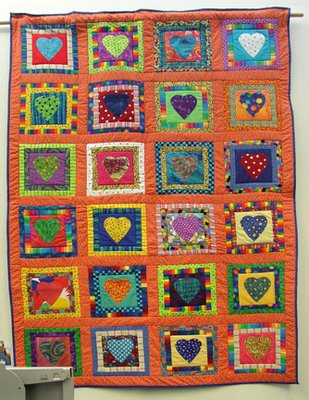
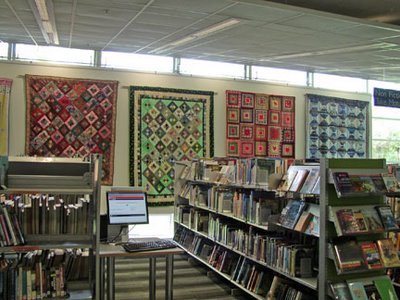
When I went to the library this week I found a display of quilts on the wall. These quilts have been made by a group set up for new immigrant women. They learn sewing skills, improve their English and make friends. The quilts are made from donated fabric, but many of the women are quite particular about what colours they use, and it shows in the wonderful results.
It was difficult to get a good clear photo with the racks of books in the way. I had to stand close and photograph upwards, so the quilts came out skewed - I have straightened them as best as I could in Photoshop (no doubt an expert Photoshop user could do better).


Blogger wants me to update to the beta version - should I? I tend to operate on the assumption "if it ain't broke don't fix it". Does anyone know whether beta works any better with Safari than the old version?
One thing I've noticed lately is that I seem to have to sign in a lot more often, even though I keep ticking the "remember me" box.
It was difficult to get a good clear photo with the racks of books in the way. I had to stand close and photograph upwards, so the quilts came out skewed - I have straightened them as best as I could in Photoshop (no doubt an expert Photoshop user could do better).


Blogger wants me to update to the beta version - should I? I tend to operate on the assumption "if it ain't broke don't fix it". Does anyone know whether beta works any better with Safari than the old version?
One thing I've noticed lately is that I seem to have to sign in a lot more often, even though I keep ticking the "remember me" box.
Thursday, October 12, 2006
Poetry Thursday: Breaking News
This week's prompt asked us to write poetry inspired by something in a newspaper or magazine - a headline, an article, an advertisement or whatever we chose.
At a workshop a few years back we were also asked to look through magazines for inspiration, so today I am posting the poem I wrote then. The triggers for this included an article on Japanese gardens and an advertisement for health supplements which included photographs of vegetables.
At the time I wrote it my daughter had just finished two years of English teaching in Korea and was visiting Mongolia before returning to New Zealand.
Sonnet
These grey days, I hunger for colour. I scavenge
in produce aisles, take home bags overflowing
with orange-skinned mandarins, broccoli, dark
as pines, purple grapes, tri-coloured capsicums.
I sip herbal tea and read your messages.
Mongolia's as hot as Korea, you say, but drier.
Everywhere is dusty. The vegetable soup is greasy
with mutton fat, and not much fibre in it.
You will pass through Osaka on your way home,
visit temples with gardens of pebbles
and carefully raked sand. By the time you return
the maples in our garden will be swelling with new buds.
The Japanese have a special name for it.
Shinryoku - the tender new green of spring.
More Poetry Thursday participants here
Tuesday, October 10, 2006
Haiku: Countryside
This week's topic at onedeepbreath is "countryside". I realised when I saw the topic that I always think of "countryside" as sheep, cows and pastures and that I find them rather boring (despite the fact that Japanese tourists in New Zealand always ooh and aah over the fluffy white sheep).
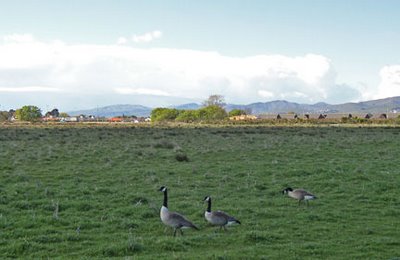
On the other hand if I take the topic to mean "outside the city" then it expands to include mountains, forests, beaches, rivers, lakes and all the vast expanse of nature. This morning Margaret, my walking buddy, and I, went to the Travis Wetlands on the fringes of the city. A swampy area has been saved from draining and development for housing and is gradually being restored to its natural state. It is a haven for birdlife. Parts of the reserve are still grazed by cattle, as some birds need shorter grasses for feeding. The area was alive and very noisy with birdlife - various species of duck, geese, pukeko (swamp hen - a New Zealand native), welcome swallows, pied stilts and others.
I was somewhat restricted for photographs by the 3x zoom on my camera and the fact that we had to keep to the walkways.

noisy traffic
geese fly honking overhead
come in to land

On the other hand if I take the topic to mean "outside the city" then it expands to include mountains, forests, beaches, rivers, lakes and all the vast expanse of nature. This morning Margaret, my walking buddy, and I, went to the Travis Wetlands on the fringes of the city. A swampy area has been saved from draining and development for housing and is gradually being restored to its natural state. It is a haven for birdlife. Parts of the reserve are still grazed by cattle, as some birds need shorter grasses for feeding. The area was alive and very noisy with birdlife - various species of duck, geese, pukeko (swamp hen - a New Zealand native), welcome swallows, pied stilts and others.
I was somewhat restricted for photographs by the 3x zoom on my camera and the fact that we had to keep to the walkways.

geese fly honking overhead
come in to land


Monday, October 09, 2006
Updates
1. As an extra to the photos of the quilt exhibition I went to, I found a couple of reviews of Sue and Galina's earlier exhibition, Merging Traditions, in the magazine of an organisation called the Chrysalis Seed Trust. It can be found online here, with photos (scroll down to page 21)
2. I rang the post office about the stolen mail bag I referred to last week. Although the letter we received said that they didn't know what was in the bag, the customer service centre told me it contained "large flats" - mostly EziBuy catalogues and Avenue magazines (a local lifestyle magazine). I think the thief was probably very surprised to find his/her efforts had netted multiple copies of the same mail-order catalogue and the same magazine! You'd think they might peek, and choose a bag more likely to contain cheques and cash! I have decided that probably we are not missing anything important. I don't subscribe to the magazine, and my copy of the same mail-order catalogue arrived today.
3. I decided to try and visit all the Sunday Scribblings websites this week. I think I'll live to regret it. I've managed about twenty so far, and there are usually around seventy to ninety participants. I suppose I can always keep going for a week or two until I get to them all.
Sunday, October 08, 2006
Sunday Scribblings: An Assignment
This week's assignment on Sunday Scribblings was to go out to a place where people gather, and observe someone interesting. Described the person, consider what sort of writing they could be part of.
I have to admit I am no Sherlock Holmes. I pretty much suck at being able to tell someone's whole life story from the fact they have a callous on their index finger and an inkspot on their shirt. In fact I tend not to notice details like that at all. And I am rather shy about staring too hard. You can't see much detail of a person from behind them, or taking side-on surreptitious glances. Still, I tried. Fortunately I took a peek at work on Friday to see if the topic was up yet, and it was. Normally I don't see it till Friday night since Thursday in the USA is Friday here. Since I saw it before I left work, I drove the couple of blocks to the airport carpark on my way home. An airport, after all, is a perfect place to find lots of people who are about their business which is fairly significant to them in one way or another. I stood with a group of people waiting for a flight from Auckland to disembark, and tried to decide who was interesting enough to write about.
What I found was that I can tell more about people once they actually start talking. Whether they are fat or thin, blond or dark, dressed casually or formally. they become much more interesting in relationship to each other.
The girl I spotted at the last moment, wearing daffodil yellow trousers, a white camisole top and white blazer jacket, carrying a large black art folio, may have made a suitable subject if I had had more chance to watch her. But the group that interested me most was a group of three - two, initially.
What drew my attention was the end of a comment the young woman was making as I walked up: "....near the hypothalamus. Tends to cause lactation in females." And then they laughed. Hmmm....okay then. Not your usual airport conversation. The young woman was of average height, with blond hair pulled back in a pony tail. She had a face that was more oval than round, with well-defined cheekbones, and she was neither overweight nor excessively thin. She was dressed in "city casual" clothes - trousers and a hooded sweatshirt type jacket or cardigan, but not the sort of clothes you'd wear down on the farm. But then, even farmers don't wear "down on the farm" clothes to the airport. Her companion was an older man, with neat grey hair and a grey beard. He too was dressed in "smart casual" clothes. He had a burgundy coloured overnight bag and a matching wheeled suitcase. I didn't watch them too hard in case I was noticed, but I listened. Most of the rest of their conversation involved the trip from Dunedin to Christchurch - how long did it take by road, what were the options for public transport, that sort of thing. It seemed as if the young woman lives in Dunedin as she said "it took us five hours leaving in the rush hour". It seemed as if she was referring to a recent trip. She seemed quite familiar with Dunedin and the transport there.
When the flight from Auckland arrived, a young man walked towards them. He was dressed in black trousers and a short, casual zipped black jacket. He had dark hair and a rounded, crumpled looking face, slightly fleshy, although he himself seemed of normal weight. He had one shoe on, and on the other foot he had the sort of rocker that is put on over a plaster cast. He had a small black wheeled suitcase. He and the girl hugged - she kissed him on the cheek in a fairly intimate manner - and he shook hands with the older man. Then they walked off.
Here is what I think their story is: The young woman and the young man are a couple, engaged to be married perhaps. They met at high school in Christchurch, where they both came from fairly wealthy families. Perhaps they were even at boarding school, and their families were farmers. They both were horse keen riders, and that is how they met. Nowadays they don't get as much time for riding, but they still try to fit some in, and that is how the young man broke his foot - it was stomped on by a horse. The woman, of course, is a doctor. She went to medical school in Dunedin (the nearest medical school). Rather than doing her clinical training in Christchurch, she stayed in Dunedin, where she is now in her final years of clinical training or is perhaps a newly qualified doctor. The young man is a teacher. It was the last weekend of the school holidays. He had been to Auckland to visit other family members. His fiancee couldn't go with him as she had to work.
Clearly there is some sort of family event in Christchurch this weekend. Possibly a funeral, but more likely a happier occasion. Perhaps it is a reunion to celebrate 150 years since their forbears arrived in the country, or perhaps it is the 100th birthday celebrations of the girl's greatgrandmother. The older man is her uncle, also a doctor. He lives elsewhere in the country - maybe Wellington. She had clearly been delegated to meet relatives at the airport, first her uncle, and then her fiance on a later, separate flight.
What sort of story are they part of? What better than a family reunion to open a sweeping family saga, complete with flashbacks. On the other hand, maybe there will be surprising relevations that mean a dramatic change in the lives of the young couple, and it will be their story. And that's as far as I got - I haven't actually written an extract yet.
Of course I could be dead wrong (although I think I am pretty close to the mark on the medical school thing).
More Sunday Scribblings here.
Saturday, October 07, 2006
An Exhibition
On Thursday between doing various errands, working on my Poetry Thursday post, and playing corporate employee at at tax seminar, I managed to fit in a visit to an exhibition by two local artists. Sue Spigel is a quiltmaker and Galina Kim is a painter in acrylics, heavily influenced by the tradition of icon painting. Recently they have been working in collaboration. Some of their works are separate works, some include panels of acrylics on canvas alongside quilted panels, and more recently Sue has been sewing the painted canvases into her quilts.
The current exhibition is called "On Pilgrimage". It results from a trip that Galina made to the Holy Land. Here are just a few of the works in the exhibition.
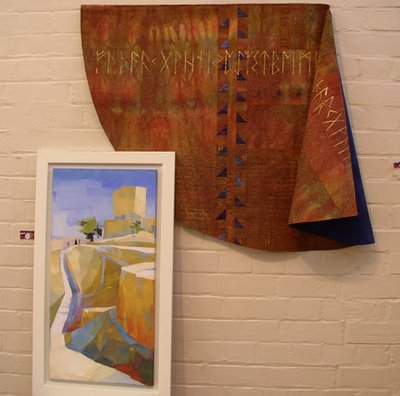
The quilt at the back is "Journeying Cloak for a Pilgrim" and the painting is "To St. Sabba"

The fish is painted on the fabric and black lines of machine quilting simulate a mosaic effect.
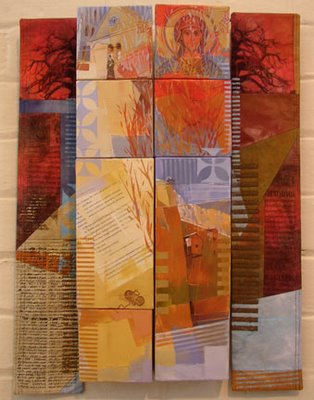
This piece is "The Burning Bush". Each of these two works have two panels of acrylic on canvas flanked by a quilted panel on each side. Sue uses a lot of printing, painting and stamping on fabric as well as some machine piecing. She has been working since the early days of quilting in New Zealand and I have seen her work grow from traditional piecing to a much more "arty" style. I didn't get many detail shots of the work, but these pieces really repay a close look. Some of the printing is of texts in different languages - Hebrew, Greek, English, Latin etc. There was a big controversy recently because she made an altar cloth for the Anglican cathedral here (a commissioned work) and it included a Sanskrit text, which some people objected to. In the end I believe a compromise was reached which allows the cloth to be used on certain occasions.
The current exhibition is called "On Pilgrimage". It results from a trip that Galina made to the Holy Land. Here are just a few of the works in the exhibition.

The quilt at the back is "Journeying Cloak for a Pilgrim" and the painting is "To St. Sabba"

The fish is painted on the fabric and black lines of machine quilting simulate a mosaic effect.

This piece is "The Burning Bush". Each of these two works have two panels of acrylic on canvas flanked by a quilted panel on each side. Sue uses a lot of printing, painting and stamping on fabric as well as some machine piecing. She has been working since the early days of quilting in New Zealand and I have seen her work grow from traditional piecing to a much more "arty" style. I didn't get many detail shots of the work, but these pieces really repay a close look. Some of the printing is of texts in different languages - Hebrew, Greek, English, Latin etc. There was a big controversy recently because she made an altar cloth for the Anglican cathedral here (a commissioned work) and it included a Sanskrit text, which some people objected to. In the end I believe a compromise was reached which allows the cloth to be used on certain occasions.
Friday, October 06, 2006
Did Anybody Mail Me Anything?
We had a letter from New Zealand Post yesterday. It says in part:
"I regret to advise you of the theft of a mailbag on the 3rd of October 2006. This bag contained mail intended for delivery in your area.... Unfortunately in such situations we are unaware of the specific mail items contained in a bag. should you have been expecting a particular article ...we suggest you contact the sender..."
Of course, as my son points out, sometimes you get important mail that you didn't know you were going to get. For instance, he received a letter that he needs to produce to claim scholarship money next year. If he hadn't received the letter he wouldn't have known that he needed to have it to claim the money.
Still, I've been doing pretty well with mail in the last couple of days. I received a magazine I was expecting, and my confirmation of classes for the Quilt Symposium. Then the next day (the same day as the above letter) I received a book token in payment for a poem I had published. And then today I received a 20% discount voucher for a local fabric store - which will come in very handy, now that I know my symposium classes, for purchasing the class requirements. So I don't feel as if I am missing out on any mail - let's hope not. No lawyers searching for me to offer me a share in an inheritance from a long-lost relative, for instance. (And if there were, let's hope they'd try again if they didn't hear back!)
I was pretty happy to find that I was able to take all my first choice classes for the quilt symposium. At least, they were the ones I'd put as my first choice. My absolutely top first choice combination was impossible because they were all on the same day. and now I find they are running an extra session for one of the classes and I could do them together after all. I think I'm going to stick with what I've got, though, and not pay the extra fee to swap classes. Now, I just have to wait till January -giving me time to practise on my new machine. I put on my registration form that I didn't need to have a class on the hire machines because they are the same as the one I have. It's just that I haven't used it very much yet (I've been too busy writing poetry. I'll blame Poetry Thursday for that!)
Speaking of poetry, the latest Guardian Poetry Workshop is up. Why not give it a try? If you like the result, you can send it in - the top fifteen are published on the website each month with comments from that month's guest poet.
Thursday, October 05, 2006
Poetry Thursday: The Body
I've been playing at being a whiz corporate accounts person today, all dressed up in my power suit to attend a tax seminar. So I'm a little late, but I have two hours to go of Poetry Thursday here, and a lot more hours in the US. Sometimes it's useful to be in this time zone.
My poem this week is a new one written for the topic (though it's from an old germ of an idea I've had sitting round for a while) so it's very new and feels a bit rushed. Usually I take a lot longer than a couple of days to write a poem. I'm going to post it anyway and will definitely work on it some more later.
Stretch Marks
You are mapped in lines on my hips. For nine months
you grew. I thought that was all the stretching
I had to do. You were small and close.
You played beside me in the garden. On the path,
a shiny trail the snails made echoed the lines
on my hips. Years passed. You moved further away
- to school, and further still, passport in hand.
Returned, only to wander in dark lands
where no one could follow. I stretch and stretch,
more than I ever knew I could,
wanting to hold you still, and I have stretch marks
like those on the globe of my belly,
shining like braided rivers that flow from the mountains
over shingle beds in many channels
searching for the sea.
As a bonus, here is a link to a discussion on poems about the body from the Academy of American Poets.
And here is a favourite poem from American poet Joyce Sutphen:
Coming Back to the Body
Coming back to the body, as if to
a house abandoned in time of war, you find
it stands as tall as you left it, the same
fingers reaching back to rub the same neck.
Returning, you remember how it feels
to stretch your arms to embrace another
body, how the tongue clicks against the teeth,
how solid voices flow into your ear.
You are relieved that what you dreamed will not
come true now that you have escaped again
into skin and bone. They'll never think of
looking for you in the body, alive.
Wherever the body is, that's where you
are now. It's the same old address you had
before you went away: no miracles,
no amazing improvements. You're still you.
Now that you are back, things go on the way
they were meant to. No one asks the question
that you couldn't answer if you wanted:
Where were you hiding all those long lost years?
Tuesday, October 03, 2006
Time for a Haiku
This week's theme at onedeepbreath is books and reading. I was thinking of going to the library to take photos and get inspiration, but it is a nasty wet day, so my library card is as far as I got:

my library card
- ticket to times and places
far away

- ticket to times and places
far away
Monday, October 02, 2006
Still Wondering...
...about the bagpiper I encountered yesterday. Why was he up in the hills playing the pipes? I have a few suggestions and would be very glad to hear any more contributions.
1) His wife won't let him practise at home.
2) His next-door-neighbour won't let him practise at home.
3) The people in the next street won't let him practise at home.
4) He is doing scientific research into the effects of bagpipe music on sheep.
4) He is practising for an upcoming family reunion. To celebrate 150 years settlement in New Zealand his family plan to have a bagpiper lead them over a narrow mountain track to their greatgrandfather's original homestead. Therefore he has to hone his ability to play the bagpipes while walking over a narrow, hilly, stony track.
Any more ideas?
Sunday, October 01, 2006
Heading for the Hills
I have been checking my genealogy files that I lost a year or so ago when my hard drive died - I hadn't completely restored them It's a tedious job going through about 3000 people one at a time. So I decided it was time to take a break and head up the Port Hills for a walk this afternoon - a bit more energetic than my usual stroll round the river.
I had company - not just the usual mountain bikers and joggers but this fellow:

He was on the path far below me, I zoomed in as far as I could and cropped the picture but it's still not quite clear what he was doing. It wasn't hard to hear though. He was playing the bagpipes. I hope the sheep weren't too startled!
Here's the view when I sat down and took a photograph of where I had come from:

Further up the track, two valleys join. This is the view down the other valley, the one I didn't come up. the ponds on the left side of the photo are a wildlife reserve. Or rather, they are part of the sewage treatment works! But wildlife reserve sounds so much better. I think the water is fairly clean before it finishes up in these ponds - there is no smell. The birds certainly don't seem to mind.
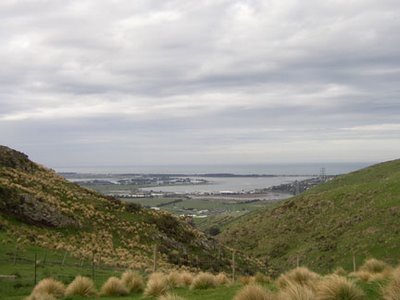
I can get from the bottom of the hill to the top in about fortyfive minutes. It is the rim of an extinct volcano crater. Inside the crater is the harbour on the other side. I didn't go quite all the way up today, the last bit is steep and I'm out of condition. In a few weeks, I probably will, then I'll take photos of the view from the top. I could walk to the beginning of the track in about twenty minutes, but usually I drive. I love having the hills so close to my home.
I had company - not just the usual mountain bikers and joggers but this fellow:

He was on the path far below me, I zoomed in as far as I could and cropped the picture but it's still not quite clear what he was doing. It wasn't hard to hear though. He was playing the bagpipes. I hope the sheep weren't too startled!
Here's the view when I sat down and took a photograph of where I had come from:

Further up the track, two valleys join. This is the view down the other valley, the one I didn't come up. the ponds on the left side of the photo are a wildlife reserve. Or rather, they are part of the sewage treatment works! But wildlife reserve sounds so much better. I think the water is fairly clean before it finishes up in these ponds - there is no smell. The birds certainly don't seem to mind.

I can get from the bottom of the hill to the top in about fortyfive minutes. It is the rim of an extinct volcano crater. Inside the crater is the harbour on the other side. I didn't go quite all the way up today, the last bit is steep and I'm out of condition. In a few weeks, I probably will, then I'll take photos of the view from the top. I could walk to the beginning of the track in about twenty minutes, but usually I drive. I love having the hills so close to my home.
Friday, September 29, 2006
Things I Like About New Zealand
I haven't travelled much, so I don't have much to compare New Zealand to, but I keep coming across people who claim that New Zealand has the most fantastic scenery in the world. And that the people are friendly and the climate is good, and things like that.
Now I have to admit that I like New Zealand, for the above reasons, but for so much more besides. Like the fact that the cities are small enough to be friendly but big enough to have culture (and you don't have to book tickets six months ahead if you want to see a show or something).
Still, I think there are other good things about New Zealand that are a little less obvious. For instance:
1) Time starts here. We get to be the first in the world to wish people a Happy New Year. We'd be the first in the world to post for Poetry Thursday, too, if the rest of the world didn't cheat by posting on Wednesday (no hard feelings). Now, given that the British have Greenwich Mean Time, you'd think they'd standardize things so that they came first. But they didn't. They let us come first instead (Isn't that sporting of the Brits?). There are other advantages to this, of course. When we travel we can leave home one day and get there the day before. Just think, if I leave on holiday next year the day after my birthday, I could have two birthdays. That's got to be a good thing.
2) Hokey pokey ice cream. I was well into adulthood before I discovered that the rest of the world didn't have hokey pokey ice cream. Actually, I think the Australians do. Maybe they pinched it from us. But no one else. Tia, if you are reading this - you have to try our hokey pokey ice cream, it's pretty good. Actually, all our ice cream is pretty good.
3) We have silly statues. Like this one:

(The girls aren't part of the statue, though, they are two of my daughters).
Besides the big L & P bottle, we have a giant salmon, and a big carrot, and a big kiwifruit. There are probably lots of others. Again, I'm not claiming this is unique. Apparently Queensland (Australia) has a giant pineapple. Still, we have a lot of them, and I like them.
4) No snakes. Except for this sort:

And only one poisonous spider, which is pretty shy, so you're very unlikely to get bitten by one.
5) The police don't, as a rule, carry guns. Although there is an Armed Offenders Squad that gets called out if the occasion warrants it. Guns in New Zealand are for rabbits. And deer. (Yes, I know some of you like cute furry animals, but these wreak havoc on the environment, not being native, so I'm symapthetic to the shooters).
6) Pineapple lumps.
7) Buzzy bees. (No, not the live sort).
8) Giant wetas. They look fearsome but actually they are quite docile (like us)
9) The Prime Minister visits the business in the next building and we go about work as usual. (On the other hand, when Bill Clinton visited, there were about a gazillion security guards on every corner and traffic had to stop to let his motorcade through).
10) We have a very special relationship with the letter "Z". Apparently New Zealanders can spot a letter Z in a page of text faster than anyone else. (We call it "zed", by the way, at least those of us old enough not to have been brought up on "Sesame Street" do). As a quilter, I am doubly blessed, because I can also spot the letter "q" almost as quickly.
There are lots more things, but ten seems a pretty good number so that's where I'm going to stop.
Now I have to admit that I like New Zealand, for the above reasons, but for so much more besides. Like the fact that the cities are small enough to be friendly but big enough to have culture (and you don't have to book tickets six months ahead if you want to see a show or something).
Still, I think there are other good things about New Zealand that are a little less obvious. For instance:
1) Time starts here. We get to be the first in the world to wish people a Happy New Year. We'd be the first in the world to post for Poetry Thursday, too, if the rest of the world didn't cheat by posting on Wednesday (no hard feelings). Now, given that the British have Greenwich Mean Time, you'd think they'd standardize things so that they came first. But they didn't. They let us come first instead (Isn't that sporting of the Brits?). There are other advantages to this, of course. When we travel we can leave home one day and get there the day before. Just think, if I leave on holiday next year the day after my birthday, I could have two birthdays. That's got to be a good thing.
2) Hokey pokey ice cream. I was well into adulthood before I discovered that the rest of the world didn't have hokey pokey ice cream. Actually, I think the Australians do. Maybe they pinched it from us. But no one else. Tia, if you are reading this - you have to try our hokey pokey ice cream, it's pretty good. Actually, all our ice cream is pretty good.
3) We have silly statues. Like this one:

(The girls aren't part of the statue, though, they are two of my daughters).
Besides the big L & P bottle, we have a giant salmon, and a big carrot, and a big kiwifruit. There are probably lots of others. Again, I'm not claiming this is unique. Apparently Queensland (Australia) has a giant pineapple. Still, we have a lot of them, and I like them.
4) No snakes. Except for this sort:

And only one poisonous spider, which is pretty shy, so you're very unlikely to get bitten by one.
5) The police don't, as a rule, carry guns. Although there is an Armed Offenders Squad that gets called out if the occasion warrants it. Guns in New Zealand are for rabbits. And deer. (Yes, I know some of you like cute furry animals, but these wreak havoc on the environment, not being native, so I'm symapthetic to the shooters).
6) Pineapple lumps.
7) Buzzy bees. (No, not the live sort).
8) Giant wetas. They look fearsome but actually they are quite docile (like us)
9) The Prime Minister visits the business in the next building and we go about work as usual. (On the other hand, when Bill Clinton visited, there were about a gazillion security guards on every corner and traffic had to stop to let his motorcade through).
10) We have a very special relationship with the letter "Z". Apparently New Zealanders can spot a letter Z in a page of text faster than anyone else. (We call it "zed", by the way, at least those of us old enough not to have been brought up on "Sesame Street" do). As a quilter, I am doubly blessed, because I can also spot the letter "q" almost as quickly.
There are lots more things, but ten seems a pretty good number so that's where I'm going to stop.
Thursday, September 28, 2006
Poetry Thursday: Synaesthesia
When I saw this week's topic for Poetry Thursday I thought of one of my favourite lines of poetry:
the afternoon was warm like a blue oboe.
This comes from a poem called "the assumption of mr dickson into the order of domestic cats" which is in a book, Sleeper by New Zealand poet John Dickson. I pulled my copy from the shelf and also found this, in a poem called "to start with"
perhaps a patch of blue sky will lose its way
and all those feelings beyond your bewareness
especially those that taste of the dense
bitter smell of apples rotting in paradise
hatred, sadness, rage, despair
will vanish to laughter, or even, a smile.
Is the author synaesthetic? Probably not. Synaesthesia - the mixing of the senses - is far more than being able to come up with a particularly striking metaphor. I can imagine what the taste or smell of an emotion might be, but that's different from permanently sensing it that way - for instance, instantly seeing spiky triangles when I smell lavender, or blue when I hear the word Tuesday.
I did some searching on google, and came up with an interesting website on synaesthesia with lots of fascinating links. There are some claimed examples of synaesthesia in poetry, but I couldn't really see it myself. I think the ones I have quoted above are far better examples. I did find an interesting link to a synaesthetic photographer. There is lots more that I have yet to explore.
As for a poem of my own this week, I would need far more time to come up with something as good as the quotes above. However, here is my rather hasty contribution.
The Synaesthete in the Garden
It is, he thinks, something planted by a Schoneberg
or a Stockhausen - roses and cornflowers,
poppies and delphiniums
all discordant seconds, sevenths,
augmented fifths. He braces himself
as he reaches the bend in the path
round which lies the herb garden.
Their fragrances mingle -
a clash of shapes
verticals, diagonals and spirals.
He lowers his gaze,
murmurs to himself
"Saturday, Saturday, Saturday"
carries its cool amethyst sound before him
like a shield.
Tuesday, September 26, 2006
Updating
I have been going easy on computer time over the last few days because I had a sore back. I think it may have been a result of too much enthusiasm on the exercycle! Every time I sat for too long, I would find it hard to straighten when I got up, until I walked around for a while.
That was really annoying, because I had just worked up the energy to tackle writing up the family history. It's proving difficult despite the vast amount of research I have accumulated - or probably because of the vast amount of research. Putting it all in some kind of linear order is difficult, when it isn't really linear. In fact it's more of a family hedge than a family tree. I think I've figured out how to do it, more or less. I'll start in a day or so.
I had a phone call from my brother who has a new job. He needs a security clearance. For that, he needed to know death dates for our parents, and birth places, and he consulted me as the "family expert". I had to admit that even though I could tell him off the top of my head the names of ancestors in various lines going back to the 1600s, I couldn't actually remember what day of the month mum died. I know that some families commemorate anniversaries of deaths every year. I have never been especially bothered by the actual day, although I remember her frequently. Perhaps it bothers me a little that I couldn't remember, or I wouldn't be writing about it here.
As for my back - it's pretty good now. I started again on an exercise programme I was doing a while ago, and let slip. I'm at the age when I get a few aches and pains - I often have a sore hip when I get up in the morning (or indeed, lying in bed at night). When I did this programme before, the soreness in my hips completely vanished. And this time, after only one set of exercises, I was able to get in the car, drive almost half an hour to work, and get out of the car standing straight up. The book is called The Core Programme by Peggy Brill, and I think it's brilliant. (If there are any guys reading this, sorry, it's designed for women. Our bodies are different). It looks as if it may be out of print, but I think this may be the same book in a newer edition.
I only have one beef - my copy has that awful cheap binding where all the pages pop loose after opening the book a few times. For something designed to be used regularly, that seems pretty stupid. I'm thinking of taking it apart and going to our local print shop to have it put in a lie-flat spiral binding.
Monday, September 25, 2006
Windows and Doorways
This week's haiku theme at onedeepbreath is windows and doorways

beads bags and bowlers
tempt upward glancing shoppers
up the narrow stairs
The shop is Shand's Emporium in Christchurch - the building dates back to the very early days of settlement in the 1850s.

Beyond the entrance on the right of the photo is a steep stairway leading to the upstairs rooms, whose windows are shown in the upper photo.
Saturday, September 23, 2006
In the Garden
I spent a fair bit of the day in the garden, weeding, hanging out laundry etc. But I also took the time to look around. At this time of year it seems to change every day. So, I took a whole bunch of photos.
This one is for Vickie at Laundry on a London Line

I'm not sure if this style of clothes line is found other than in New Zealand and Australia. Most homes have them here, they rotate so you can stand in one spot and hang all the laundry out. You can see some branches of the cherry tree that P. has been cutting down. Sadly, it is just way too close to the house and too big. And we never beat the birds to the cherries, anyway.

I love the new leaves on the maple trees, I think that is just about the most perfect shade of green ever.

The wisteria has just started blooming in the last few days. Again, such a wonderful shade of green, and it goes so well with the light purple.

The magnolias have been blooming for a while, and they are shedding petals in thick fleshy piles all over the lawn.

This plant is honesty. It is growing very thickly in the border under the grape vine. We never planted it, it just arrived. Later it will have flat oval translucent seed pods.

As sunset arrived, I noticed that there was a good view from the top of the ladder where P. had been trimming the tree. So he went to get his camera..

My turn!
Friday, September 22, 2006
This and That
1) Pantihose: Most of the time I wear trousers, but when spring comes I start to feel all girly and like to wear skirts and dresses sometimes. Which means pantihose. Because face it, I'm not going to frighten my coworkers by displaying my startlingly white and slightly hairy legs. And it's a lot easier to put on a pair of pantihose than to shave my legs and apply a fake tan.
I used to buy the size marked "tall". And then I started to look more like a Rubens than a Modigliani. So I figured I needed "extra large". Somehow they always end up slipping further and further down my hips during the day. That's when I realised, though the average width ones come in different lengths, the larger ones are all made for short fat people. I think I have it solved, I ignore the sizing on the back of the packet and buy the extra extra fat ones, so that they stretch lengthwise instead of widthwise. But, really, you'd think the manufacturers would realise that there are as many tall fat people as short fat people, when you just have to go and look around the street and see them.
2) Dr Who: I was watching last night, and I suddenly realised something. Britain is a very dangerous place! Apparently whenever aliens reach earth, or there is a warp in the fabric of space-time, releasing all sorts of horrors on the world, it happens in Britain. Never anywhere else. OK, there is a little variation - it might be London, or Cardiff, or the Scottish highlands. But the UK is a rather small island, along with a few even smaller islands - and yet the aliens never land anywhere else. Maybe I should think twice about planning a visit?
As for the London Olympics episode, well, in this household we are agreed that it wasn't very good. Last week's was great, maybe they used up all their good ideas.
3) Richard Hammond: Get well soon. Top Gear wouldn't be the same without you!
4) A photo: this is kowhai, a New Zealand native tree that flowers in springtime. Just one of the things I love about the season.

Thursday, September 21, 2006
Poetry Thursday: My Authentic Self
I'm not sure how to take this week's prompt at Poetry Thursday. Last week we were asked to write as someone else. This week we are asked to "be yourself". Really, even when imagining someone else's voice, I believe I am being "myself". Even if I am trying to copy something I admire, I believe I am being myself, because the urge to do so comes from within me. I'm not sure what it really means to be authentic, or not.
This probably requires a greater subtlety of philosophical discussion than I am capable of, so instead of agonising over it, I'm just going to post a poem that I've been wanting to share for a while. This is part of a set of sonnets inspired by familiar ingredients in cooking. It also relates to the rather astonishing feeling that I am now older than my own mother (she died at the age of 52).
Kitchen Sonnet #3
In memoriam Margaret Miller 1925 – 1977
Sometimes I feel ten years old, watching you
in the kitchen. You are mixing mash for the hens.
I will feed them, gather the eggs, carry them
carefully into the house. Did you ever wonder
how eggs in the nest bear the warm weight
of the hen and do not break? Here I am now,
older than you ever were. I don’t feel wise,
but astonished to have arrived in this body.
Every year there is more I do not know.
There is so much I would still ask you, but
you would not know the answers, even if you could speak.
I am the child who has run ahead on the path.
I glance over my shoulder, you are no longer there.
I am as strong as eggshells, and ready to break open.
Wednesday, September 20, 2006
There's Rosemary, That's for Remembrance
Last Saturday morning I met my poetry group friends for brunch at a great little restaurant that was new to me, the Oddfellows Cafe. It was hard to choose from the menu, but I settled for pancakes with fresh berries, yoghurt and maple syrup. Great food, great poetry, great friends!
Just down the road from the restaurant was the Addington Cemetery. Seeing it reminded me that I have been intending for quite a while to take a look, as two of my greatgrandparents are buried there, along with some of their children, their son-in-law (my greatgrandfather), and several of his children who are identified only as "stillborn".
One of them was my grandfather's twin. My grandmother told me that my granddad was the weaker of the two, and they were so busy attending to him that the other twin died. She said he had twin brothers who also died - the later burial doesn't identify that there were two babies, so I have no way of proving that. It's sad that so little attention was paid to stillbirths in those days, the births and deaths didn't even have to be registered. My greatgrandfather died leaving a young family. Two of the boys took jobs in the Post Office as messenger boys at the age of 14. When they were transferred to Auckland, the whole family moved up there.
I went back to look around and take photos. The cemetery is rundown, but efforts are being made to tidy it up. There is rosemary on some of the graves, which is covered with blue flowers just now. Greatgrandmother Georgina is buried in Auckland, and has a gravestone, as her boys were grown by then and able to pay. But the Christchurch graves have no markers. The two back to back plots are the grassy stretch in the photo with no concrete edging. There is a part of me that feels it would be good to put a plaque on the graves - and another part that thinks it would be a waste of money.
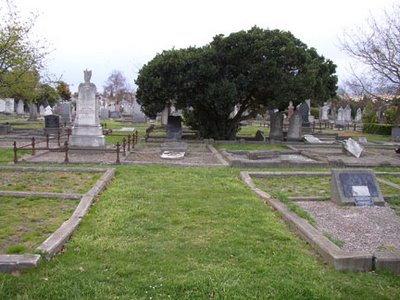
The other photos are just because I love old cemeteries (and to show the rosemary).


This angel with a broken wing reminded me of the quote: "We are each of us angels with only one wing, and we can only fly by embracing each other". (Luciano de Crescenzo)

Just down the road from the restaurant was the Addington Cemetery. Seeing it reminded me that I have been intending for quite a while to take a look, as two of my greatgrandparents are buried there, along with some of their children, their son-in-law (my greatgrandfather), and several of his children who are identified only as "stillborn".
One of them was my grandfather's twin. My grandmother told me that my granddad was the weaker of the two, and they were so busy attending to him that the other twin died. She said he had twin brothers who also died - the later burial doesn't identify that there were two babies, so I have no way of proving that. It's sad that so little attention was paid to stillbirths in those days, the births and deaths didn't even have to be registered. My greatgrandfather died leaving a young family. Two of the boys took jobs in the Post Office as messenger boys at the age of 14. When they were transferred to Auckland, the whole family moved up there.
I went back to look around and take photos. The cemetery is rundown, but efforts are being made to tidy it up. There is rosemary on some of the graves, which is covered with blue flowers just now. Greatgrandmother Georgina is buried in Auckland, and has a gravestone, as her boys were grown by then and able to pay. But the Christchurch graves have no markers. The two back to back plots are the grassy stretch in the photo with no concrete edging. There is a part of me that feels it would be good to put a plaque on the graves - and another part that thinks it would be a waste of money.

The other photos are just because I love old cemeteries (and to show the rosemary).


This angel with a broken wing reminded me of the quote: "We are each of us angels with only one wing, and we can only fly by embracing each other". (Luciano de Crescenzo)

Tuesday, September 19, 2006
Tuesday Rambles
Tuesday is my morning to go for a walk with my neighbour Margaret and her dog Bella. I am trying to get into the habit of taking my camera wherever I go, because if I don't I always see something worthy of a photo. However today I left my camera at home, because we usually take much the same route, so I thought that I wouldn't see anything new. And of course, because we walk for exercise, so I didn't want to stop to take photos all the time.
Did I say that I always regret it when I leave it behind? Today for the first time this spring, I saw ducklings on the river. The river is tidal where we walk, and it was low, so the fluffy little ducklings were skittering along on the exposed mud. Gardens were blooming everywhere - magnolia trees thick with blossom, and a number of flowers that weren't familiar to me. On the opposite side of the river bank I saw an odd dark lump perched on the top of a willow tree. At first I thought it was a bird. As I got closer I realised it wasn't moving, and it looked too large and too stumpy to be a bird, but I couldn't quite figure it out. Then as I got closer still, I saw the tail sticking out the bottom, which quivered slightly. So I suggested we cross the bridge over the river so I could get a closer look. When I got really close on the other side, I realised it was a shag - but larger and blacker than the usual pied shags that I see in the willows along the river. It had a ragged crest of feathers. I checked our bird reference books when I got home, and found it was a black shag. Although this website doesn't show it, it has a crest in the breeding season. This is when I started to regret leaving the camera at home. It's not a bird I've ever seen along the river before. We have lived here about twenty years, and I'm finding that there are more and more different species to be seen on the river, which is good to see in an urban area.
Now that we were on the other side of the river, I realised that we were near the home of Jill, a member of our church, who had invited the congregation to come and visit her garden to see something unusual. Her yuccas are flowering. Apparently they only flower once, so it is a sight only seen every few years, even with quite a large number of them in the garden. They produce a spectacular tall flower spike, almost as large as a house. I wasn't sure if I remembered the address correctly, but I found what I thought was the right house. I was taken aback by the unexpected grandeur of it, but a knock on the door confirmed I had the right house. It is on a low slope that rises from the river terrace. On the corner of two streets is a historic homestead, Riverlaw. It's large grounds was gradually subdivided, and there are several rather large houses along this area now - Jill's home is one of them. They have no fences, although hedges mark the boundaries between houses - consequently the houses look out on a beautiful wooded area that looks like one large park, with the river beyond. Jill was very welcoming and showed us around the gardens, and around the house which she and her husband have done a wonderful job of renovating over the last ten years. It was a real treat. However my plans for the day had rather gone out the window by the time we finished our very extended walk - both in time and distance!
Next time, I really will take the camera.
A Postscript:
Firstly, shages are known in the rest of the world as cormorants, in case you wondered what they are. Secondly, I meant to mention that the godwits referred to in my Monday post have just arrived in New Zealand for spring. Consequently, yesterday the cathedral bells were rung at noon to welcome them. I think that's rather cool!
Monday, September 18, 2006
Delicious Autumn
...is the theme this week at onedeepbreath.
Strictly speaking, I shouldn't be writing autumn haiku. Unfortunately there is a lot of ocean in the Southern Hemisphere, and therefore fewer people, and our seasons are always out of step with the majority. Or perhaps they are out of step with us? After all, the majority once thought the earth was flat, but that didn't make them right.
Haiku are all about being fully aware of the present moment. So a haiku written about events of six months ago isn't really a haiku. In fact I see that as more important than a strict 5-7-5 syllable count. Nearly all Japanese haiku translate to fewer syllables than that. Many words that are two syllables in Japanese are one syllable in English - pine, wind, pear. Rose is three syllables in Japanese. (Although there are exceptions - chrysanthemum, for instance which is shorter in Japanese). Apart from that, there are little grammatical words in Japanese that aren't translated into English. So I feel that 5-7-5 can be too wordy in English, and detract from the simplicity of the idea. Occasionally though, one of my haiku falls close to 5-7-5, and in that case I give it a little nudge. Both of today's efforts fall into that category.
Every autumn the godwits gather on the Christchurch estuary prior to making the long journey back to Siberia and Alaska. The park rangers organise an event: "Farewell to the Godwits". It makes me smile to think of the birds all lining up with their suitcases and waving goodbye. In reality, of course, they never leave on exactly the day the event is held. The date is fixed according to the day of the highest tides (which depend on the phases of the moon), so that the birds will come closer to the shoreline and can more readily be viewed through binoculars. There is a sausage sizzle, and local Maori tell legends of the estuary and of the birds, and sing waiata (songs).

autumn migrations
on the beach godwits gather
planes fly overhead
sausages sizzle
our stories and waiata
farewell the godwits
Strictly speaking, I shouldn't be writing autumn haiku. Unfortunately there is a lot of ocean in the Southern Hemisphere, and therefore fewer people, and our seasons are always out of step with the majority. Or perhaps they are out of step with us? After all, the majority once thought the earth was flat, but that didn't make them right.
Haiku are all about being fully aware of the present moment. So a haiku written about events of six months ago isn't really a haiku. In fact I see that as more important than a strict 5-7-5 syllable count. Nearly all Japanese haiku translate to fewer syllables than that. Many words that are two syllables in Japanese are one syllable in English - pine, wind, pear. Rose is three syllables in Japanese. (Although there are exceptions - chrysanthemum, for instance which is shorter in Japanese). Apart from that, there are little grammatical words in Japanese that aren't translated into English. So I feel that 5-7-5 can be too wordy in English, and detract from the simplicity of the idea. Occasionally though, one of my haiku falls close to 5-7-5, and in that case I give it a little nudge. Both of today's efforts fall into that category.
Every autumn the godwits gather on the Christchurch estuary prior to making the long journey back to Siberia and Alaska. The park rangers organise an event: "Farewell to the Godwits". It makes me smile to think of the birds all lining up with their suitcases and waving goodbye. In reality, of course, they never leave on exactly the day the event is held. The date is fixed according to the day of the highest tides (which depend on the phases of the moon), so that the birds will come closer to the shoreline and can more readily be viewed through binoculars. There is a sausage sizzle, and local Maori tell legends of the estuary and of the birds, and sing waiata (songs).

on the beach godwits gather
planes fly overhead
sausages sizzle
our stories and waiata
farewell the godwits
Saturday, September 16, 2006
Do You Backup?
I am told that statistics gathered by Apple computer are that 26% of computer users say they back up regularly, but only 4% actually do what they say they do. (This is a word of mouth report, so I don't promise that the figures are entirely accurate, but they sound as if they reflect reality).
I learnt the hard way about backups when my hard disk died a year or two back, and I found my last full backup wasn't as up-to-date as I would have liked. In fact, it was a year old! Of course, the problem with backups is that storage media tend not to keep up with the size of hard disks. That particular computer had a floppy disk drive and could read but not write CDs. The backup was done by way of our family network, onto another computer. It required arrangements to be made with my husband, when he was around at the same time as I remembered, which tended not to happen.
When I bought my new computer Apple was between models, so there wasn't much choice in the shop. I was pretty pleased with my new computer which reads and writes CDs, and reads DVDs but doesn't write them. I didn't think I needed to write DVDs. That was before I found out how quickly my photos fill up the space of a CD. I backup all my documents onto CD, but it would take a lot of CDs to backup all my photos.
So, P. bought me a spare hard drive. It is set up so that I can easily copy the entire contents of my hard drive. Wonderful! Hopefully I will never have two hard drives die at once. And I don't keep it on all the time, so that if there is a power surge, it won't fry both hard disks.
Now I am looking forward to Apple's new operating system - Leopard. Apparently as soon as you turn on an extra hard drive, it will ask "Do you want to use this for backup?", and it will then automatically back up everything, once a day, to the second hard drive.
Of course there is always the possibility of the house burning down. I really should take the spare hard drive, plug it into P's computer (which does burn DVDs), make a copy of everything and store it somewhere out of the house. One day I will get round to it.
Do you back up regularly? What would you most miss if your hard drive died?
Thursday, September 14, 2006
Poetry Thursday: Other Voices
Our "assignment" this week was to be someone else. I wasn't that clear on the instructions, actually. Was it to write a poem in which the "I" of the poem was someone else - such as a would-be suicide, a stripper, an abused wife? (I heard all those poems at the Writers' Festival last weekend).
Or was it to write a poem in the style of another poet? I just remembered this morning an idea I once had for a poem influenced by Mary Oliver - but I haven't written that one yet.
Anyway, as usual, I haven't written a new poem for the prompt but am pulling something out of my files. This is a poem in which I am speaking as Abraham, in the Biblical story, which rather bothers me. It was intended to be part of a series on "Hearing Voices" but the series rather fizzled out.
Hearing Voices. 1.
Abraham
You ask for explanation – I have none
except to say my Lord commanded me.
I saddled up my ass, took fire and knife,
two serving men, a load of firewood,
and bid my son accompany me. Three days
we journeyed, to the place of which my Lord
had spoken. There I looked up and saw the hill.
I left my men to guard the ass, and laid
the wood on Isaac’s shoulder; I myself
carried the fire and knife. But Isaac spoke:
“Father” he said, “though here are wood and fire,
we have no animal to sacrifice”
“God will provide” I told my son, and he
was silent, for he trusted me, as I
entrusted all to God. We built a pyre.
I bound my son, and laid him there, and stretched
my hand out, though I felt a tightness grip
my heart. A father never loved a son
as I loved Isaac. That’s a claim you’’ll hear
often enough. Believe me, when I say
it’s true, for Isaac was the son I longed for,
knowing my wife to be too old to bear
a child. God promised otherwise. He gave
my son to me; should I then refuse
to give him back? But when he saw the knife
held high above, the look upon his face
was almost - well, I’ll think of it no more
for it was then we heard the bleating sound
and turned, and saw a fine young ram, caught fast,
its horns entangled in the brambles there.
It turned out fine, you say? Perhaps. But when
the wood was blazing, and the roasting flesh
perfumed the air, the heat before me seemed
as distant as the memory of sun
in mountain shade, where frost chills long past noon.
Now all revere me, for I trusted God.
And yet, if I had slain my son, for such
an act I was about to do, what then?
Would they revere me still, or would they say
it was a demon, not the Lord, I heard?
At the time I wrote the above poem, I had been reading Robert Browning, who inspired me to attempt a dramatic monologue. My style differs from Browning's in that his poem was in rhyming couplets, whereas mine was blank verse - unrhymed iambic pentameter. However in a sense, I was trying to "be" Browning, as well as trying to "be" Abraham, so whatever the meaning of the prompt this week, the poem more or less fits.
Here is Browning's poem - on careful reading, it tells quite a chilling story.
My Last Duchess
Ferrara
That's my last Duchess painted on the wall,
Looking as if she were alive. I call
That piece a wonder, now: Frà Pandolf's hands
Worked busily a day, and there she stands.
Will't please you sit and look at her? I said
"Frà Pandolf" by design, for never read
Strangers like you that pictured countenance,
The depth and passion of its earnest glance,
But to myselfthey turned (since none puts by
The curtain I have drawn for you, but I)
And seemed as they would ask me, if they durst,
How such a glance came there; so, not the first
Are you to turn and ask thus. Sir, 'twas not
Her husband's presence only, called that spot
Of joy into the Duchess' cheek: perhaps
Frà Pandolf chanced to say "Her mantle laps
Over my Lady's wrist too much," or "Paint
Must never hope to reproduce the faint
Half-flush that dies along her throat": such stuff
Was courtesy, she thought, and cause enough
For calling up that spot of joy. She had
A heart -- how shall I say? -- too soon made glad,
Too easily impressed; she liked whate'er
She looked on, and her looks went everywhere.
Sir, 'twas all one! My favour at her breast,
The dropping of the daylight in the West,
The bough of cherries some officious fool
Broke in the orchard for her, the white mule
She rode with round the terrace -- all and each
Would draw from her alike the approving speech,
Or blush, at least. She thanked men, -- good! but thanked
Somehow -- I know not how -- as if she ranked
My gift of a nine-hundred-years-old name
With anybody's gift. Who'd stoop to blame
This sort of trifling? Even had you skill
In speech -- (which I have not) -- to make your will
Quite clear to such an one, and say, "Just this
Or that in you disgusts me; here you miss,
Or there exceed the mark" -- and if she let
Herself be lessoned so, nor plainly set
Her wits to yours, forsooth, and made excuse,
--E'en then would be some stooping, and I choose
Never to stoop. Oh sir, she smiled, no doubt,
Whene'er I passed her; but who passed without
Much the same smile? This grew; I gave commands;
Then all smiles stopped together. There she stands
As if alive. Will't please you rise? We'll meet
The company below, then. I repeat,
The Count your master's known munificence
Is ample warrant that no just pretence
Of mine for dowry will be disallowed;
Though his fair daughter's self, as I avowed
At starting, is my object. Nay, we'll go
Together down, sir. Notice Neptune, though,
Taming a sea-horse, thought a rarity,
Which Claus of Innsbruck cast in bronze for me!
- Robert Browning (1812-1889)
More Poetry Thursday here
Wednesday, September 13, 2006
More on Meteors
Here is a link to the news story about yesterday's meteor. Apparently quite a few people saw the fireball, though I missed that part of the excitement because I was inside at the time. The sonic boom was heard over about half of the South Island as it sped through the atmosphere.
Tuesday, September 12, 2006
Latest News
I was sitting at my computer and heard a bang. At first I thought it was an earthquake, but it was definitely an explosion, all the neighbours rushed into the street but we couldn't see anything. We turned ou the radio and found that people from all over Christchurch and Canterbury were phoning in having heard it - current reports are that it was a meteor or space junk coming down just south of Ashburton which is about 100 kilometres (70 miles) south of here - it must have been large.
Strange that it should happen today of all days. I'll be checking the TV news tonight for sure.
Strange that it should happen today of all days. I'll be checking the TV news tonight for sure.
I Can't Ignore It...
Today, wherever I go on the net, visiting blogs, there are comments about the events of September 11. I didn't know whether to post on the topic, to post on something else, or simply to ignore my blog for today. But in the end I decided it wouldn't be honest to try and ignore it.
I have a different perspective on the events than most of the blogs I visit, whose authors are for the most part, American. It was of course a terrible tragedy. But some of the overblown rhetoric at best irritates me slightly - at worst, I find it dangerously misguided. For instance "the day the world changed".
If I was to lose say, a close family member in a violent unprovoked attack before my eyes, I would be devastated. It would certainly be the day that the world changed for me. If it happened to my neighbour, I would share her grief as best as I could, and understand that it was the day the world changed for her. But the words would be qualified - "the day the world changed for me" "for her".
I don't see that in the reporting of 9/11. The day the world changed? Not surely for a Rwandan who has endured years of genocide. Not for those who have lived through years of sectarian violence in Northern Ireland. Not for Jews who lived through the holocaust. Not for Londoners who endured the blitz, or those who lost family members when the American Airlines flight was blown up by terrorists over Lockerbie, or many others. There were always terrible things done in the world. And good things, too. There still are.
At the time of 9/11 an American friend asked with bewilderment "why do they hate us?" I don't hate Americans. I just see a powerful nation with a dangerously insular outlook. when you are small, like New Zealand, it's more important to try and understand the rest of the world - not just the US. I do at times feel this overwhelming urge to remind Americans that they are not the whole world. They are not even the whole internet, although it seems as if many make this assumption at times.
I'm sorry if my post offends anyone. I hope you'll look at my photos from yesterday - I felt that Americans would like to see this memorial from a far corner of the world.
Monday, September 11, 2006
September 11
Near where I parked my car for the Writers' Festival yesterday is the Central Fire Station, and beside the river is the Firefighters' Reserve.
The sculpture below is made of five girders salvaged from the World Trade Centre and gifted to the city of Christchurch in May 2002. The sculpture is a memorial to firefighters worldwide who have died in the course of duty. It was dedicated in October 2002 on the occasion of the World Firefighters' Games which were held in Christchurch that year.


The sculpture below is made of five girders salvaged from the World Trade Centre and gifted to the city of Christchurch in May 2002. The sculpture is a memorial to firefighters worldwide who have died in the course of duty. It was dedicated in October 2002 on the occasion of the World Firefighters' Games which were held in Christchurch that year.


Sunday, September 10, 2006
More Writers
Two posts today, because I wanted to take part in Sunday Scribblings, but I also wanted to write more about the Writers' Festival. This is a bit long, but for those who like pretty pictures, you will find some at the end.
Firstly, from the comments on my Saturday post, it seems I didn't make one point quite clear. It wasn't the audience who were whining about how hard it was for women to find time to write, but the panel of writers, one in particular. I should probably forgive her,because after all she has found the time to write around half a dozen books - several novels, and two commissioned non-fiction works.
I missed one of the sessions I planned to attend yesterday, because there was a printing glitch on the ticket. The correct time was shown on the butt, but an incorrect time was shown on the main part of the ticket. If I'd stuck to the printed programme I would have been OK. Still, it was a bit disappointing. The session was called "The Wide White Page" and it was a panel of writers who had been to, and written about Antarctica.
Today I was up bright and early so I could attend a session entitled "Are Angels OK?" This was a session about the interaction between poetry and physics. Bill Manhire talked to Iggy McGovern, who is both a professor of physics and an acclaimed poet. I found it very interesting. Bill Manhire is the public face of poetry in New Zealand. He has writtten a number of award winning collections and been New Zealand's first Poet Laureate. He also runs the creative writing course at the Victoria University in Wellington, and has established the International Institute of Modern Letters, with links to the Iowa writing course. There is a large writing prize awarded annually by the IIML - he has been very successful in seeking funding. Of course with such a profile he has his detractors. Some critics think all the graduates of his writing course sound the same. It's probably just jealousy since they have such a wide range of ages and backgrounds that such a claim seems unlikely. I must say that I din't much like his poetry up until now. However he was one of the "Poetry for Lunch" poets today and read from his latest collection - I was impressed. Perhaps hearing the poetry out loud makes a difference, but it seemed much more accessible than his earlier work.
We also heard poetry from Cecilia Guridi, a Chilean poet reading in Spanish with a translation given; Ishle Yi Park, a Korean-American, formerly Poet Laureate of Queens, New York; Paul Tan from Singapore; Andrew Fagan, solo yachtsman, lead singer in a band, and poet; and Jess Feibig, a local high school student and talented poet. A very eclectic collection of readers.
I had been impressed with the international line-up and assumed that large sums of money were expended bringing them all here. In fact as it turned out, both Cecilia Guridi and Ishle Yi Park are currently living in New Zealand, while Iggy McGovern though Irish is spending six months at La Trobe University in Melbourne. The three Singaporean poets had their expenses paid by the Singapore Arts Council. I think that some of the other international writers were obtained by piggy-backing on the Melbourne festival. Fair enough. As Bill Manhire pointed out, New Zealand is a long skinny village. (He's a New Zealander, so he's allowed to say things like that).
Someone asked if anyone could attend, or only published writers. Well, basically it is a big book promotion. So yes, anyone can attend. The speakers of course are published writers, but the audience is anyone willing to pay for tickets. For about double what I spent in tickets I could have had a festival pass which would have got me into all the sessions - around four or five a day. Or rather, not quite all, since first there were double-ups - two sessions at the same time - and secondly, a number of events were excluded from the festival pass. Events like the gala opening, a theatre production based on the works of Lauris Edmond, another New Zealand poet who died a few years ago, and of course the workshops the previous weekend.
Next time I will just pick out the "in conversation with" sessions, which seem to be by far the most interesting. I filled out a survey form on the first day - I don't know if my opinions are worth much since I had only been to one session at the time, but it involved a draw for $250 worth of book tokens - I'm not very hopeful, but you never know.
Between my two sessions today I intended to stroll down to the Arts Centre craft market. I was halfway there when I came across a performance by a group of dancers from Kalimantan (part of Borneo) in front of the Art Gallery. Here are a few photos.

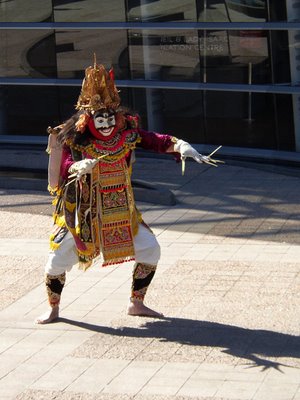
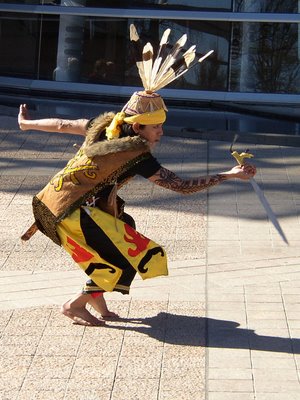
Firstly, from the comments on my Saturday post, it seems I didn't make one point quite clear. It wasn't the audience who were whining about how hard it was for women to find time to write, but the panel of writers, one in particular. I should probably forgive her,because after all she has found the time to write around half a dozen books - several novels, and two commissioned non-fiction works.
I missed one of the sessions I planned to attend yesterday, because there was a printing glitch on the ticket. The correct time was shown on the butt, but an incorrect time was shown on the main part of the ticket. If I'd stuck to the printed programme I would have been OK. Still, it was a bit disappointing. The session was called "The Wide White Page" and it was a panel of writers who had been to, and written about Antarctica.
Today I was up bright and early so I could attend a session entitled "Are Angels OK?" This was a session about the interaction between poetry and physics. Bill Manhire talked to Iggy McGovern, who is both a professor of physics and an acclaimed poet. I found it very interesting. Bill Manhire is the public face of poetry in New Zealand. He has writtten a number of award winning collections and been New Zealand's first Poet Laureate. He also runs the creative writing course at the Victoria University in Wellington, and has established the International Institute of Modern Letters, with links to the Iowa writing course. There is a large writing prize awarded annually by the IIML - he has been very successful in seeking funding. Of course with such a profile he has his detractors. Some critics think all the graduates of his writing course sound the same. It's probably just jealousy since they have such a wide range of ages and backgrounds that such a claim seems unlikely. I must say that I din't much like his poetry up until now. However he was one of the "Poetry for Lunch" poets today and read from his latest collection - I was impressed. Perhaps hearing the poetry out loud makes a difference, but it seemed much more accessible than his earlier work.
We also heard poetry from Cecilia Guridi, a Chilean poet reading in Spanish with a translation given; Ishle Yi Park, a Korean-American, formerly Poet Laureate of Queens, New York; Paul Tan from Singapore; Andrew Fagan, solo yachtsman, lead singer in a band, and poet; and Jess Feibig, a local high school student and talented poet. A very eclectic collection of readers.
I had been impressed with the international line-up and assumed that large sums of money were expended bringing them all here. In fact as it turned out, both Cecilia Guridi and Ishle Yi Park are currently living in New Zealand, while Iggy McGovern though Irish is spending six months at La Trobe University in Melbourne. The three Singaporean poets had their expenses paid by the Singapore Arts Council. I think that some of the other international writers were obtained by piggy-backing on the Melbourne festival. Fair enough. As Bill Manhire pointed out, New Zealand is a long skinny village. (He's a New Zealander, so he's allowed to say things like that).
Someone asked if anyone could attend, or only published writers. Well, basically it is a big book promotion. So yes, anyone can attend. The speakers of course are published writers, but the audience is anyone willing to pay for tickets. For about double what I spent in tickets I could have had a festival pass which would have got me into all the sessions - around four or five a day. Or rather, not quite all, since first there were double-ups - two sessions at the same time - and secondly, a number of events were excluded from the festival pass. Events like the gala opening, a theatre production based on the works of Lauris Edmond, another New Zealand poet who died a few years ago, and of course the workshops the previous weekend.
Next time I will just pick out the "in conversation with" sessions, which seem to be by far the most interesting. I filled out a survey form on the first day - I don't know if my opinions are worth much since I had only been to one session at the time, but it involved a draw for $250 worth of book tokens - I'm not very hopeful, but you never know.
Between my two sessions today I intended to stroll down to the Arts Centre craft market. I was halfway there when I came across a performance by a group of dancers from Kalimantan (part of Borneo) in front of the Art Gallery. Here are a few photos.


Sunday Scribblings: I would Never Write...
When I was about nine years old I decided to write a book. It was a novel - a children's novel, but still a novel. I remember that it was set in Hong Kong and was titled "The Silver Bird of Happiness". I wrote somewhere around a page, in longhand, before I abandoned it. Partly I lacked persistence, but that wasn't really it. I was very persistent at certain things, things that just required repeating over and over until I was successful. But I didn't know what the story was going to be, other than in the sketchiest detail. And so I gave up.
Later at high school we had an assignment to write the first chapter of a novel. Again, I had absolutely no idea of plot. So I fudged it. I decided the first chapter would "set the scene". I thought of a character (based on my father) and a scene (near my home), and wrote a descriptive first chapter. I received a very high mark, I recall, but it's a good thing that no one asked me to write the second chapter.
And so I decided that I would never be a writer, after all. Until years later I found myself writing poetry. But I still told myself I would never write a novel. Except that I notice that stories are creeping into my poems. Small stories, certainly, but nevertheless stories. And then there is NaNoWriMo. I've bought the book. Maybe one day I will write that novel.
I would never write a sex scene, though. I wouldn't know how to handle it. After all, my knowledge is far too limited. Sex scenes in novels don't involve couples who have been married forever. But then, there the topic of writing sex scenes came up in the writers' festival yesterday. "Writing sex", declared one of the authors, "is just writing. It arises out of character and plot." She admitted that some sex scenes are put in just to spice things up, but usually they don't work. Good sex scenes are there because they advance the plot. And I thought of a character or two I had in mind for a novel, and how the sex between them would go, and admitted to myself that maybe I could do it. One day. Right now I have my poetry, and I have a family history or two to write (one for my mother's family, and one for my father's family.) So, not just yet. But maybe one day...
More Sunday Scribblings here
Saturday, September 09, 2006
Inhaling the Mahatma
Writers' festivals seem to promise more than they deliver. A large asembly of locval, national and international writers need to be crammed into a few days. Sessions are planned which throw together three or four writers around a loose theme - "women's writing" or "historical fiction" or "writing about India". These are advertised under a clever title, with an intriguing question eg "what is our fascination with India?" or "is there such a thing as women's writing?"
In fact when I went to these sessions, I found that the topic was only very loosely addressed. The chair person asked each writer a few questions. Answers wandered onto other matters. Each writer read a passage from his or her book. A couple of questions from the audience and then it was time for the next question.
Is there such a thing as women's writing? Some of the panellists drifted off into whining about how hard it is for women to find time to write. This seemed to be based on the assumption that women today have fulltime jobs, and do all the housework and childcare, while the men lead pampered lives. It was refreshing that one of the panellists said that it had been easier for her beacuse she had worked part time, and that it was hard for men too. Then they agreed that it was actually harder for fiction writers because they don't get paid an advance, while non-fiction writers generally do. That was interesting because I had always assumed that for the vast majority of non-fiction writers one would write the book and send it out when finished, in the same way fiction writers do. Another panellist commented that the best thing that had happened for her writing was that her husband left. Now, she is busy with work, house and children for twelve days, and then she has two days entirely for herself which she devotes to writing while the dishes pile up on the bench. My opinion is that it is important to have the desire. Given sufficient desire, anyone, man, woman, working or childrearing or both or neither, will find the time somehow.
The session on "Indian Ink" yielded one rather bad short story writer (I thought her story was a superficial look at India from a Western point of view), one very experienced journallist, and an Anglo-Indian novelist.
Far better than the panel sessions above, are those labelled "in conversation with". This morning I heard a wonderful discussion entitled "East and West" where a local writer and publisher talked to Christopher Kremmer, the journalist author of "Inhaling the Mahatma". He had the audience riveted for an hour, then we all rushed out to buy his book and have it signed. He has also written "The Carpet Wars" on Afghanistan, and "Bamboo Palace" on Laos.
I also enjoyed "Poetry for Lunch" with a wonderful selection of local, national and international poets including Felix Cheong, a young poet from Singapore. I was fascinated by the way in which he was able to write in different voices, including a suicide, an abused wife, and a stripper. He told us that when he was doing his Masters' in Creative Writing in Brisbane, Australia, instead of writing in cafes, he used to go and write in strip clubs. He talked to the strippers and tried to get inside their heads (he hastened to add, "not inside anywhere else"!).
More on the Christchurch Writers' Festival, including the various writers, here.
In between sessions I moved my car to the carpark in the Botanic Gardens, because it's free. Then I strolled back through the gardens and the Arts Centre, taking lots of photos. In the Arts Centre I stopped for lunch. On Saturdays and Sundays there is a large contingent of vans selling ethnic food. On Friday only the Lebanese stall was there. I bought pita bread filled with chicken, hummus and salad and chatted to the owner. I commented on the photos of Lebanon displayed on the stall. "It's a beautiful country" she sai, "everyone wants it." And then she said "there's one land missing." I was confused, until she said "like that game with the chairs." "Musical chairs?" "Yes," she answered, "there's not enough for everyone, there's one land missing."
The millwheel in the photo is all that remains of an old flour mill dating back to the 1850s. This is one of the photos I took on my way through the city from my car to the festival venue.
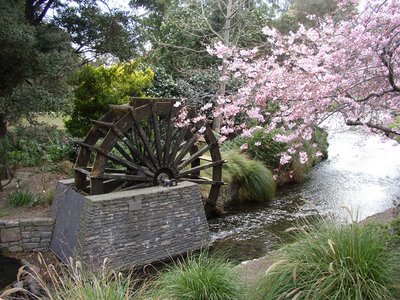
In fact when I went to these sessions, I found that the topic was only very loosely addressed. The chair person asked each writer a few questions. Answers wandered onto other matters. Each writer read a passage from his or her book. A couple of questions from the audience and then it was time for the next question.
Is there such a thing as women's writing? Some of the panellists drifted off into whining about how hard it is for women to find time to write. This seemed to be based on the assumption that women today have fulltime jobs, and do all the housework and childcare, while the men lead pampered lives. It was refreshing that one of the panellists said that it had been easier for her beacuse she had worked part time, and that it was hard for men too. Then they agreed that it was actually harder for fiction writers because they don't get paid an advance, while non-fiction writers generally do. That was interesting because I had always assumed that for the vast majority of non-fiction writers one would write the book and send it out when finished, in the same way fiction writers do. Another panellist commented that the best thing that had happened for her writing was that her husband left. Now, she is busy with work, house and children for twelve days, and then she has two days entirely for herself which she devotes to writing while the dishes pile up on the bench. My opinion is that it is important to have the desire. Given sufficient desire, anyone, man, woman, working or childrearing or both or neither, will find the time somehow.
The session on "Indian Ink" yielded one rather bad short story writer (I thought her story was a superficial look at India from a Western point of view), one very experienced journallist, and an Anglo-Indian novelist.
Far better than the panel sessions above, are those labelled "in conversation with". This morning I heard a wonderful discussion entitled "East and West" where a local writer and publisher talked to Christopher Kremmer, the journalist author of "Inhaling the Mahatma". He had the audience riveted for an hour, then we all rushed out to buy his book and have it signed. He has also written "The Carpet Wars" on Afghanistan, and "Bamboo Palace" on Laos.
I also enjoyed "Poetry for Lunch" with a wonderful selection of local, national and international poets including Felix Cheong, a young poet from Singapore. I was fascinated by the way in which he was able to write in different voices, including a suicide, an abused wife, and a stripper. He told us that when he was doing his Masters' in Creative Writing in Brisbane, Australia, instead of writing in cafes, he used to go and write in strip clubs. He talked to the strippers and tried to get inside their heads (he hastened to add, "not inside anywhere else"!).
More on the Christchurch Writers' Festival, including the various writers, here.
In between sessions I moved my car to the carpark in the Botanic Gardens, because it's free. Then I strolled back through the gardens and the Arts Centre, taking lots of photos. In the Arts Centre I stopped for lunch. On Saturdays and Sundays there is a large contingent of vans selling ethnic food. On Friday only the Lebanese stall was there. I bought pita bread filled with chicken, hummus and salad and chatted to the owner. I commented on the photos of Lebanon displayed on the stall. "It's a beautiful country" she sai, "everyone wants it." And then she said "there's one land missing." I was confused, until she said "like that game with the chairs." "Musical chairs?" "Yes," she answered, "there's not enough for everyone, there's one land missing."
The millwheel in the photo is all that remains of an old flour mill dating back to the 1850s. This is one of the photos I took on my way through the city from my car to the festival venue.

Thursday, September 07, 2006
Poetry Thursday: Blue
This week for the first time I have written a poem in response to the prompt, rather than pulling an already finished poem from my files. Consequently it's a bit raw and will probably be edited further in future. More blue poems at Poetry Thursday here.
Blue
In the first week
the sea is the dark blue of the mountains
between the blooming heather and the first snowfall
In the second week
the sea is the greyish blue of her Sunday best sateen
which she wore when they first met
In the fifth week
there are storms. White waves crash on the deck.
Through her porthole she sees a sea as green blue as his eyes
that caught her gaze and asked for her hand in marriage.
In the eighth week
her child sickens.
they are becalmed in the turquoise blue of the bracelet
on her sister’s arm, waving at the dockside
In the ninth week
the days grow shorter. At twilight
the sea is the inky blue of the words in her diary,
recording births, deaths and distance travelled
In the last week
they bury her child. The ship is enclosed by sea and sky
the blue of the eggshell she found on the path to the byre.
Nearby an unfledged chick with staring eyes,
covered in flies.
The next week she unpacks seeds brought from home,
plants cabbages and carrots,
and in the borders marigolds, poppies and nasturtiums.
The cornflower seed, she sets aside.
In summer the garden is aflame with red, orange and yellow
but no blue
not any scrap of blue
Wednesday, September 06, 2006
A Grab Bag
To Do Lists:
I have just about worked my way through my Tuesday "to do" list. Of course I wrote it Tuesday last week, not this week! I always seem to be over ambitious about what I can do in a day - and a little laid back about getting it done.
Here is a fascinating blog that consists entirely of lists:todolistblog
On Patience:
It's not that I don't like my beach photograph posted yesterday. I do - but I am envious of the fantastic series of photos my husband took on the same beach a few hours later. After I had gone in to make dinner, he stayed and took photographs in the fading light. There has been lots of discussion in the past about the reasons why it is harder for women to be artists. That "making dinner" thing is one of them. It is, or has been, easier for men to focus on one thing, while women do the cooking and cleaning around them, and carve out a little time to create, here and there. But it's not just that. He is just so much more darned patient than me in the first place. He does have a lot of different projects that he gets involved in, besides working fulltime, but he seems to have that ability to focus on just one at a time for as long as it takes. Am I naturally less patient, or is it a consequence of the distractions of bringing up children, taking care of the house etc? Would I be more patient if I had had a chance to develop it?
To get his photos, P. had to run down the beach to the right spot, take the photo and quickly run back before being swamped by an incoming wave. His battery was flat. Instead of giving up and coming in, he took the battery out of the camera and warmed it under his armpit. Then he took the next photo. Then repeated the whole process.
He also actually checks his photos on the display of the camera to see if he has what he wants, before he takes the next one. I rarely check mine until I get them onto my computer. Maybe I could learn more patience if I really wanted.
On Buses:
Warning: Rant follows!
Our newspaper recently reported on an upmarket community which is objecting to a proposal to run a bus service through their suburb. What on earth are they thinking? They say that it is a road safety issue, that there will be accidents when they and their children are walking to their posh country club. And that crime follows bus routes!
So, I assume that they all drive flash cars. There is no school - they must drive their children to their fancy private schools in their BMWs. And when the children get old enough, they will have their own cars. So each family of mum, dad and 2.2 children will have 4.2 cars. How is this safer than buses with trained drivers? And what are they doing to the environment? I must admit that I rarely get the bus myself. I certainly would if my place of work was on a bus route. And I love that my children can get the bus anywhere they need to go - high school when they were there, university, work, and other activities - and I haven't needed to drive them anywhere since they were about twelve years old.
I wish a big fat oil crisis on those complacent rich people. And carless days - a remedy adopted in the past in a previous oil crisis. We had to carry a sticker on our cars nominating a day on which we wouldn't drive it. Two or three carless days a week would knock the smugness out of them.
Tuesday, September 05, 2006
Solitude
- is the haiku theme this week at onedeepbreath.
This is another of my holiday photographs, the beach at Mt Maunganui. As we were outside the school holiday period, we had it largely to ourselves much of the time.
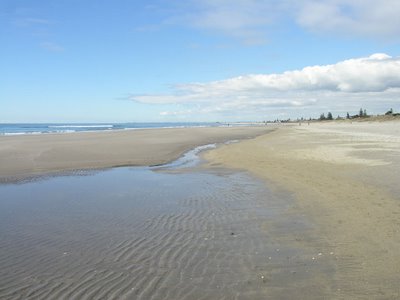
deserted beach
- the incoming tide
covers my footprints
This is another of my holiday photographs, the beach at Mt Maunganui. As we were outside the school holiday period, we had it largely to ourselves much of the time.

- the incoming tide
covers my footprints
Tuesday Update
I was going to post a "Monday Miscellany" but I got lazy.
I spent Sunday at a poetry workshop about which I have mixed feelings. I love the workshop presenter, love my poetry friends who took the workshop with me, and had a great time. But I doubt that it will lead to better poetry (from me, anyway). New Zealand is too small a place to keep taking workshops for long and expect fresh ideas, at least in any workshop as short as one day. What I learnt is that it is within me. It is up to me. (There was a travel writing workshop, too. I'm thinking I should have taken that one instead. I need to know about potential markets, now that I am actually planning to do some travel.)
The workshop was held at the Christchurch Arts Centre, which is situated in the Gothic Revival buildings of the former university. At lunchtime we bought food from the ethnic food stalls and sat outside in the sun while a busker sang under the stone arches. I took photographs, and my friend took this one of me. For once I'm willing to let it out in public, though the shadows are a bit strong.

Our garden is changing every day. The tulips are bloooming and opening up from cups to flat starshaped saucers. The magnolia tree is covered in tight buds. The curl on this tulip petal caught my eye:

Saturday, September 02, 2006
Fortune Cookies
"Fortune cookies" was the topic for Sunday Scribblings this week. As I am having a busy weekend my contribution is short and sweet.
On a still hot day
I hear small explosions
pellets shot from seed pods
the sun is opening fortune cookies
all of them make the same promise
"spring will come again
there will be beauty"
More Sunday Scribblings here
On a still hot day
I hear small explosions
pellets shot from seed pods
the sun is opening fortune cookies
all of them make the same promise
"spring will come again
there will be beauty"
More Sunday Scribblings here
Spring!
September 1st is generally regarded as the first day of spring around here, so I stopped on the way home from work yesterday to take this photo:

We had a visit at work from a former colleague with his wife and young son. I got to play peek a boo with a one year old. I haven't done that in a long time.
Today I have been mowing lawns for the first time since before winter. Soon they will be growing rapidly. If I don't do it now, it will be very hard work.
More holiday photos:
We came back through Rotorua which is a thermal area. Most of the scenic attractions are fenced off with ticket booths at the gate. However there is a park at the centre of town, Kuirau gardens, which contains pools of steaming water and mud, and is freely open to public access. We stopped and took photos.


Another forty minutes or so south, we stopped at Huka Falls just north of Taupo. Nothing to rival Niagara, but it is still quite an awesome sight as a river 100 metres wide forces itself into a long channel only 15 metres wide. The roar of the river is quite loud. The water rushes through this channel and then spills over the falls at the far end.

Friday, September 01, 2006
More Holiday Plans
Yayy!! I'm Michele's site of the day! (Or at least, I think I still am - pesky time zones). A big welcome to all new visitors.
Now that we are back from holiday I am busy planning the next one. Our planned trip to England and Scotland is a year away, but we plan to use time share for at least one week of our big trip, and it's necessary to book early - up to ten months ahead. So I am working on our itinerary, to be sure to get a booking in the area we want.
I went to the library yesterday to borrow the "Rough Guide to Scotland". I found all sorts of interesting books jostling together on the 941.1 SCO shelves and nearby. Besides the Rough Guide, I came home with Bill Bryson's "Notes from a Small Island" and Scottish poet Kathleen Jamie's lovely book "Findings". So I now have three very different perspectives of Scotland to ponder over.
Fortunately most of my Scottish ancestors seem to have lived in the most interesting parts of the country - so I can see where they lived and visit top tourist attractions in one visit.
In Edinburgh my greatgrandmother Georgina was born. She was the daughter of a highland-born domestic servant and a British militia soldier, otherwise a carpenter. His wife Ann found after their marriage that he had given a false name. I don't think she ever knew he was a bigamist! After leaving Scotland they spent ten years in Leeds, avoiding his first wife in Surrey, and then came to New Zealand. Amos and Ann were the grandparents of New Zealand's first woman cabinet minister, Mabel Howard (my grandfather's cousin).
Near Stirling my ancestor Elizabeth died in 1674 leaving "three fir kists" and "ane oak standing bed". Also in Stirling, in 1880 my greatgrandmother Jessie hid the family silver down the well to save it from the bailiffs, before the family made a hasty and secret departure for New Zealand.
In Dundee my grandmother Edith was born, and saw Halley's comet in 1910. She told me that her brothers convinced her that when the earth went through the planet's tail "we would all be burnt up". Brothers haven't changed much! She came to New Zealand in 1912, and died here at the end of last year, a month before her 104th birthday. This is her photo.
It is her legacy that is making this trip possible. In a strange coincidence, Dundee is the resting place of Captain Robert Scott's ship RSS Discovery. This is the ship that Georgina's children, including my grandfather John, visited in Lyttelton harbour in New Zealand before it left for the Antarctic. John's father had been in the Royal Navy and knew some of the crew of Scott's ship.
Sir Walter Scott wrote:
Breathes there the man, with soul so dead,
Who never to himself hath said,
This is my own, my native land!
I have been learning the stories of my ancestors for the last few years. I truly feel as if I have two native lands - the one I was born in, where my parents were born, and two of my grandparents, and the one I have never seen, but which formed so much of my parents' and grandparents' characters and experience. I can't wait to see it!
Now that we are back from holiday I am busy planning the next one. Our planned trip to England and Scotland is a year away, but we plan to use time share for at least one week of our big trip, and it's necessary to book early - up to ten months ahead. So I am working on our itinerary, to be sure to get a booking in the area we want.
I went to the library yesterday to borrow the "Rough Guide to Scotland". I found all sorts of interesting books jostling together on the 941.1 SCO shelves and nearby. Besides the Rough Guide, I came home with Bill Bryson's "Notes from a Small Island" and Scottish poet Kathleen Jamie's lovely book "Findings". So I now have three very different perspectives of Scotland to ponder over.
Fortunately most of my Scottish ancestors seem to have lived in the most interesting parts of the country - so I can see where they lived and visit top tourist attractions in one visit.
In Edinburgh my greatgrandmother Georgina was born. She was the daughter of a highland-born domestic servant and a British militia soldier, otherwise a carpenter. His wife Ann found after their marriage that he had given a false name. I don't think she ever knew he was a bigamist! After leaving Scotland they spent ten years in Leeds, avoiding his first wife in Surrey, and then came to New Zealand. Amos and Ann were the grandparents of New Zealand's first woman cabinet minister, Mabel Howard (my grandfather's cousin).
Near Stirling my ancestor Elizabeth died in 1674 leaving "three fir kists" and "ane oak standing bed". Also in Stirling, in 1880 my greatgrandmother Jessie hid the family silver down the well to save it from the bailiffs, before the family made a hasty and secret departure for New Zealand.
In Dundee my grandmother Edith was born, and saw Halley's comet in 1910. She told me that her brothers convinced her that when the earth went through the planet's tail "we would all be burnt up". Brothers haven't changed much! She came to New Zealand in 1912, and died here at the end of last year, a month before her 104th birthday. This is her photo.

It is her legacy that is making this trip possible. In a strange coincidence, Dundee is the resting place of Captain Robert Scott's ship RSS Discovery. This is the ship that Georgina's children, including my grandfather John, visited in Lyttelton harbour in New Zealand before it left for the Antarctic. John's father had been in the Royal Navy and knew some of the crew of Scott's ship.
Sir Walter Scott wrote:
Breathes there the man, with soul so dead,
Who never to himself hath said,
This is my own, my native land!
I have been learning the stories of my ancestors for the last few years. I truly feel as if I have two native lands - the one I was born in, where my parents were born, and two of my grandparents, and the one I have never seen, but which formed so much of my parents' and grandparents' characters and experience. I can't wait to see it!
Subscribe to:
Posts (Atom)